How Do I Find An Arborist Near Me In Sammamish?
To locate an Arborist near me in Sammamish, it is crucial to request an ISA Certified Arborist and verify the company’s license with Washington L&I. If you will need to have any of your trees removed, make sure the arborist has the necessary TRAQ (Tree Risk Assessment Qualification). That last part isn't optional here. Sammamish asks for a TRAQ arborist's paperwork before most unhealthy or hazard trees can be removed.
By Daniel Montgomery, Co-Founder, Tree Ninjas · Last updated October 21, 2026
What does a certified arborist actually check on a tree?
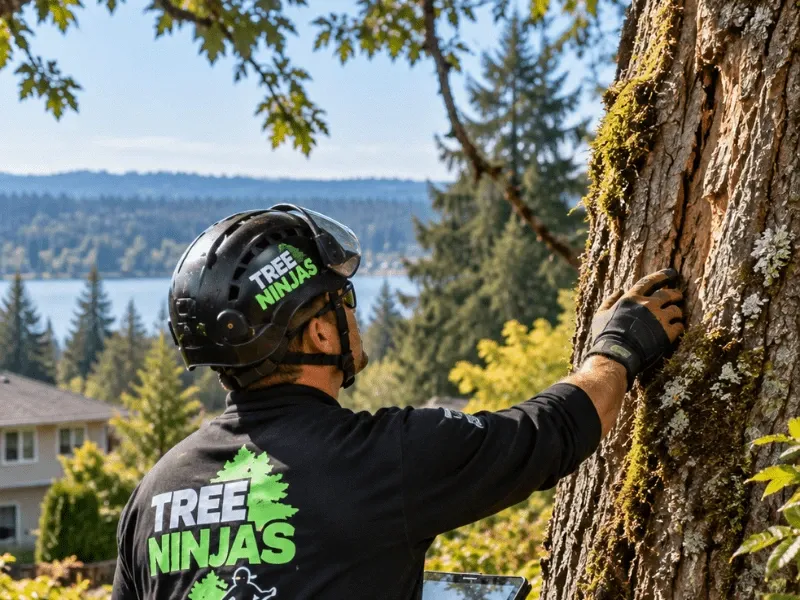
A certified arborist can examine the tree’s whole ecology, including roots and the soil, the trunk, the union of the branches and trunk, the crown, and the leaves. Therefore, if you wonder what an arborist does, simply put, they read the tree like a doctor examines a patient.
During a visit, they look at:
The root zone. Soil heave, cut roots, fungus at the base, or a buried root flare
The trunk. Cracks, cavities, seams, oozing, and hollow sounds when tapped
Branch unions. Tight V-shaped forks that can split under load
The crown. Thinning, early leaf drop, dead tops, and dieback
The site. What the tree could hit if it fails, from your roof to the street
A crew can cut a tree. A certified arborist, on the other hand, can tell you whether it should be cut at all, and that judgment is often worth more than the work itself.
When does Sammamish require a tree risk evaluation?
Sammamish require a tree risk evaluation when you wanted to remove a significant tree because it's unhealthy or hazardous. According to the city's tree removal permitting guide, that evaluation has to come from a TRAQ-certified ISA arborist on an ISA Basic Tree Risk Assessment Form.
Here's how the city sorts trees by size, measured at 54 inches above the ground:
Tree category | Trunk size (DBH) | Replacement required |
Significant conifer | 8 inches or more | One native tree |
Significant deciduous | 12 inches or more | One native tree |
Heritage tree | 22 inches or more | Two native trees |
Landmark tree | 32 inches or more | Three native trees |
Pruning is treated differently. You don't need a permit when less than 30% of the branches are removed over the tree's life and the tree isn't topped. Topping isn't allowed at all. In addition, city staff verify arborist credentials through the ISA database, so a missing number can stall your application.
What happens during a tree health assessment?
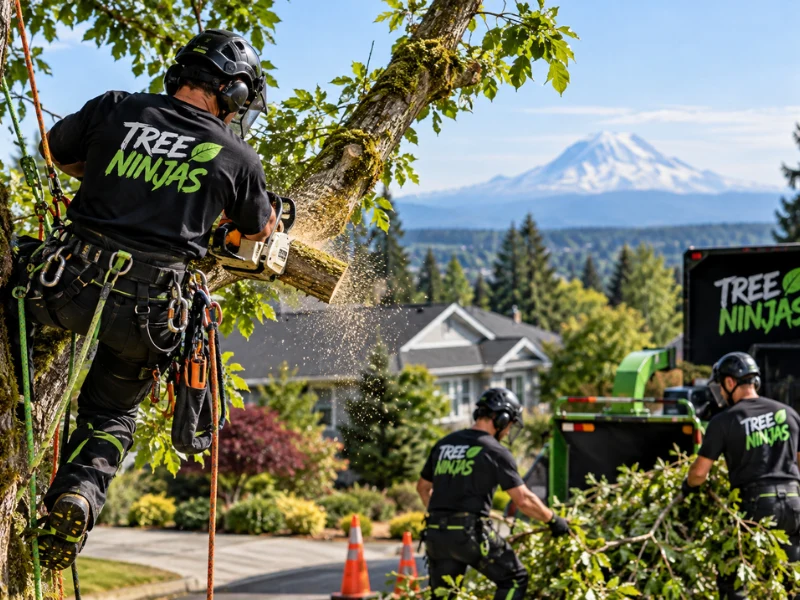
A tree health assessment is a close inspection that ends with a clear diagnosis and a plan. People booking a tree health assessment Sammamish WA homeowners rely on can usually expect these steps:
History. The arborist asks when you first noticed changes, and whether there's been construction, grading, or new irrigation nearby.
Ground-level inspection. They walk around the tree, check the root flare, and tap the trunk with a mallet to listen for decay.
Crown review. Binoculars or a climb help them spot dead limbs, cracks, and pests higher up.
Recommendation. You get options such as pruning, cabling, soil care, monitoring, or removal.
Most problems show up in the canopy long before a tree fails. Our guide to signs your tree is dying covers what homeowners can spot on their own.
Which Northwest tree problems do Sammamish arborists see most?
Sammamish arborists most often see root disease, drought stress, and construction damage. The Plateau's mix of big native conifers and steady new building creates its own set of problems.
Laminated root rot is common in Douglas fir across western Washington. It decays roots out of sight, so an infected tree can look fine until it tips over in a windstorm. Arborists watch for it in clusters, since it spreads through root contact.
Western redcedar dieback has become more noticeable after recent hot, dry summers. Dead tops and thinning foliage are the usual signs. Meanwhile, bigleaf maples in the area have also shown decline, with sparse crowns and dead branches.
Construction damage is a big one locally. Trenching, grading, or parking equipment over roots can kill a tree slowly over several years. That's why it pays to get an arborist involved before a remodel or new driveway, not after.
What should you ask after searching for an arborist near me?
Ask about certification, license, insurance, and judgment before you hire anyone. When you're comparing certified arborists near Sammamish and Redmond Washington, run through this quick list:
ISA number. Ask for it and look it up in the ISA's online directory.
TRAQ status. You'll need it for any hazard or unhealthy tree removal in Sammamish.
State license. Search the company on the L&I Verify a Contractor tool. Tree Ninjas, for example, is licensed as WA TREENNL752Q1.
Insurance. Request proof of liability coverage before work starts.
Red flags. Be wary of anyone who suggests topping a tree.
People also ask how much does an arborist cost. Pricing depends on how many trees need review, whether you need a written report or permit form, and any follow-up work. Ask for that scope in writing, since a quick verbal opinion and a city-ready risk form are very different jobs. If you're also wondering how do I find a certified arborist fast, start with the ISA directory and then confirm the license with L&I.
Frequently asked questions
1. What is the difference between an arborist and a tree trimmer?
The arborist is a certified professional with the proper knowledge and experience in relation to tree biology, risk assessment, and pathology. An arborist knows what and how to cut to prevent damage to a tree and determine the tree’s future growth. The tree trimmer, on the other hand, is not necessarily trained to identify tree problems. A competent tree trimmer can be hired to make the cut, but he or she may not have the skills or the background to determine the tree’s condition.
2. When do you actually need an arborist rather than a crew?
The arborist is needed when the decision-making process about the tree is in question. This may include trees growing near the house that appear sick, leaning trees with split roots or trunk, trees that require a permit for removal, or trees near the worksites. However, when it comes to basic hedge trimming and crew work on healthy trees, an experienced crew can be a better value option.
3. How can you tell if a tree has become hazardous?
Signs of a potentially hazardous tree include leaning trees, split trunks, mushroom growths on the trunk, and large dead branches. Another common sign is a bulge on one side of the trunk which can be an indicator of internal decay. If the tree grows near power lines or structures, or will affect the play areas or your home in case of a fall it should be evaluated by an arborist as soon as possible.
4. What certification should an arborist hold?
Any competent arborist should have ISA Certified Arborist certification. In addition, they should have TRAQ certification if the job requires tree risk assessment. Some arborists can have a Board Certified Master Arborist certification and/or ASCA Registered Consulting Arborist qualification for more involved tasks and paperwork.
5. Can an arborist save a tree that is already declining?
Depending on the tree’s condition and the problem causing it to decline, an arborist might be able to prescribe a course of action that will save it. The measures can include irrigation, root zone improvement, pruning, and fertilizing. However, a tree with extensive root or trunk decay is unlikely to recovery, and a professional will inform you of the risks and costs involved.
6. How long does a tree assessment take?
The tree survey or inspection can take up to an hour or two for a couple of trees. The inspection of large trees on big plots can take longer. Also, a formal risk assessment and paperwork required by the city or municipality can take several days.
7. Will an arborist give me a written report?
If requested, the majority of arborist will provide a written report about the findings, recommendations, and risk assessment. A report is a must if you plan to remove the tree for insurance purposes or municipal approval. It will also help you understand the issues and prepare a budget for the tree care. The report might incur additional costs, so it is wise to request it in advance.
8. How often should trees be checked by an arborist?
The interval for tree risk assessment can be every three to four years or after windstorms. Large trees on small plots or with apparent defects should be assessed more frequently, even annually. Regular tree assessments are necessary for early defect detection and appropriate cost-effective measures.
Where can you book an arborist in Sammamish?
You can book an arborist visit in Sammamish by calling Tree Ninjas at (206) 736-3757 for a free estimate. We'll walk your property, talk through what we see, and explain your options clearly. Learn more on our Sammamish tree service and Redmond tree service pages, browse all our tree services, or reach us through our contact page.
Visit or Call Us
Tree Ninjas 31524 NE Cherry Valley Rd Phone: (206) 736-3757 WA Contractor License: TREENNL752Q1 Office hours: Monday to Friday, 8:00 AM to 5:00 PM, with 24/7 emergency response Service area: Sammamish, Redmond, Issaquah, Bellevue, Duvall, Carnation, and communities across King and Snohomish counties
