How Can I Tell If a Tree Is Dead or Just Dormant in Snohomish, WA?
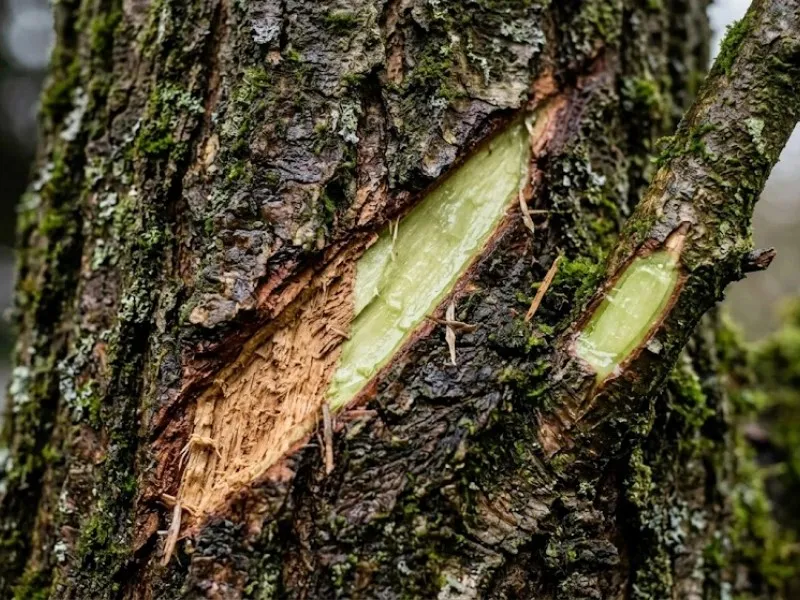
The most reliable way to confirm a dead tree in Snohomish, WA is the scratch test: scratch a small area of bark with a fingernail or pocketknife — a living tree has a moist green or white inner layer (cambium); a dead tree has a brown, dry layer. Tree Ninjas provides free dead tree assessments throughout Snohomish County.
By Daniel Montgomery, Co-Founder, Tree Ninjas · Last updated July 2026
Key Takeaways
Scratch the bark: a green moist inner layer means living; brown and dry means dead.
Dead tree removal in Snohomish typically costs $400 to $1,500 depending on size and access.
Dead trees dry and become brittle, failing more suddenly and unpredictably than living trees.
Dead trees fall under Snohomish County’s hazardous tree permit exemption under SCC 30.91H.040.
Homeowners in Snohomish contact us regularly about trees they suspect are dead but aren’t sure about — particularly in late fall and winter when deciduous trees are fully bare, and throughout the year with conifers that can look partially alive while being substantially dead. Knowing the difference matters because it changes the urgency, the permit picture, and what your insurance will and won’t cover.
Dead vs. Dormant: Quick Identification Guide
The scratch test (most reliable): scratch away a small patch of outer bark on a branch. Green, white, or cream moist inner layer = living cambium. Brown or gray dry inner layer = dead wood. Test multiple spots on the tree.
Deciduous trees (big-leaf maple, alder, ornamentals):
Dormant in winter: bare branches with visible buds forming; buds are plump and firm
Dead: no leaf buds by mid-March in Snohomish; twigs snap cleanly and are dry inside; scratch test shows brown inner wood. A dormant tree will begin showing leaf buds by late March; if it hasn’t by April, the tree is dead or in severe decline.
Douglas fir and Western red cedar — the PNW identification challenge:
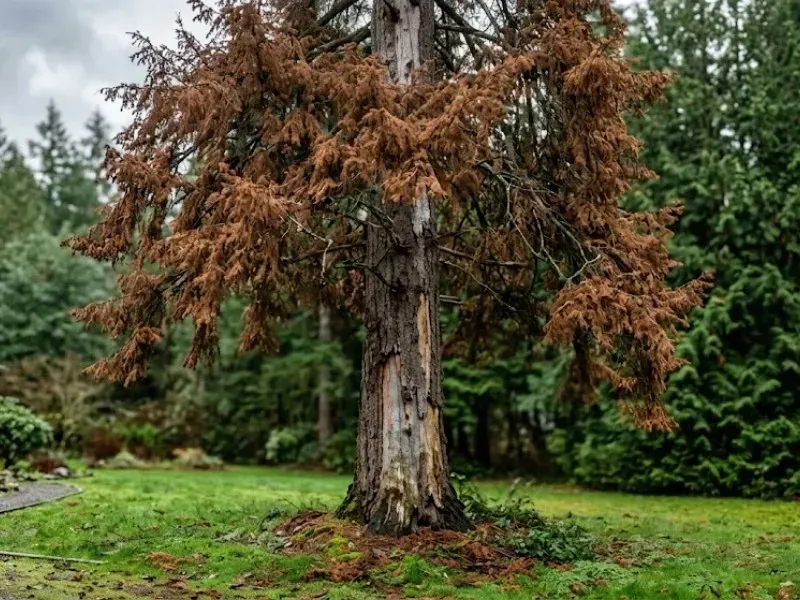
Dead conifers in Snohomish’s climate create genuine confusion because they hold their needles for one to three years after death. A dead Douglas fir can look “mostly okay” for an entire season while being structurally dead. Brown needles that cling to branches rather than falling naturally signal death; live firs have green needles year-round.
Western red cedar adds another layer: cedar “flagging” — patches of orange-brown foliage — is normal in fall when interior needles shed. Widespread discoloration throughout the canopy is distinct. The scratch test on a branch from the affected section will confirm which you are dealing with.
Branch snap test:
Live branches flex and bend before breaking, showing green or white moist wood when snapped. Dead branches snap cleanly with a dry crack and show brown or gray interior.
Is It Dangerous to Leave a Dead Tree Standing in Snohomish?
Yes — and more dangerous than leaving a hazardous living tree. Dead trees dry out progressively, losing moisture and structural resilience. Rather than failing through root plate issues or included bark failure as living trees do, dead trees experience sudden crown and trunk failures that are harder to predict. The failure timeline is compressed in Snohomish’s moist climate: structural deterioration progresses faster here than in drier regions.
What changes structurally as a dead tree ages in Snohomish:
Brittleness increases progressively: in the first one to two years after death, the tree may be structurally sound but increasingly brittle. By year three to five, significant structural sections may fail with little warning.
Crown failures before the trunk: dead trees tend to shed large sections of upper canopy before the whole tree comes down — and these failures happen at any wind speed, not just in major storms. Widow-makers in dead canopies are among the most unpredictable failure types in arborist practice.
Root plate integrity declines separately: after the tree dies, the roots decay on their own timeline, eventually destabilizing the whole tree. In Snohomish’s wet soils, this happens faster than in dry climates.
The one context where leaving a dead tree standing has value: in a rural or wooded setting well away from structures, utilities, and occupied areas, a standing dead tree (snag) provides habitat for cavity-nesting birds and other wildlife. In suburban Snohomish lots near homes, this ecological benefit does not outweigh the risk.
How Much Does Dead Tree Removal Cost in Snohomish?
Dead tree removal in Snohomish typically costs between $400 and $1,500 for most residential trees. Large dead conifers, trees close to structures, or trees with significant structural deterioration run $1,500 to $3,000 or more. Tree Ninjas provides free assessments and estimates throughout Snohomish County.
Dead tree removal is often less expensive than removing an equivalent hazardous living tree, but specific factors can affect cost:
Unpredictable wood condition: a dead tree standing for several years may have hidden hollow sections or severely punky wood that changes how it responds to chainsaw cuts; the arborist must probe for structural integrity before committing to the approach
Brittleness and rigging challenges: brittle dead wood can split or fail during rigging in ways live wood would not; near structures this requires more care per cut
Proximity to structures: a dead tree next to a historic district home in Snohomish requires the same precision rigging as any hazardous tree close to a structure
Stump condition: a dead stump with root decay is often easier to grind than a live stump, which may slightly reduce stump removal cost
For large dead conifers on steep Snohomish bluff properties or in the historic district, crane-assisted removal may still be necessary. Those jobs run $2,500 to $5,000 or more.
Do I Need a Permit to Remove a Dead Tree in Snohomish?
In most cases, no. Dead trees are explicitly covered under the Snohomish County and City of Snohomish hazardous tree exemptions, making dead tree removal one of the clearest permit-exemption cases in the area.
Unincorporated Snohomish County: SCC 30.91H.040 defines a hazardous tree as one with “significant damage, decay, or death.” A dead tree is the most straightforward example. No permit is required even in critical areas, though a TRAQ arborist letter is recommended when the tree is in an NGPA/CAPA to document the condition.
City of Snohomish (SMC 14.120): dead, dying, or diseased trees can be removed via a Hazard Tree declaration with certified arborist documentation. Contact City of Snohomish Planning at 360-282-3167 to confirm requirements. For full permit detail see our
For full permit detail for both county and city, see our hazardous tree removal guide for Snohomish. Tree Ninjas provides the certified arborist documentation required for dead tree removal as part of the removal process.
Can Homeowners Insurance Cover Dead Tree Removal in Snohomish?
Preventive removal of a standing dead tree is not covered by standard homeowners insurance — no policy covers removing a tree before it falls. However, the insurance implications of a dead tree are more significant than most homeowners realize.
What insurance does and does not cover for dead trees:
Not covered: removing a dead tree that is still standing and hasn’t caused damage; this is maintenance, and standard policies do not cover maintenance
Potentially covered: if a dead tree falls on your insured structure during a weather event, structural damage and debris removal may be covered up to your policy’s tree removal limit ($500 to $1,000 per tree typically)
Risk of denial: if a claim is filed and an insurer investigates and finds evidence the tree was visibly dead for an extended period — browning needles, peeling bark, prior documentation — they may invoke a “known hazard” or “negligence” exclusion to reduce or deny the claim
The practical insurance argument for removing dead trees proactively: removing a known dead tree does not generate an insurance payment. But it eliminates the risk that a future storm damage claim — whether related to this tree or another event — is compromised by the insurer finding evidence of deferred maintenance. Leaving a dead tree standing is a liability that costs nothing to maintain and potentially a great deal when something goes wrong.
For a fuller look at how insurance handles tree damage claims in Snohomish, see our storm damage tree removal guide.
Why Dead Trees Are a Specific Problem in Snohomish County
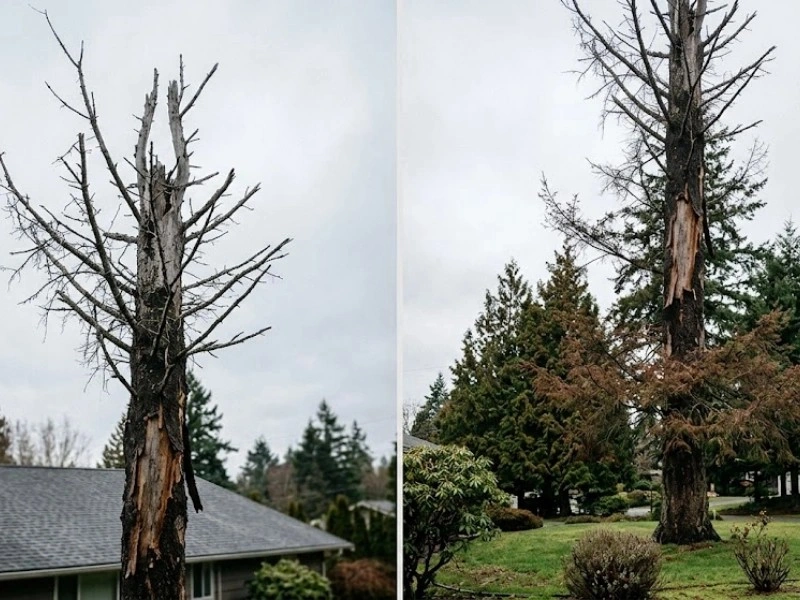
The slow-dying conifer problem. Douglas firs and Western red cedars in Snohomish County can take one to three years to fully die after a root disease, drought stress, or beetle infestation kills them. During that period, the tree continues to hold its needles, appears structurally intact from the outside, and accumulates significant structural deterioration. Snohomish County PUD identifies and removes dead and dying trees near utility lines as part of their annual 500-mile vegetation management program precisely because of this pattern. Homeowners with dead conifers near structures face the same timeline risk.
The historic district proximity challenge. Snohomish’s downtown and historic neighborhoods have mature ornamental and shade trees — many now showing end-of-life decline — on small urban lots directly adjacent to Victorian-era homes. Removing a large dead ornamental tree from a narrow historic district lot requires precision rigging and aerial equipment regardless of whether the tree is technically dead, and often costs as much as removing a living tree of the same size and proximity.
If you have a tree in Snohomish County that is showing browning foliage, dead branches, or declining canopy, a free arborist assessment is the first step before deciding whether removal is warranted.
Dead Tree Removal Near Snohomish: Where We Work
Tree Ninjas provides dead tree removal and certified arborist assessments throughout Snohomish County. Our crews regularly serve Snohomish and surrounding neighborhoods, Lake Stevens, Monroe and the Highway 2 corridor, and Everett.
For the full list, see our Washington service area page.
Get a Free Dead Tree Assessment in Snohomish
Not sure if your tree is dead, dormant, or declining? Tree Ninjas provides free on-site assessments for dead and suspected hazardous trees throughout Snohomish County. The assessment confirms the tree’s condition, produces the documentation required for county or city removal, and gives you a clear cost estimate.
Call or text: (206) 601-9390
Or request a free assessment at treeninjaspnw.com/contact-us.
Contact Tree Ninjas
Tree Ninjas
31524 NE Cherry Valley Rd
Duvall, WA 98019
Phone: (206) 601-9390
Hours: Available 24/7 for emergency service; office hours Monday through Friday, 8 am to 5 pm
Serving Snohomish, Lake Stevens, Everett, Monroe, Mukilteo, and surrounding Snohomish County and King County communities.
