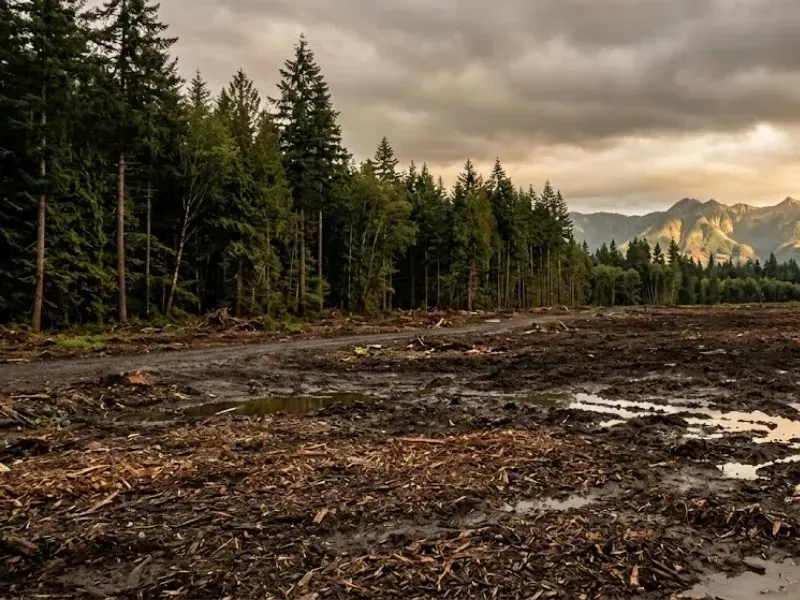
How Much Does Land Clearing Cost in Monroe, WA?
Land clearing in Monroe, WA typically costs $1,500 to $5,000 per acre for most residential jobs, with heavy forest clearing running $5,000 to $8,000 or more. Cost depends on tree density, terrain, and whether grubbing — stump and root removal — is included. Snohomish County requires a Land Disturbing Activity (LDA) permit for clearing 7,000 square feet or more. Tree Ninjas handles land clearing throughout Monroe and Snohomish County.
By Daniel Montgomery, Co-Founder, Tree Ninjas · Last updated July 2026
Key Takeaways
Land clearing in Monroe costs $1,500 to $5,000 per acre; heavy forest or grubbing runs higher.
Clearing removes above-ground vegetation; grubbing removes stumps and roots for construction-ready soil.
Snohomish County’s LDA permit is required for clearing 7,000 square feet or more of land.
Clearing near wetlands, streams, or steep slopes triggers critical area review regardless of clearing size.
Monroe’s Skykomish River valley is one of the most active land-clearing zones in western Washington. Development pressure along the Highway 2 corridor, combined with the valley’s extensive second-growth timber and dense tributary network, means Monroe property owners face a more complex clearing picture than most. The costs are predictable once you understand what drives them; the permitting is not difficult once you know which thresholds trigger what review. Here is both.
Land clearing cost breakdown for Monroe, WA:
Light clearing (primarily brush, blackberry, small trees under 6 inches): $500 to $2,000 per acre
Medium clearing (mixed brush and trees up to 12–14 inches): $1,500 to $4,000 per acre
Heavy clearing (dense second-growth Douglas fir, cedar, large hardwoods): $3,000 to $7,000 per acre
Add for grubbing (stump and root removal to construction-ready depth): $500 to $2,000 per acre above clearing cost
Proximity to critical areas: work adjacent to streams, wetlands, or steep slopes requires more careful staging and selective techniques, adding time and cost
How long does land clearing take in Monroe? A small residential lot under half an acre: one to two days. One-to-three-acre jobs: two to five days. Larger projects run a week or more. Permitting and planning, when required, typically adds weeks before physical work begins — the permit and critical area review timeline usually determines the project schedule, not the site work itself.
What Is the Difference Between Land Clearing and Grubbing?
Clearing and grubbing are distinct operations that are often quoted and performed together, but they address different depths of site preparation.
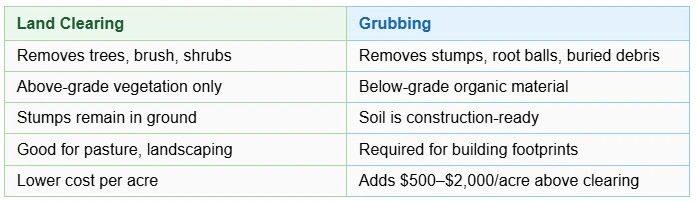
Clearing only: adequate for sites being converted to pasture, agricultural use, or landscaping where surface roots will be managed over time
Clearing plus grubbing: required for any building footprint; necessary for driveways, septic systems, and any site where soil stability matters
Clearing only with selective grubbing: common for large acreage where only the building footprint and access areas need full grubbing; reduces cost on the non-construction portions
For most Monroe building-site preparation, the correct scope is full clearing and grubbing on the building footprint and driveway areas, with clearing-only on the balance of the acreage.
What Equipment Is Used for Land Clearing in Monroe?
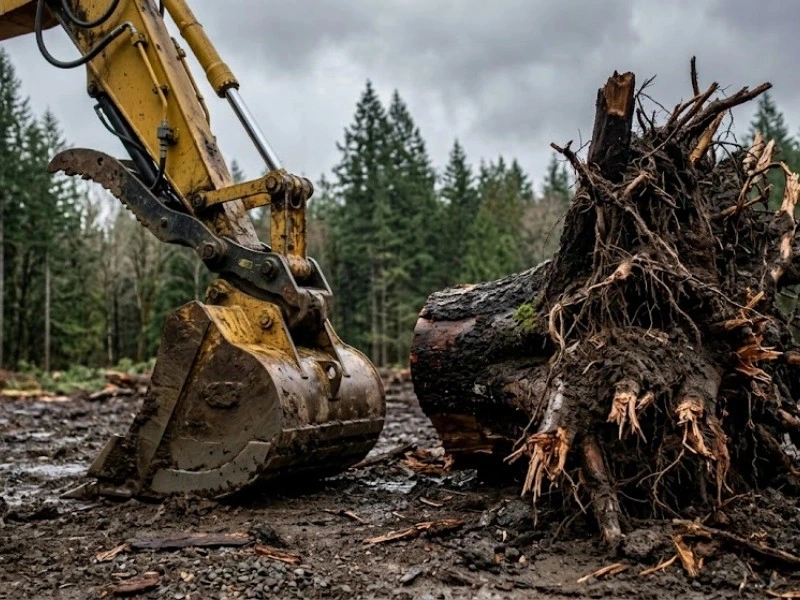
The equipment deployed for a Monroe clearing job depends on vegetation type, site access, proximity to critical areas, and whether grubbing is included. Most clearing projects use a combination of tools.
Crawler dozers (D6 or larger): the primary tool for heavy clearing of large trees and dense second-growth; most efficient for large open areas away from structures and critical area boundaries
Excavators: the most versatile tool near critical areas and structures; can selectively remove stumps without disturbing adjacent root zones; preferred within buffer transition zones where a dozer would cause broad soil disturbance
Forestry mulchers (tracked or wheel-mounted): grind vegetation in place, producing mulch that stays on-site; ideal for brush, small trees, and light clearing where debris hauling is impractical; commonly used along Skykomish tributary corridors
Skid steers with mulching heads: good for smaller acreage jobs and precision work around existing landscaping or structures
Stump grinders: post-clearing stump removal when full grubbing with an excavator is not required; grinds to below grade without full excavation
Chippers and log/dump trucks: process brush and small-diameter material for on-site mulch or haul material off-site
For Monroe’s Skykomish Valley properties adjacent to the river system, the preferred equipment combination near critical areas is excavator-led with minimal dozer footprint — reducing soil disturbance, avoiding ruts that channel sediment toward waterways, and allowing selective work within buffer transition zones.
Do I Need a Permit for Land Clearing in Monroe, WA?
The permit threshold in unincorporated Snohomish County is based on the size of the disturbed area and whether critical areas are nearby. The key threshold under Snohomish County Code Chapter 30.63B:
LDA permit required when:
Clearing 7,000 square feet or more (roughly 0.16 acres), OR
Work occurs within or adjacent to a critical area — wetlands, streams, steep slopes, flood hazard areas — regardless of size
No LDA permit required when:
Clearing is less than 7,000 square feet AND the site is outside all critical areas
Even exempt activities must comply with Snohomish County drainage Minimum Requirement 2: a Stormwater Pollution Prevention Plan (SWPPP) must address soil erosion and sedimentation control
Additional permits that may apply:
Forest Practices Application: required if cutting more than 5,000 board feet or if any timber leaves the site to be sold, bartered, or traded (see our logging services guide)
Work near water: US Army Corps of Engineers (Section 404), WA Department of Ecology, or WDFW permits may be required
City of Monroe: contact Monroe Public Works / Building Division for clearing within city limits
Contact Snohomish County Planning and Development Services to confirm requirements: 425-388-3311 | snohomishcountywa.gov/1687/Permitting
How Are Critical Areas Protected During Land Clearing in Snohomish County?
Critical areas are Snohomish County’s most important site-specific constraint for land clearing. Monroe’s position in the Skykomish watershed means a significant proportion of properties have mapped critical areas, and many homeowners discover mid-project that buffer requirements apply to areas of their lot they had not anticipated.
What Snohomish County considers a critical area:
Wetlands and fish/wildlife habitat conservation areas: streams, lakes, marine waters, wetlands, and their buffers
Geologically hazardous areas: erosion hazard, landslide hazard, and seismic areas
Frequently flooded areas: 100-year floodplain and channel migration zones (CMZs)
Critical aquifer recharge areas
The 500-foot rule: any development within 500 feet of a mapped critical area must identify those critical areas in the site development plan (400 feet for geological hazard areas). This is not a setback — it is an assessment and disclosure requirement that triggers before any permits can be approved.
Wetland delineation: before clearing near any potential wetland, a formal wetland delineation by a qualified wetlands biologist is required under SCC 30.62A.140. The delineation maps wetland boundaries and establishes the required buffer. In Monroe’s Skykomish Valley, many properties that appear dry in summer have seasonal wetlands that only a professional delineation will accurately identify.
Critical Area Site Plan (CASP): if critical areas or their buffers are present, a CASP identifying their location, buffers, and protected features must be submitted with any permit application.
Channel Migration Zones (CMZs): new development is highly restricted in CMZs, with exceptions only for public roads, utilities, and certain flood protection measures. Properties adjacent to the Skykomish River and active tributaries in Monroe may have significant CMZ overlap.
Pre-application conference: for any Monroe property within 500 feet of mapped critical areas, a pre-app conference with Snohomish County PDS is strongly recommended before committing to a project scope. The fee is $320, with $200 credited toward the permit application if submitted within 18 months.
Tree Ninjas coordinates with qualified wetlands professionals and follows buffer setback and sediment control requirements on all clearing jobs adjacent to Snohomish County critical areas.
Can I Do My Own Land Clearing in Monroe?
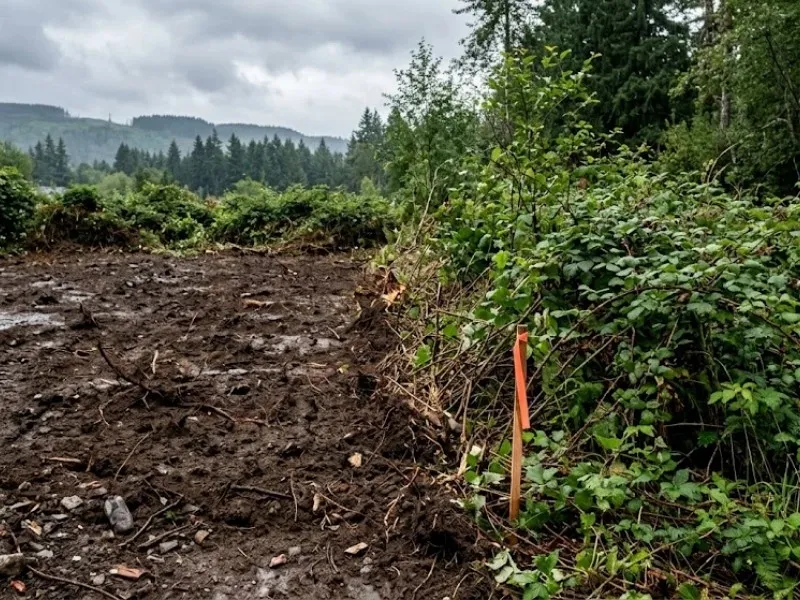
For small brush and shrub clearing on a standard residential lot away from critical areas: yes, with appropriate equipment and safe practices. For anything involving large trees, stumps, or land adjacent to wetlands or waterways, the combination of equipment requirements and regulatory complexity makes professional clearing the more practical and safer choice.
What homeowners can reasonably handle:
Brush, blackberry, and small shrub clearing with hand tools, brush hogs, or small rented equipment on standard lots away from critical areas
Removing small trees under 6 inches DBH with proper chainsaw technique and clear fall zones on open, flat properties
What requires professional equipment or expertise:
Trees over 10 inches DBH: safe felling and root ball removal require trained operators and excavators
Equipment rental costs: a tracked dozer or excavator rents for $200–$400 per day plus transportation, and operators need experience to avoid damaging utilities, septic systems, or adjacent structures
Work within 500 feet of critical areas: regulatory requirements — LDA permits, wetland delineations, critical area setbacks — apply regardless of who performs the work; a homeowner clearing within a wetland buffer without permits faces the same compliance obligations as a contractor
Debris disposal: burning requires WA DNR permits; large volumes of timber and root balls must be hauled, which requires appropriate trucks and disposal arrangements
The regulatory requirement is the most important consideration. If your Monroe clearing project intersects with critical areas, the permit requirements, wetland delineation, and CASP do not change based on who swings the chainsaw. Getting the regulatory work right before any clearing begins protects both the project and the property owner from costly violations and required restoration.
Land Clearing Near Monroe: Where We Work
Tree Ninjas provides land clearing, brush clearing, and site preparation throughout Monroe and the Sky Valley corridor. Our crews regularly serve Monroe and the Skykomish Valley communities, Snohomish, Duvall and the upper Snoqualmie Valley, and Sultan.
For the full service area, see our Washington locations page.
Get a Free Land Clearing Estimate in Monroe
Land clearing scope requires an on-site visit — tree density, terrain, proximity to critical areas, and debris management options all affect cost and timeline. Tree Ninjas provides free on-site estimates throughout Monroe and Snohomish County.
Call or text: (206) 601-9390
Or request a free estimate at treeninjaspnw.com/contact-us.
Permits and critical area compliance: always confirm requirements with Snohomish County PDS at 425-388-3311 or the City of Monroe Public Works before any clearing begins.
Contact Tree Ninjas
Tree Ninjas
31524 NE Cherry Valley Rd
Duvall, WA 98019
Phone: (206) 601-9390
Hours: Available 24/7 for emergency service; office hours Monday through Friday, 8am to 5pm
Serving Monroe, Sultan, Snohomish, Duvall, and surrounding Snohomish County and King County communities.
