Land Clearing Snohomish WA: Costs & Permits in 2026
How Much Does Land Clearing Cost in Snohomish, WA?
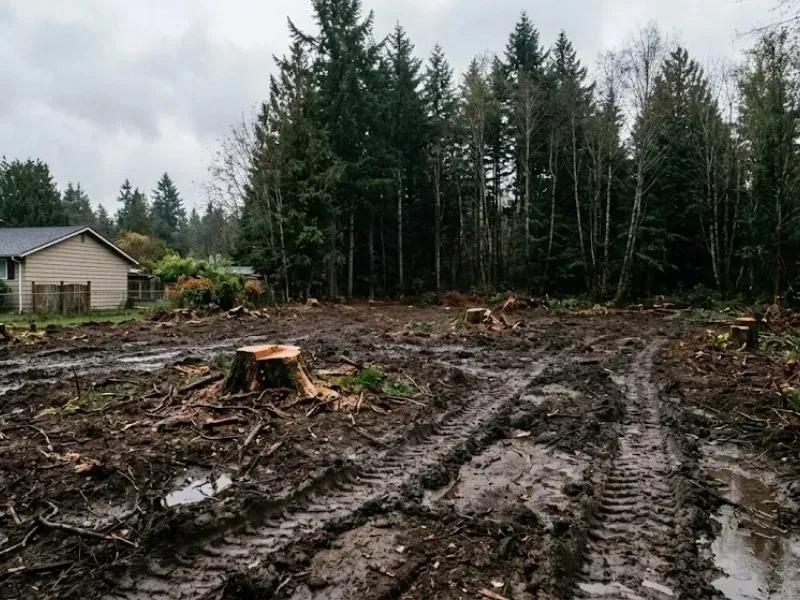
Land clearing in Snohomish, WA typically costs $1,500 to $5,000 per acre for most residential and rural jobs, with heavily forested or wetland-adjacent properties running higher. Snohomish County requires a Land Disturbing Activity permit for clearing 7,000 square feet or more. Tree Ninjas provides land clearing throughout Snohomish County.
By Daniel Montgomery, Co-Founder, Tree Ninjas · Last updated August 2026
Key Takeaways
Land clearing in Snohomish runs $1,500 to $5,000 per acre depending on vegetation and terrain.
An LDA permit is required for clearing 7,000 square feet or more in Snohomish County.
Wetland delineation is required before clearing near potential wetlands under Snohomish County code.
Tree Ninjas chips brush on-site or hauls material off depending on scope and site access.
Snohomish County has some of the most active land clearing activity in western Washington, driven by a combination of residential development pressure, second-growth timber reaching maturity, and property owners preparing rural parcels for construction. Snohomish’s specific position — at the confluence of the Snohomish River and Pilchuck Creek, surrounded by extensive wetland systems and mapped critical areas — means clearing projects near the city often require more regulatory awareness than typical suburban clearing jobs elsewhere.
Land clearing cost breakdown for Snohomish, WA:
Light clearing (brush, blackberry, small trees under 6 inches): $500 to $2,000 per acre
Medium clearing (mixed brush and trees up to 12–14 inches): $1,500 to $4,000 per acre
Heavy clearing (dense second-growth Douglas fir, cedar, large hardwoods): $3,000 to $7,000 per acre
Grubbing (stump and root removal to construction depth): add $500 to $2,000 per acre
Proximity to critical areas: work adjacent to the Snohomish River, Pilchuck Creek, or mapped wetlands requires additional planning and selective techniques
Do I Need a Clearing or Grading Permit in Snohomish?
Whether you need a permit depends on whether you are in the City of Snohomish or in unincorporated Snohomish County — and how large your clearing footprint is.
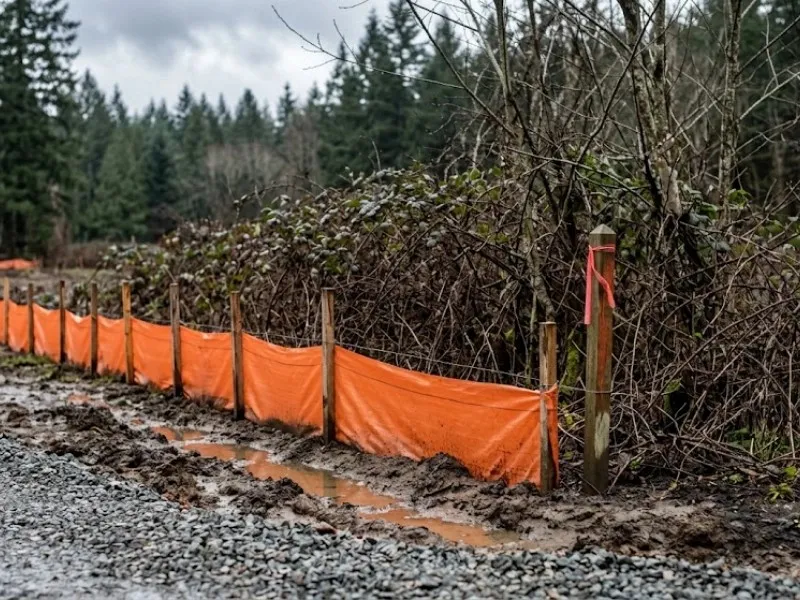
Unincorporated Snohomish County (SCC 30.63B): a Land Disturbing Activity (LDA) permit is required for clearing 7,000 square feet or more of land. For clearing below that threshold outside critical areas, no LDA permit is required — but even exempt activities must comply with Snohomish County drainage Minimum Requirement 2, which requires a SWPPP addressing erosion and sediment control. Any clearing within or adjacent to critical areas triggers critical area review regardless of clearing size.
City of Snohomish (within city limits): the City of Snohomish has its own grading and clearing permit requirements for work within city limits, separate from county requirements. Contact the City of Snohomish Building Division at 360-282-3167 to confirm what is required for your specific property before any clearing begins.
Additional permits may apply for commercial timber harvesting (Forest Practices Application from WA DNR) or work near water (US Army Corps Section 404, WA Department of Ecology). Contact Snohomish County Planning and Development Services at 425-388-3311 for unincorporated parcels.
Do You Handle Wetland and Critical-Area Restrictions?
Yes — wetland and critical-area coordination is a standard part of land clearing work near Snohomish. Snohomish’s position at the Snohomish River and Pilchuck Creek confluence means the surrounding landscape includes extensive mapped wetlands, floodplain, and critical aquifer recharge areas. Properties that appear to be upland from the river may still have seasonal wetlands or mapped buffers that affect where clearing can legally occur.
What critical-area compliance involves:
Wetland delineation (SCC 30.62A.140): before clearing near any potential wetland, a formal delineation by a qualified wetlands biologist is required; many Snohomish-area properties that look dry in summer have seasonal wetlands that only a professional delineation will accurately identify
Critical Area Site Plan (CASP): if wetlands, streams, or other critical areas are present on or adjacent to the property, a CASP must be submitted with any permit application
Channel Migration Zones (CMZs): new development is highly restricted in CMZs adjacent to the Snohomish River and its active tributaries; properties directly adjacent to the river may have significant CMZ area where clearing and development is prohibited or severely limited
Pre-application conference: for any property within 500 feet of mapped critical areas, a pre-app conference with Snohomish County PDS is strongly recommended; $320 fee, $200 credited toward permit if submitted within 18 months
Multi-agency permits: work near or over water may require US Army Corps Section 404, WA Department of Ecology, or WDFW permits depending on scope
Tree Ninjas coordinates with qualified wetlands professionals and follows buffer setback and sediment control requirements on all clearing jobs near Snohomish County critical areas.
Do You Clear Brush, Trees, and Stumps Together?
Yes. Tree Ninjas handles the full clearing sequence as a single coordinated scope: brush and understory removal, tree felling, stump grinding, and full grubbing (stump and root ball excavation) where the project requires construction-ready soil.
Most Snohomish building-site preparation involves all three phases, though the depth required varies by location on the lot:
Full clearing and grubbing: on the building footprint, driveway corridor, and utility corridors — any area where structural settlement from decaying organic material would be a problem
Clearing with stump grinding: on areas not being built on but that need to be usable (future lawn, landscaping, access paths) — grinds to below grade without full root ball excavation
Clearing only: on areas being converted to pasture, native vegetation, or landscaping where roots can be managed over time
The equipment used for each phase depends on site conditions. Excavators handle precision stump removal near structures and in critical-area transition zones. Dozers cover open-area heavy clearing efficiently. Forestry mulchers process brush and small trees in place where material removal would be impractical. For most Snohomish jobs, the right approach is a combination of these tools.
Do You Haul Off or Chip the Debris?
Both — and the decision depends on what the material is, what condition the site needs to be in after clearing, and whether on-site disposal makes practical sense.
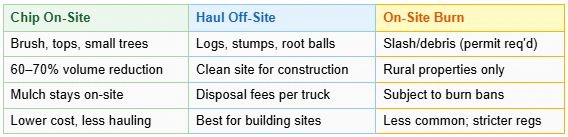
Chipping brush on-site: a drum chipper or tracked forestry mulcher processes brush, tops, and small-diameter material into wood chips that remain on-site as mulch; reduces brush volume by 60 to 70 percent and avoids per-load disposal fees; works well for clearing not immediately followed by construction
Hauling logs and material off-site: large-diameter logs, full stumps, and root balls are loaded onto dump trucks and hauled to transfer stations, mills, or composting facilities; for Snohomish building sites where clearing leads directly to foundation work, hauling all cleared material off-site is usually the cleanest option
On-site burning: an option in rural areas of Snohomish County with a valid WA DNR burn permit, subject to air quality regulations and seasonal burn bans; becoming less common due to stricter air quality standards and more frequent burn ban periods
Stump grindings: after grinding, the wood chip material can stay in the ground for non-building areas, or be excavated and removed for building footprints; grindings are composted material that benefit soil structure in landscaping areas
What Makes Land Clearing Near Snohomish Specific
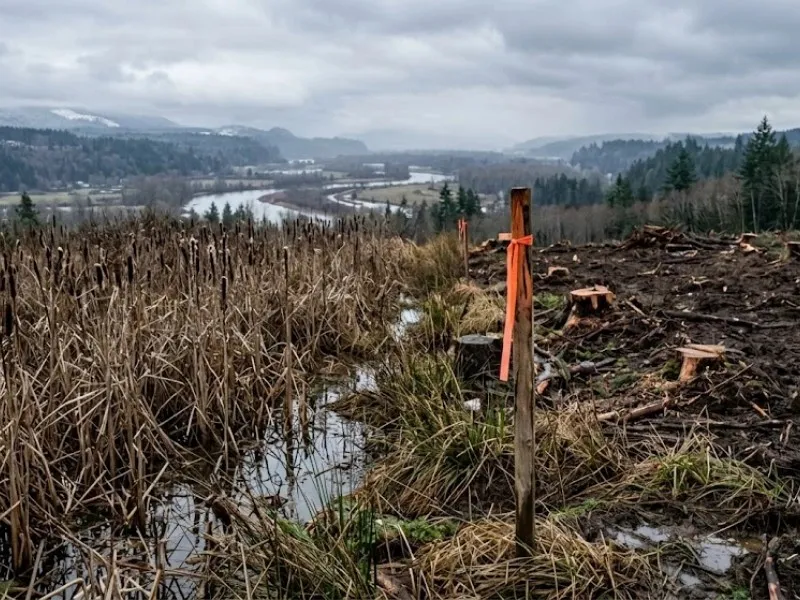
The Snohomish River and Pilchuck Creek corridor. The two waterways that define Snohomish’s geography create an extensive network of mapped critical areas surrounding the city. Properties within a quarter-mile of either waterway almost certainly have some mapped buffer or flood hazard area affecting their site. This does not necessarily prevent clearing, but it means that a pre-clearing regulatory assessment is more important in Snohomish than in most other Puget Sound communities.
The Snohomish River delta wetlands. The area downstream of Snohomish city center — the Snohomish River delta and Ebey Island — is one of the largest estuarine wetland systems in Snohomish County. Properties near the delta face the most extensive critical area constraints of any clearing location in the Snohomish area, and in some cases the buildable area of a parcel is significantly smaller than the total parcel acreage once buffers are mapped.
Soil erosion on bluff properties. Snohomish sits on a river bluff above the flood plain. Clearing on steep bluff-side properties creates erosion risk that SWPPP requirements specifically address. Bluff clearing projects require careful installation of erosion and sediment control measures before ground is disturbed, and inspection during clearing to ensure those measures are functioning.
City of Snohomish historic district. Clearing within the city’s historic district for redevelopment or new construction requires attention to both the city’s codes and the character standards for adjacent historic structures. The city planning department (360-282-3167) can advise on any specific constraints for historic district parcels.
Land Clearing Near Snohomish: Where We Work
Tree Ninjas provides land clearing, brush clearing, and site preparation throughout Snohomish and Snohomish County. Our crews regularly serve Snohomish and surrounding neighborhoods, Lake Stevens, Monroe and the Highway 2 corridor, and Everett.
For the full service area, see our Washington locations page.
Tree Ninjas provides free on-site assessments for land clearing throughout Snohomish and Snohomish County. Always confirm permit requirements with Snohomish County PDS at 425-388-3311 or the City of Snohomish Building Division at 360-282-3167 before any clearing begins.
Phone: (206) 601-9390 | treeninjaspnw.com/contact-us
Contact Tree Ninjas
Tree Ninjas
31524 NE Cherry Valley Rd
Duvall, WA 98019
Phone: (206) 601-9390
Hours: Available 24/7 for emergency service; office hours Monday through Friday, 8am to 5pm
Serving Snohomish, Lake Stevens, Monroe, Everett, and surrounding Snohomish County and King County communities.
