How Much Does Large Tree Removal Cost in Snohomish, WA?
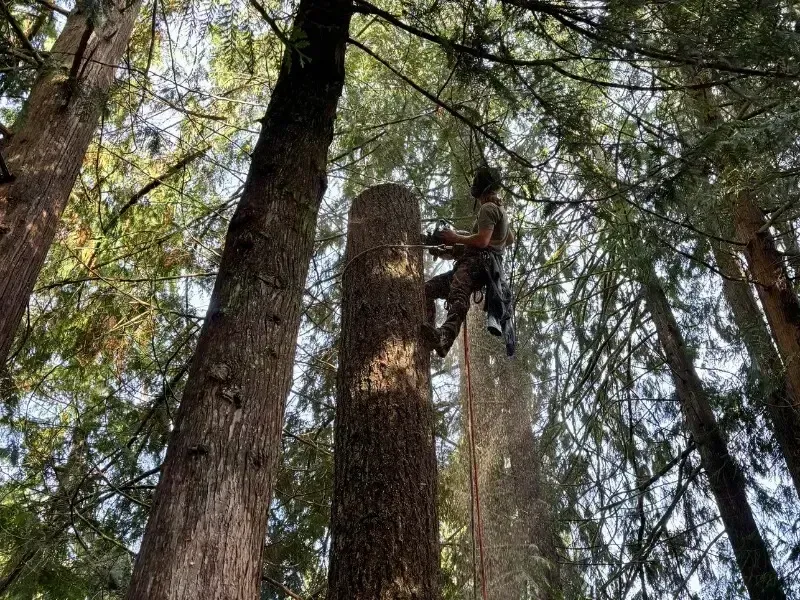
Large tree removal in Snohomish, WA typically costs between $1,200 and $3,500 for trees in the 60-to-100-foot range, with crane-required removals and very large conifers near structures running $4,000 to $7,000 or more. Tree Ninjas handles large tree removal throughout Snohomish County, where mature Douglas firs, Western red cedars, and big-leaf maples regularly reach 80 to 120 feet at maturity.
By Daniel Montgomery, Co-Founder, Tree Ninjas · Last updated July 2026
Key Takeaways
Large tree removal in Snohomish costs $1,200 to $3,500 for most 60-to-100-foot jobs; crane work runs $4,000 or more.
Trees 60 feet or taller or 12 inches or more in DBH are generally considered large for removal purposes.
Most large tree removals in Snohomish take a full day; crane-required jobs near structures can extend into a second day.
Large tree removal is significantly more dangerous due to stored energy, equipment complexity, and unpredictable wood conditions.
Snohomish County grows large trees fast. The city’s combination of high annual rainfall, mild winters, and older established neighborhoods means the trees homeowners deal with are often mature 60-to-120-foot specimens, not the small ornamentals that most national pricing guides reference when they quote “average” tree removal costs. Here is what large tree removal actually looks like in Snohomish.
Large tree removal cost breakdown for Snohomish County:
60 to 80 feet, accessible location: $1,200 to $2,500 for a crew of three; add $500 to $1,000 if near a structure
80 to 100 feet, near structures: $2,500 to $4,500; likely a full-day job
100 feet and over, crane-required: $4,000 to $7,000 or more; planned as a full-day or multi-day project
Proximity premium: a large tree in an open backyard can cost half as much as the same tree positioned next to a historic district home in downtown Snohomish, where precision sectional removal and crane coordination are required
Stump grinding is typically quoted as a separate add-on. For more on what removal includes, see our tree removal service page.
What Is Considered a Large Tree for Removal Purposes?
A tree is generally considered large for removal purposes when it reaches 60 feet or more in height or 12 inches or more in diameter at breast height (DBH). In practice, the combination of height, trunk diameter, and proximity to structures determines complexity more than any single measurement. A 50-foot tree directly over a roofline may be more complex to remove than an 80-foot tree in an open field.
Industry size categories used in tree removal:
Small: under 30 feet or under 6 inches DBH
Medium: 30 to 60 feet or 6 to 12 inches DBH
Large: 60 to 100 feet or 12 to 24 inches DBH — mature Douglas firs, large big-leaf maples, established Western red cedars
Very large: over 100 feet or over 24 inches DBH — old-growth adjacent conifers, exceptionally mature hardwoods
What this means for Snohomish County permit purposes: Snohomish County considers “significant trees” at 10 inches DBH or larger under county code. The City of Snohomish’s tree preservation ordinance (SMC Chapter 14.120) establishes its own threshold for protected trees. Because large trees frequently exceed the significant tree threshold, permit considerations are more likely to apply to large tree removals than to smaller trees. See the permit section below for full detail.
How Long Does It Take to Remove a Large Tree in Snohomish?
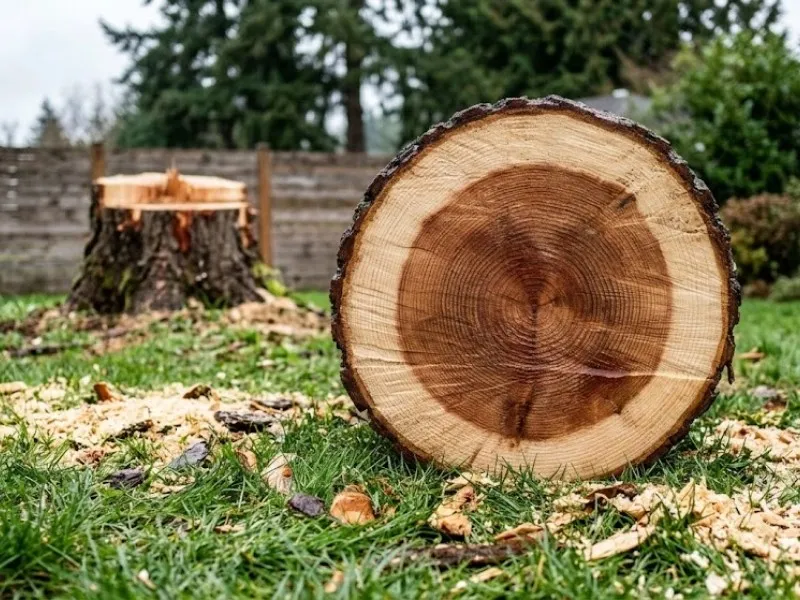
Most large tree removals in Snohomish take a full day for trees in the 60-to-100-foot range. Crane-required removals and trees near structures can extend into a second day. Cleanup is often the most time-consuming phase for large trees.
Timeline by job type in Snohomish County:
60 to 80 feet, accessible: six to eight hours for a crew of three
80 to 100 feet, near structures: a full eight-to-ten-hour day; sometimes continuing the following day for very heavy sectional work
100 feet and over, crane-required: planned as a full-day or multi-day project; crane mobilization, scheduling, and positioning add significantly to overall project time
Historic district and urban lots: access to narrow Snohomish city streets for crane and chipper trucks requires advance coordination with the city for road use or lane closures, adding lead time before the removal day itself
How Do Arborists Safely Remove Large Trees? A Step-by-Step Guide
Large tree removal involves significantly more hazard than small tree removal because of the stored gravitational energy in a large tree’s mass, the height above ground during work operations, the length of time the work takes, and the greater likelihood of unstable wood conditions in older specimens. Here is how the process works, and why each step exists.
Site assessment and planning. A certified arborist evaluates tree height, trunk condition, lean, root plate stability, proximity to structures and utilities, and site access. This determines whether rigging alone can safely control the removal or whether a crane is needed.
Permit and documentation. For large trees in the City of Snohomish or in critical areas of unincorporated Snohomish County, permit documentation is gathered before work begins.
Site preparation. The work zone is cleared of vehicles and movable structures. Drop zones are established and communicated to the full crew. Rigging anchor points or crane positioning is set.
Crown work from the top down. The arborist begins at the top, removing widow-makers and clearing dead material before the first major cut. Top-down work on large trees is non-negotiable — removing hazardous overhead material before working the main stem is how serious injuries are prevented.
Sectional removal. Large sections of trunk are cut sequentially and lowered under controlled tension. Each section is assessed before the cut: wood condition, rigging load, and landing zone.
Stump management. The trunk is cut to ground level and the stump is ground below grade. Large stumps from old Douglas firs and cedars often require industrial grinding equipment.
Cleanup. All branch material is chipped. Log rounds are cut for firewood, hauled, or split on-site per your preference.
Is large tree removal more dangerous than small tree removal?
Yes — substantially. A 100-foot Douglas fir stores roughly 50 to 100 times the gravitational potential energy of a 30-foot ornamental. Large PNW conifers in Snohomish County also carry specific additional risk factors: widow-makers from accumulated dead crown material, internal decay that is often invisible from outside, and root plate behavior in Snohomish’s saturated clay-loam soils that can be unpredictable during sectional removal. This is why large tree removal requires certified arborists working to ANSI Z133 safety standards, not general labor.
Do I Need a Permit for Large Tree Removal in Snohomish?
Permit requirements in Snohomish depend on whether you are in unincorporated Snohomish County or within the City of Snohomish city limits — and large trees are more likely to trigger those requirements than small ones.
Unincorporated Snohomish County: standard residential tree removal on developed lots generally does not require a permit outside critical areas. However, large trees are more likely to be located near streams, wetlands, or steep slopes that fall under the county’s Critical Areas Ordinance. For hazardous large trees meeting the definition under SCC 30.91H.040, the permit exemption still applies even in critical areas — but a TRAQ arborist letter is required.
City of Snohomish (within city limits, SMC 14.120): large trees that meet the city’s significant tree threshold will typically require a permit application and may be subject to tree replacement requirements. Contact City of Snohomish Planning at 360-282-3167 for your specific property. For the full permit framework including hazardous tree exemptions, see our hazardous tree removal guide.
Tree Ninjas can provide the arborist assessment and documentation to support the permit process as part of the removal job.
What Makes Large Tree Removal in Snohomish Especially Complex
Three factors make Snohomish’s large tree landscape specifically more challenging than many comparably sized communities in the Pacific Northwest:
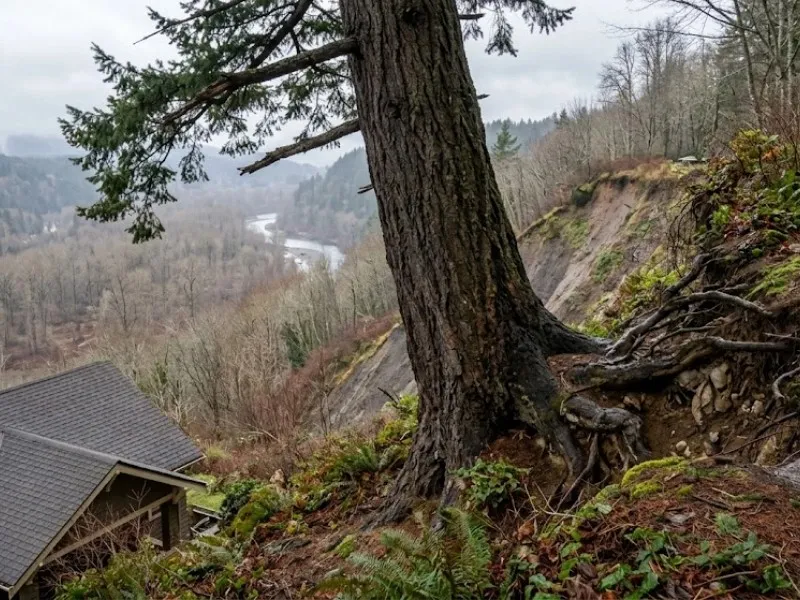
River bluff terrain. The city sits on a bluff above the Snohomish River and Pilchuck Creek confluence. Large trees on bluff-adjacent properties present an access problem that flat-terrain removals don’t: crane outriggers need stable, level ground that may not be available, and the steep grade below the work zone increases the consequence of any uncontrolled drop. Jobs on these properties take more planning and more time than equivalent removals on flat sites.
Historic district access. Removing a large tree from a narrow lot in downtown Snohomish’s historic district involves logistics that rural tree removal rarely does: crane access through narrow streets, coordination with the City of Snohomish for road closures or temporary traffic management, and navigation around historic fences and adjacent structures with limited setback. These logistics add planning time and cost to what would otherwise be a straightforward removal.
Tree age and internal condition. Many of Snohomish’s established neighborhoods have trees that are 60 to 100 years old — in the age range where internal decay is common but not always externally visible. A large tree being removed for size or permit reasons may have hidden structural compromise that doesn’t become apparent until the first cuts are made. Experienced PNW arborists anticipate this and build their cut sequences to accommodate the possibility of unexpected wood conditions mid-job.
Large Tree Removal Near Snohomish: Where We Work
Tree Ninjas handles large tree removal throughout Snohomish County and the surrounding region. Our crews regularly serve Snohomish and surrounding neighborhoods, Lake Stevens, Monroe and the Highway 2 communities, and Everett.
For the full list, see our Washington service area page.
Get a Free Large Tree Removal Estimate in Snohomish
Large tree removal scope cannot be quoted reliably by phone. The height, trunk condition, access, and proximity to structures all determine what the job actually requires. Tree Ninjas provides free on-site estimates for large tree removal throughout Snohomish County.
Call or text: (206) 601-9390
Or request a quote at treeninjaspnw.com/contact-us.
Contact Tree Ninjas
Tree Ninjas
31524 NE Cherry Valley Rd
Duvall, WA 98019
Phone: (206) 601-9390
Hours: Available 24/7 for emergency service; office hours Monday through Friday, 8 am to 5 pm
Serving Snohomish, Lake Stevens, Everett, Monroe, Mukilteo, and surrounding Snohomish County and King County communities.
