Do You Need a Permit to Log Your Duvall, WA Property?
Whether you need a Forest Practices Application (FPA) to log in Duvall, WA depends on scale and land classification. Commercial timber harvesting and removing more than 5,000 board feet requires at minimum a Class II notification or FPA from WA DNR. Tree Ninjas handles small-acreage logging and timber removal throughout Duvall and King County.
By Daniel Montgomery, Co-Founder, Tree Ninjas · Last updated August 2026
Key Takeaways
Washington requires a Forest Practices Application for timber harvesting above 5,000 board feet.
Marketable Douglas fir and cedar can generate timber revenue that offsets Duvall logging costs.
Logging on forestland before development triggers a 6-year development moratorium without a COHP waiver.
Logging requires a Forest Practices Application; land clearing for development requires a King County LDA permit.
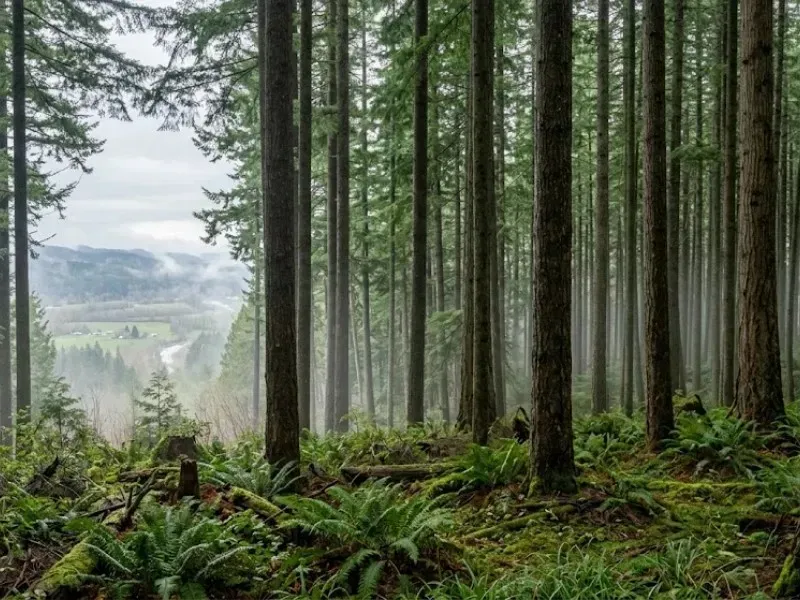
Duvall’s rural and semi-rural properties along Cherry Valley Road and the upper Snoqualmie Valley hold some of the most productive second-growth timber in King County — Douglas fir and Western red cedar that in many cases have not been actively managed since the mid-20th century. Property owners in this corridor frequently ask the same questions: do they need a permit, what does it cost, and is there any value in the timber itself? Here is a clear, Duvall-specific guide.
How the Forest Practices Act applies to Duvall-area properties:
Class I (no FPA required): removal of fewer than 5,000 board feet for personal use in any 12 months
Class II (DNR notification only): limited operations with low resource impact
Class III (FPA required): standard commercial harvest on maintained forestland; DNR reviews within 30 days
Class IV-General (FPA plus SEPA): land being converted from forestland to another use; triggers the 6-year development moratorium
Contact WA DNR’s Northwest Region before any harvest planning: [email protected] | (360) 856-3500. Small Forest Landowner Office: 1-800-523-TREE (8733).
How Much Does Logging Cost Per Acre in Washington?
Small-acreage logging and timber removal near Duvall typically costs $1,500 to $5,000 per acre in gross extraction costs depending on tree density, terrain, access, and debris management. Properties with marketable timber may have timber value that offsets or eliminates the net cost. Tree Ninjas provides free on-site assessments throughout Duvall and King County.
The net cost calculation for Duvall timber harvesting:
Marketable mature Douglas fir (40+ years, 16-inch+ diameter): current standing timber value in the Duvall area is roughly $200 to $400 per thousand board feet (MBF); a 3-acre stand with 30,000 board feet of marketable timber could produce $6,000 to $12,000 in timber revenue before logging costs
Western red cedar: commands a premium over Douglas fir; high demand for siding and finish lumber means cedar stands generate the highest per-unit timber value of Duvall’s common species
Red alder: lower value but marketable for furniture and paper; typically reduces net logging cost but rarely produces net revenue on its own
Big-leaf maple: limited commercial timber market locally; its presence in a stand reduces overall timber revenue but doesn’t necessarily increase harvest cost
Young growth (under 30 years) or mixed brush: little or no timber revenue; the landowner pays full clearing cost without offset
What affects logging cost beyond timber value:
Terrain: Cherry Valley Road’s alluvial valley bottom is relatively flat and equipment-accessible; steeper properties on valley walls add complexity and cost
Debris management: slash and debris must be managed per Forest Practices rules; chipping, piling, or mastication carry different costs
Proximity to critical areas: Snoqualmie River tributaries and wetlands create RMZ buffer requirements; work around these adds planning time and cost
What Is Selective Logging?
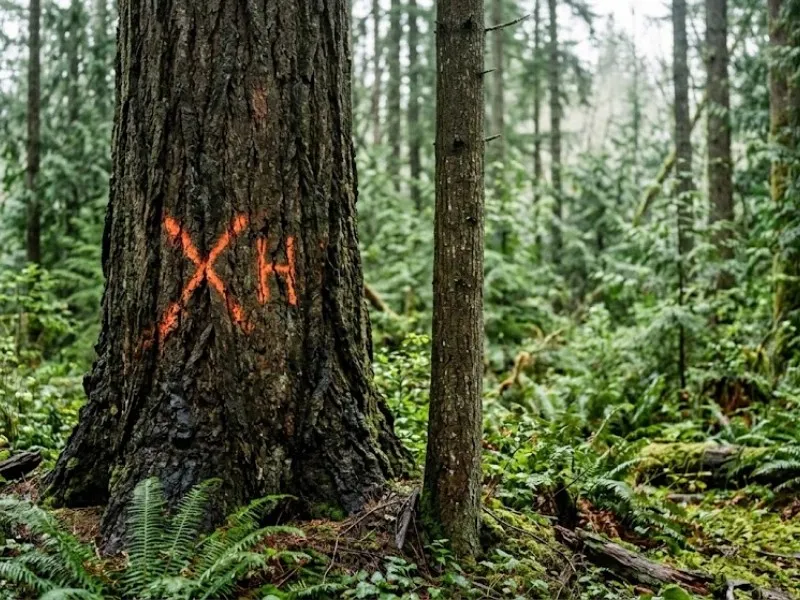
Selective logging removes specific individual trees from a forest stand based on size, species, quality, or condition — leaving the remaining trees standing and the stand structurally intact. It is the approach most often appropriate for Duvall’s small-acreage rural properties where landowners want to harvest some timber value without clearing their land.
Two selection approaches:
Commercial selective harvest targets the largest, most valuable trees for maximum short-term revenue. Done well, this harvests mature Douglas fir and cedar while leaving younger trees to develop. Done poorly (high-grading), it removes the genetic and structural elite of the stand and degrades long-term timber quality.
Improvement cutting targets trees based on health and stand structure: removing diseased, damaged, or suppressed trees, and releasing the best-quality individuals to concentrate their growth. This approach improves both stand health and long-term timber value.
For most Duvall small-acreage owners, some combination is appropriate — harvesting the best mature trees for revenue while removing alder competition, suppressed conifers, and hazard trees to improve the remaining stand.
For a detailed guide to selection methodology and ecological benefits, see our selective logging guide.
Can I Sell Timber from My Duvall Property?
Yes — if your Duvall property has marketable timber, you can sell it. Whether it makes financial sense depends on what species you have, how much volume is present, and the condition of the timber.
The timber sale process:
Timber cruise. A licensed forester or timber cruiser walks your property and estimates the volume, species mix, and quality of standing timber. This report states how many thousand board feet (MBF) of each species are present and their approximate market value. Cost: typically $300 to $800 depending on acreage.
Stumpage agreement. If the timber has sufficient commercial value, a logger or timber buyer offers a stumpage price — payment per MBF for the right to harvest. For Duvall Douglas fir and cedar, stumpage prices vary with market conditions. The landowner receives this payment before or during the harvest.
Forest Practices Application. Before any commercial harvest, a Class II or III FPA is required above the 5,000 board feet Class I threshold. The logging contractor typically handles the FPA as part of their service, though the landowner is ultimately responsible for compliance.
Harvest and settlement. The logger harvests the selected trees, hauls logs to a mill, and pays the agreed stumpage amount (or deducts agreed costs from gross timber revenue).
When timber sales make financial sense in Duvall: a commercial sale typically makes sense when a property has at least 5 to 10 acres of mature Douglas fir or cedar not recently harvested. Smaller parcels with less than 10,000 to 15,000 board feet of marketable timber may not attract a commercial buyer. In those cases, smaller-scale selective harvest — where logging cost is paid by the landowner but partially offset by firewood or small-volume log sales — is more realistic.
What Is the Difference Between Logging and Land Clearing?
The distinction determines which regulatory system applies and what permits are needed.
Logging (timber harvesting): governed by Washington’s Forest Practices Act (RCW 76.09) through WA DNR; the land remains as forestland after harvest unless a conversion plan is in place; regulated through FPA classes I-IV.
Land clearing (development preparation): governed by King County’s clearing and grading permit requirements; focused on preparing land for construction or a change of land use; involves removing all vegetation including stumps; regulated through King County DPER, not DNR.
When both apply: if a Duvall property owner wants to harvest timber AND then develop the property, both systems are triggered: the timber harvest requires a Class IV-General FPA plus SEPA through King County; the site preparation requires King County clearing/grading permits; and the Class IV-General FPA triggers the 6-year development moratorium unless a Conversion Option Harvest Plan (COHP) is in place.
The 6-year development moratorium: harvesting timber from forestland before completing proper conversion planning triggers a 6-year moratorium on developing that land for non-forest purposes. The COHP pathway waives this moratorium and should be arranged before any harvest begins. For a complete breakdown, see our logging services guide — the WA DNR system is the same for King County as it is for Snohomish County.
What Makes Logging Near Duvall Specific
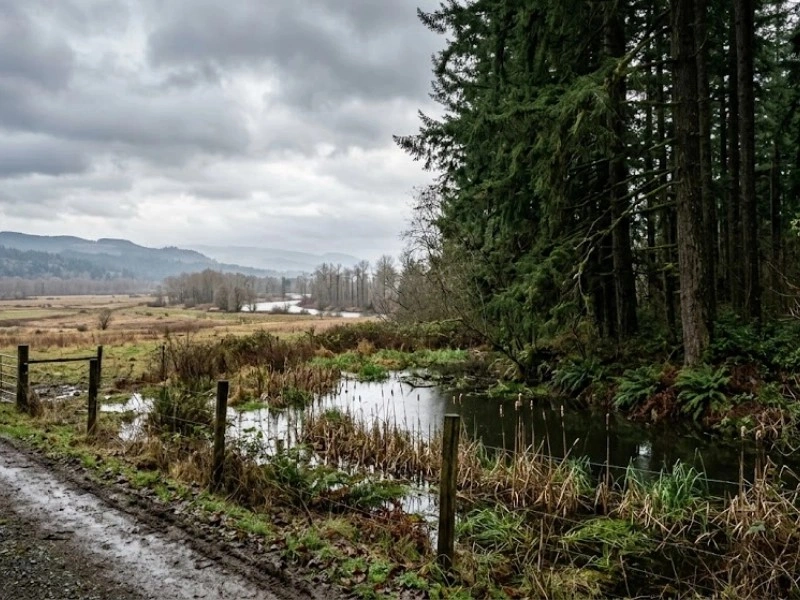
Snoqualmie River flood plain and King County Critical Areas. Duvall sits in the Snoqualmie River valley, one of the most extensively mapped critical areas corridors in King County. The river’s active flood plain, Channel Migration Zone (CMZ), and tributary network create significant buffer requirements for any harvest or clearing operation near the river. Properties along Cherry Valley Road may have substantial portions of their acreage within King County Critical Area buffers under the King County Critical Areas Ordinance (KCC Chapter 21A.24), separate from the Forest Practices Act’s RMZ requirements.
King County vs. Snohomish County jurisdiction. The Forest Practices Act rules are the same across both counties. However, critical areas review, SEPA processing, and clearing/grading permits for development-related work run through King County’s Department of Local Services (DPER), not Snohomish County. For logging-related development questions in King County: 206-296-6600.
PSE utility corridor. Logging operations near Puget Sound Energy’s overhead distribution lines on Cherry Valley Road require prior coordination with PSE. Felling trees near energized lines is prohibited without utility involvement. Contact PSE before beginning any harvest involving trees within fall distance of overhead lines: pse.com/en/pages/tree-trimming.
Duvall city limits distinction. Commercial logging typically occurs on rural parcels outside Duvall’s city limits. Within city limits, Duvall Municipal Code Chapter 14.40 applies to trees 10 inches DBH or larger and requires a permit for removal — in addition to any Forest Practices requirements for commercial harvest. Most Cherry Valley Road rural properties and surrounding unincorporated King County land are outside city limits and subject to county rather than city code.
Logging Near Duvall: Where We Work
Tree Ninjas provides small-acreage logging, selective timber removal, and site preparation throughout Duvall and King County. Our crews regularly serve Duvall, Carnation, Cottage Lake, and Redmond.
For the full service area, see our Washington locations page.
Get a Free Logging Assessment in Duvall
Logging scope is property-specific. Stand composition, density, proximity to critical areas, and your end goals all determine the right approach and FPA pathway. Tree Ninjas provides free on-site assessments throughout Duvall and King County.
Call or text: (206) 601-9390
Or request a free assessment at treeninjaspnw.com/contact-us.
Always confirm FPA requirements with WA DNR’s Northwest Region at (360) 856-3500 before beginning any timber harvest on Washington forestland.
Contact Tree Ninjas
Tree Ninjas
31524 NE Cherry Valley Rd
Duvall, WA 98019
Phone: (206) 601-9390
Hours: Available 24/7 for emergency service; office hours Monday through Friday, 8am to 5pm
Serving Duvall, Carnation, Cottage Lake, Redmond, and surrounding King County and Snohomish County communities.
