Who Handles Rope Swing Installation Near Duvall?
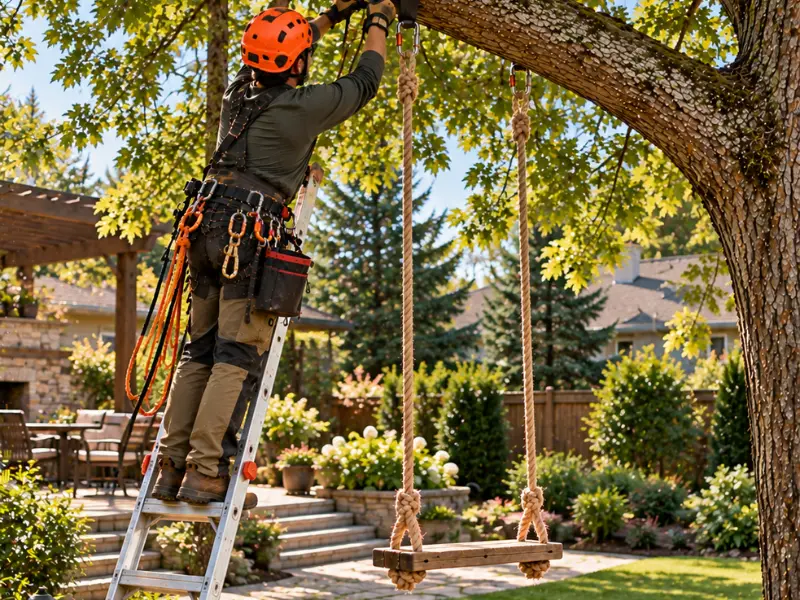
Rope swing installation near Duvall should start with the tree, not the rope. Tree Ninjas, an arborist crew based in Duvall, checks the tree and limb first, rigs the swing so it won't strangle or wound the tree, and tests it under load before your family sits down.
By Daniel Montgomery, Co-Founder · Last updated October 12, 2026
Tree Rope Swing Installation Duvall: Why the Tree Matters More Than the Rope?
Duvall is a tough place to be a swing tree. The ground along the Snoqualmie Valley stays saturated through the wet months, wind comes down the valley in real gusts, and the lineup is mostly cedar, fir, hemlock, alder and maple. They don't fail the same way. Big-leaf maples are usually the best candidates, because they grow wide, heavy limbs. Douglas firs mostly don't have a limb that suits a swing. The low branches are thin, and the strong ones sit high and angle upward. Red alders look sturdy and aren't. They grow fast, live short lives and tend to rot from the inside.
A swing also asks more of a limb than you'd guess. Someone pumping back and forth loads that wood harder than the same person sitting on it. The limb flexes, the joint at the trunk takes the strain, and the roots feel every sway. Here are the red flags we watch for out here:
Ground that's heaved, cracked or soggy around the base, especially on a slope
Mushrooms, or soft, flaking bark on the trunk or at the root flare
A lean that's new, or one the tree has been fighting with curved growth
Alders with dead tops or a hollow sound when you knock on the trunk
Any one of those is worth a closer look before anyone hangs a thing.
Safe Tree Swing Hanging Duvall: Where the Rope Meets the Tree?
This is the part you can't see from the lawn, and it's where most of the damage happens. There are a handful of ways to connect a swing to a limb, and they don't treat the tree the same.
Method | Why people pick it | What to watch |
Wide strap or sling over the limb | No hole in the tree, and the wide contact spreads the load | It still sits on the bark, so it needs checking and moving every few years |
Rope with a protective sleeve and a loosening knot | Simple, no drilling, and the knot slackens when the weight comes off | The contact point rubs, so the sleeve has to stay put and stay loose |
Hardware through the limb | Very strong, with no rope on the bark | It's a permanent hole, and it's only as good as the wood around it |
A rope tied tight around the limb | Easiest thing to do | It can strangle the limb as it thickens, so this is the one to avoid |
Arborists argue about the first three. We lean on non-invasive rigging, which means nothing gets spiked into the wood, because a hole is a way in for decay. What matters more than the method is that somebody looks at it again next year.
Then there's what's under the swing. The U.S. Consumer Product Safety Commission says dirt and grass don't protect kids from serious head injuries, and that for swings the soft surface under a swing should reach twice the height of the suspending bar in front and back. That advice was written for swing sets, not trees, but the idea carries over. Clear out roots, stumps and rocks, and give the swing room to travel. The same page warns against tying extra ropes, jump ropes or leashes to play equipment, since they're a strangulation hazard.
Arborist Installed Tree Swing Duvall: What the Climb Actually Covers?
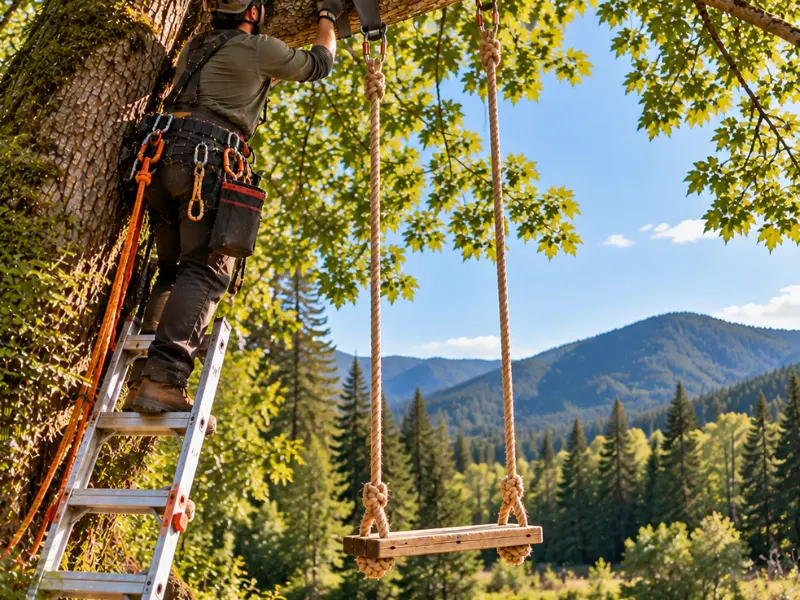
It's someone climbing into the tree and reading it from the inside out. Before any hardware goes on, we look for disease, decay, cavities and weak joints, and pick the strongest, best-placed limb. Then we choose rope and hardware for your tree, your swing style and the people who'll use it, install it, and test it under load. Last comes a pass over every connection point and the hang height before we leave.
Who can check if our tree is strong enough for a swing? An arborist, in person, before anything gets hung. Photos help, but a limb can look perfect from the yard and have a split you'd only see from above.
Who installs tree rope swings near Duvall? We do, out of our shop on Cherry Valley Road. Tree Ninjas is licensed, bonded and insured, and the state license number is TREENNL752Q1. You can confirm any company's registration, bond and workers' comp on L&I's Verify tool, and you should. We work to ANSI tree safety standards. Ropes wear in our rain, so the swing needs a look once a year, and the rope usually needs replacing every two to three years. We offer maintenance and replacement, so you don't have to climb up there yourself.
Where We Hang Swings Around Duvall
Most of our swing jobs are a short drive from the shop: in Duvall, out along Big Rock Road and West Snoqualmie Valley Road, and over to Carnation, Fall City and Cottage Lake. Our rope swing installation page lists the styles, from a single rope and a plank seat to double-rope seats, tire swings, tree-to-tree lines and family sets, and our Duvall tree services page covers the rest of what we do around here.
Dead wood over the swing's path is a separate job, and our tree pruning page explains how we handle it. An old stump under the swing is a trip hazard too, and our post on stump grinding in Duvall covers that. Ready to find out if your tree is a swing tree? Request a free estimate or call (206) 736-3757.
Frequently Asked Questions
1. Can you tell whether our tree and limb are suitable for a swing?
Yes, and it's the first thing we do. We look at the whole tree, not just the limb: the base and the soil, the trunk, the spot where the limb joins it, and anything dead hanging overhead. We check for cracks, cavities and fungus, and for how the limb grows out from the trunk. If the answer's no, we say so, and we'll point to a better limb or a better tree on your property if there is one.
2. Does a rope tied around a branch damage the tree?
It can. If the rope is tight, or just stays there for years, it squeezes the layer under the bark that carries water and sugar. That's called girdling, and the limb can die back past that point. Even a loose rope rubs. Look for a groove or sunken ring around the limb, bark peeling under the rope, or thin leaves beyond the attachment. If you spot any of those, take the swing down and call us.
3. What hardware do you use so the tree can keep growing?
We use rigging that doesn't spike into the wood, so there's no hole for decay to get in, plus rope and hardware rated for the load and for a wet climate. The exact setup depends on the limb and the swing, so ask us what's going on your tree and we'll tell you. Whatever goes up, check it yearly, and move attachment points every few years if the tree starts growing around them.
4. How high and how strong does the limb need to be?
A good rule of thumb is a limb at least 8 inches thick where the swing hangs, with the seat about two feet off the ground. Most swings hang from somewhere around 10 to 20 feet up. Higher gives a longer arc, but it's harder to rig and to inspect. Thickness isn't the whole story. The limb should be sound and mostly horizontal, and no more than about half the trunk's width where it joins, because oversized limbs connect poorly. The rope and hardware should be rated well above the heaviest person who'll use it.
5. Can you check the rest of the tree while you are here?
Yes. While we're up there we look over the crown and trunk from top to bottom and flag anything that needs attention, like dead branches over the swing's path, weak joints or a failing neighbor. We do pruning and removal too, so you can handle it in the same visit instead of booking a second company.
6. How do you hang a rope swing without damaging the tree?
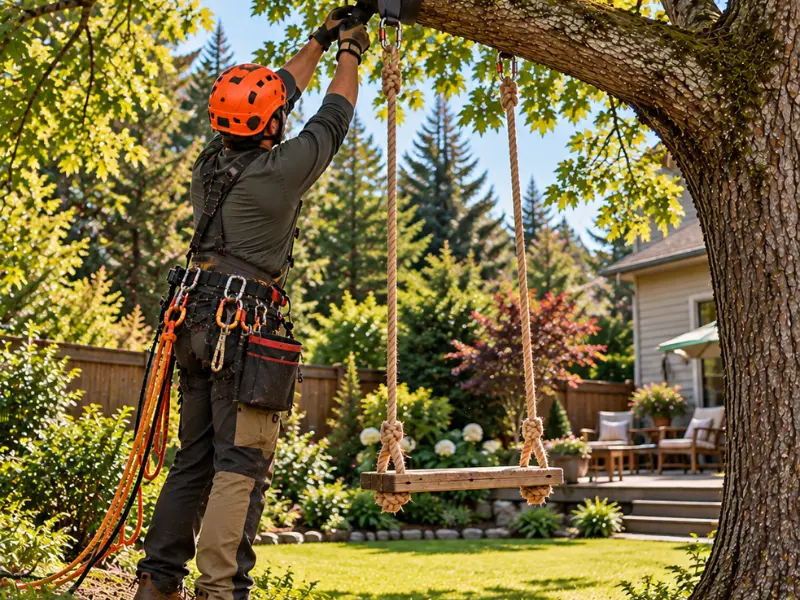
Pick a sound limb, keep anything tight off the bark, and look at it every year. In practice that means no nails, screws, staples or lag bolts into the trunk or limb, no bare chain over the bark, and a wide strap or a protected rope instead. Never leave a swing rope wrapped snug around a limb that's still growing. And if climbing 15 feet on a ladder doesn't sound fun, that's what an arborist is for.
7. Which trees and limbs are safe for a rope swing?
A mature, healthy hardwood with a thick, mostly horizontal limb, like a maple or oak. Skip anything with dead branches, cracks at the limb joint, mushrooms, a fresh lean, or a tight V-shaped fork, which is a weak connection. Most conifers and alders are poor choices, and we'll walk you through why on site.
Visit or Call Us
Tree Ninjas 31524 NE Cherry Valley Rd Duvall, WA 98019
Phone: (206) 736-3757
Hours: Monday to Friday, 8:00 AM to 5:00 PM, with 24/7 emergency response
WA Licensed · TREENNL752Q1.
Serving Duvall, Carnation, Fall City, Cottage Lake and the wider Eastside.
