What Should I Do Immediately After a Tree Falls in Snohomish, WA?
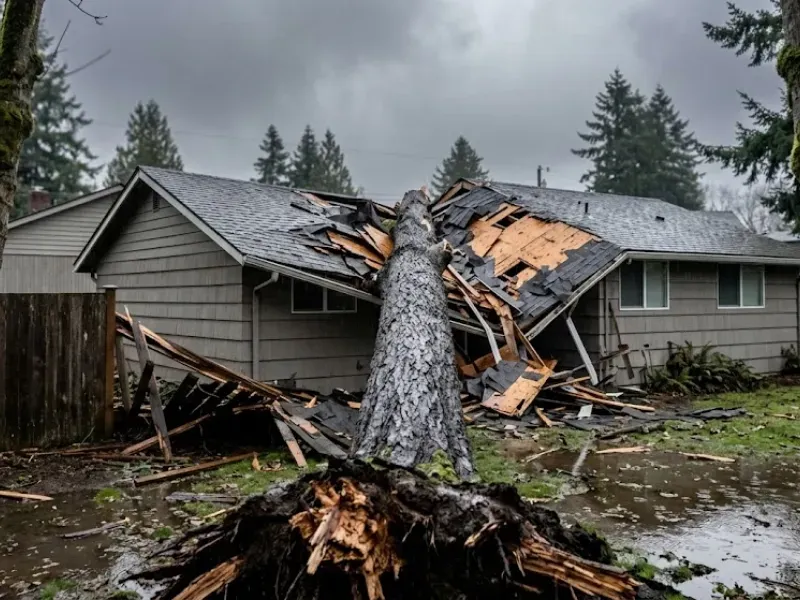
After a tree falls on your Snohomish property, your immediate priorities are personal safety, damage documentation, and contacting your insurer. Get everyone clear of the tree and any structure it is touching, photograph the scene from multiple angles before anything is moved, and notify your insurance company before removal begins if the situation is not an active life-safety emergency. Then call Tree Ninjas.
By Daniel Montgomery, Co-Founder, Tree Ninjas · Last updated June 2026
Key Takeaways
Call your insurer and document damage before tree removal begins if safety allows.
Storm damage tree removal in Snohomish typically costs $600 to $2,000 for most residential jobs.
Your own insurance, not your neighbor’s, typically covers a tree that falls on your property.
Trees with root plate heaving or major crown loss generally need removal, not restoration.
Snohomish County sees some of the highest tree-related storm damage rates in Washington. Its combination of fast-growing rural tree canopy, aging urban tree stock in the Snohomish historic district, and heavy fall and winter rainfall creates conditions where storm damage happens predictably and where acting quickly and correctly matters both financially and structurally.
What to do immediately after a tree falls — in order:
Get clear. Move everyone away from the tree and any structure it is touching. Partially fallen trees can continue to shift.
Check for utility line contact. If power lines are involved, call SnoPUD at 425-783-1001 (24 hours a day) and keep at least 30 feet of clearance. If anyone is in immediate danger, call 911 first.
Photograph everything before you touch anything. Wide-angle shots and close-ups from multiple sides, dated and time-stamped. This documentation is essential for your insurance claim.
Make temporary repairs to prevent further damage. A tarp over a roof breach in Snohomish’s fall and winter rainfall season can prevent significant secondary water damage within hours. Keep all receipts.
Call your insurer. If a structure was hit, notify your insurance company before removal begins if the situation is not an immediate safety hazard. Some insurers want to assess before the tree is moved.
Call Tree Ninjas at (206) 601-9390. We handle storm damage removal throughout Snohomish County and can guide you through the next steps on the call.
For emergency situations where a tree is actively on your home or blocking access, see our 24/7 emergency tree service guide for Snohomish.
How Much Does Storm Damage Tree Removal Cost in Snohomish?
Storm damage tree removal in Snohomish typically costs between $600 and $2,000 for most residential jobs. Complex jobs — trees resting on structures, debris requiring precision rigging, or multi-tree storm cleanup — commonly run $2,000 to $4,000 or more. Tree Ninjas provides free on-site assessments throughout Snohomish County.
What affects the cost on storm-damage jobs specifically:
Tree condition: a partially uprooted or split tree is often more complex to remove safely than a standing tree of the same size — the unstable position creates unpredictable movement during cutting
Structural involvement: a tree resting on a roof requires precision sectional removal with controlled rigging to avoid making the structural damage worse
Access and debris volume: storm-damaged trees often bring down secondary material — hanging widow-makers, entangled branches in surrounding trees — that adds to the total scope
After-hours and storm-season demand: calls during or immediately after a major storm carry after-hours premiums; calling as soon as the tree comes down gives you the best chance at fast response and competitive pricing
If your homeowners' insurance covers the removal, your actual out-of-pocket cost may be limited to your deductible.
Does Homeowners Insurance Cover Storm-Damaged Trees in Snohomish?
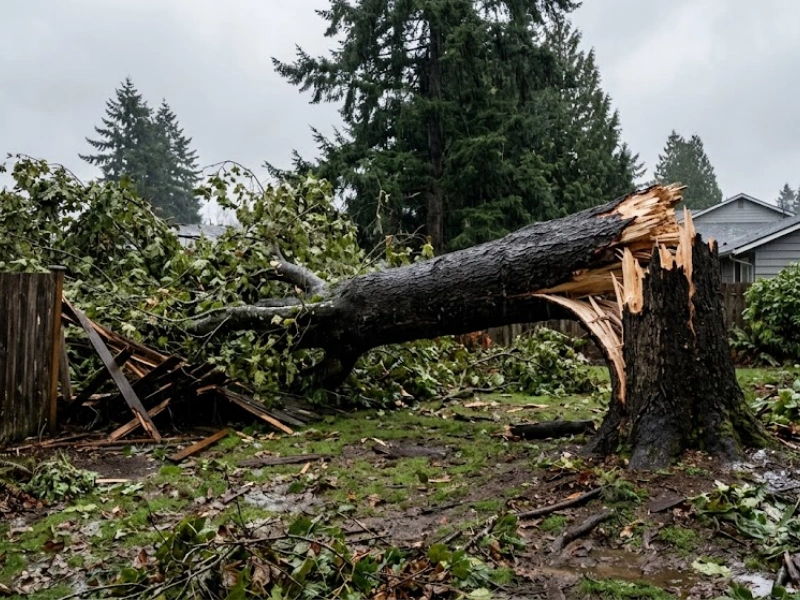
Homeowners insurance typically covers storm damage tree removal in Snohomish when a tree falls on an insured structure due to a covered peril such as windstorm or lightning. Most policies limit tree removal coverage to $500 to $1,000 per tree under a debris removal provision, separate from the structural repair coverage.
What is typically covered:
Tree falls on insured structure (home, garage, shed, fence) during a covered weather event: debris removal plus structural repair costs
Tree damages your property but originated from a neighbor’s yard: your own insurance covers your damage regardless of tree origin
Temporary repairs to prevent further damage (tarping, boarding): keep all receipts for reimbursement
What is typically not covered:
Tree falls in your yard without hitting a covered structure: cleanup costs are your responsibility
Standing trees revealed to be hazardous by the storm but that did not fall: preventive removal is not covered
Flood or earthquake damage: requires separate coverage
How to file an insurance claim for storm tree damage in Snohomish:
Document with photos and video before anything is moved
Contact your insurer to open a claim and ask whether they want to send an adjuster before removal
Obtain a written scope and cost estimate from Tree Ninjas — typically required for claim processing
Make temporary repairs to prevent secondary damage; keep all receipts
Proceed with removal after insurer confirmation, or sooner if there is active structural risk
Who Is Responsible If a Neighbor’s Tree Falls on My Property?
Under Washington State law, if a neighbor’s healthy tree falls on your property during a storm, your own homeowners' insurance covers your damage — not your neighbor’s insurance. The neighbor is not liable when the cause is a weather event, and the tree was healthy. Your neighbor’s liability arises only if negligence can be established.
Negligence means: the tree was dead, diseased, or structurally compromised, and your neighbor was aware of that risk and failed to act. Washington case law has long held that tree owners must address known hazardous conditions. The standard requires both that the tree was hazardous AND that the owner had knowledge of that hazard.
How to establish a negligence record, if applicable:
Send written notice to your neighbor by certified mail describing the specific hazard you observed and requesting they address it
Document the tree’s condition with dated photographs before it fails
Obtain a written arborist assessment documenting the hazard — this creates an official record that the neighbor received notice of a known risk
If the tree subsequently falls after your neighbor received that notice, you have a substantially stronger basis to pursue a liability claim against their homeowners policy
This is general information about Washington property law, not legal advice. If you believe neighbor negligence contributed to storm damage on your property, consult a licensed Washington State attorney alongside your insurance company.
How Quickly Should Storm-Damaged Trees Be Removed in Snohomish?
In Snohomish, urgency matters more than in drier climates. The city averages over 40 inches of annual rainfall, with October through December among the wettest months. A roof breach left unprotected through a Snohomish fall can accumulate significant secondary water damage within days — often costing more than the tree removal itself.
Removal urgency guide for Snohomish County:
Immediate (same day): tree actively resting on a structure; hanging widow-makers over occupied areas; utility line contact; blocked emergency access route
Within 24 to 48 hours: uprooted trees near structures (root plates can resettle after secondary rain, complicating access); split trunks still partially standing; debris blocking private driveways
Within one to two weeks: trees down in open areas without threatening structures; crown debris in the canopy of other trees
After arborist assessment: trees with crown damage only but still standing — these may not need removal at all (see below)
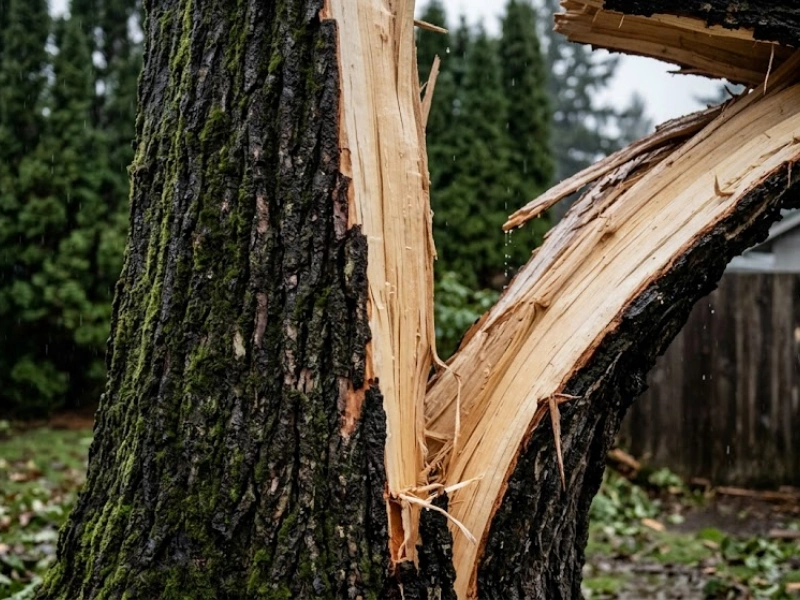
One Snohomish-specific urgency factor: when a storm exposes raw wood — a split trunk, a torn scaffold branch, a broken top — that wood begins showing fungal activity within days in Snohomish’s moist climate. Acting during a dry spell within the first week after a storm is almost always better than waiting.
How to Tell If a Storm-Damaged Tree Can Be Saved in Snohomish
Not every storm-damaged tree needs to be removed. Some recover fully; some are total losses. A certified arborist assessment is always worthwhile before committing to removal — particularly for large, established trees in Snohomish where replacement cost and permit requirements are significant.
Assessment guide for common storm damage scenarios:
Root plate heaving: if significant root mass is exposed or the root plate has lifted substantially, the tree typically cannot be structurally restored. Removal is the standard recommendation.
Trunk split at or below the first scaffold: a split through the main trunk below where the primary scaffold branches originate is a structural total loss. Remove.
Major scaffold branch failure (25 to 50% of canopy): depends on which scaffold was lost. Trees that lost one major scaffold but retain a sound, balanced structure can often recover through crown restoration pruning over two to three seasons.
Crown damage only (branches, no structural failure): trees that lost branches but retained trunk and major scaffold structure are often strong restoration candidates. Crown damage under 40 to 50% generally recovers; more is a removal candidate.
Lightning bark stripping: if one-sided (less than 25 to 30% of bark circumference), the tree may survive. Ring damage — stripping all the way around the trunk — severs the vascular system; the tree will not recover.
Tree Ninjas provides free on-site storm damage assessments throughout Snohomish County. If you are uncertain whether your tree warrants removal or restoration, an arborist visit before you commit either way is almost always worth the trip.
Storm Damage Tree Removal Near Snohomish: Where We Work
Tree Ninjas respond to storm damage calls throughout Snohomish County and surrounding communities. We regularly serve Snohomish and surrounding neighborhoods, Lake Stevens, Monroe and the Highway 2 corridor, Everett, and Mukilteo.
For the full service area, see our Washington locations page.
Get a Free Storm Damage Assessment in Snohomish
If a tree came down on your Snohomish property, call now for a free on-site assessment. We provide written scope and cost estimates that support your insurance claim and guide the removal plan.
(206) 601-9390 — Available 24/7
For non-urgent quotes, request an estimate at treeninjaspnw.com/contact-us.
Contact Tree Ninjas
Tree Ninjas
31524 NE Cherry Valley Rd
Duvall, WA 98019
Phone: (206) 601-9390
Hours: Available 24/7 for emergency service; office hours Monday through Friday, 8 am to 5 pm
Serving Snohomish, Lake Stevens, Everett, Monroe, Mukilteo, and surrounding Snohomish County and King County communities.
