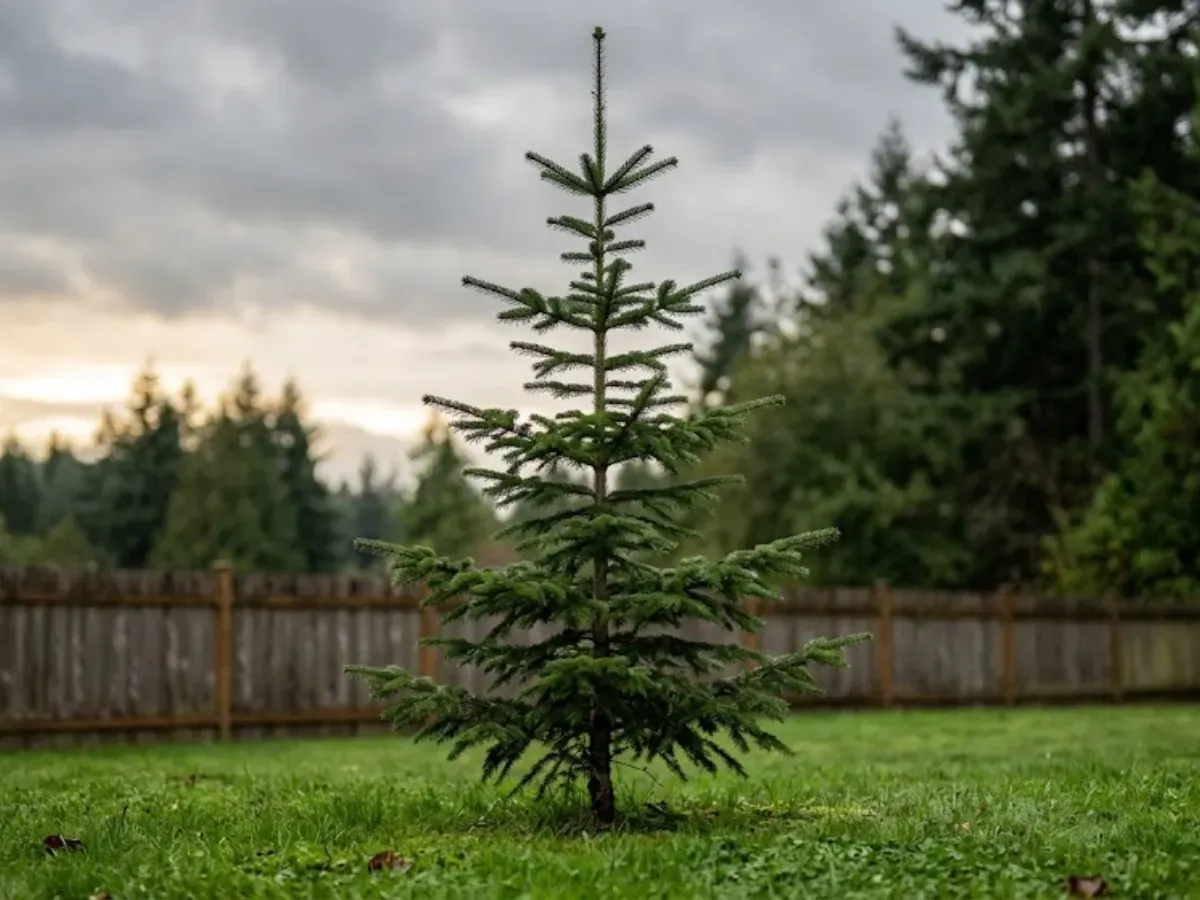
What Is Structural Tree Pruning and Why Does My Tree Need It?
Structural tree pruning is the deliberate shaping of a tree’s branch architecture during its formative years to establish stable long-term growth. In Duvall, WA, where trees grow rapidly in the Snoqualmie Valley’s moist climate, structural pruning from a certified arborist prevents the codominant stems and includes bark that becomes hazardous — and expensive — to address in mature trees.
By Daniel Montgomery, Co-Founder, Tree Ninjas · Last updated June 2026
Key Takeaways
Structural pruning establishes a tree’s long-term scaffold before structural defects become permanent hazards.
The window for effective structural pruning closes as trees mature; earlier is always better.
Structural pruning in Duvall typically costs $150 to $700, far less than corrective work or removal later.
Douglas fir, big-leaf maple, and ornamental trees are the primary structural pruning candidates in Duvall.
Most tree problems in Duvall are not sudden. They develop over ten to twenty years, beginning with a structural decision — or lack of one — made when the tree was young and the issue was minor. A codominant stem that could have been removed at year eight with a single cut becomes a cable bracing project at year twenty-five and a removal at year forty. Structural pruning is the discipline of making those decisions early, while options are still simple, affordable, and genuinely effective.
How Much Does Structural Tree Pruning Cost in Duvall, WA?
Structural tree pruning in Duvall typically costs $150 to $700 per tree for work done during the formative window — trees under 40 feet still in their primary development phase. Because early structural work involves one to three targeted cuts on a small tree with minimal material to remove, it is significantly less expensive than the corrective pruning, cable bracing, or removal that becomes necessary if structural defects go unaddressed.
Cost by tree size and stage:
Young trees (under 20 feet): $150 to $350 per structural visit. One or two key cuts. Fast to assess, fast to execute.
Mid-maturity (20 to 40 feet): $300 to $700. More assessment time is required; scaffolds are established, and the corrective choices are more significant.
Corrective structural work on established trees (40 feet and over): $500 to $1,200 or more. At this stage, structural pruning converges with full health pruning in complexity and cost.
The value argument is straightforward: a $250 structural visit on a 12-foot Douglas fir at year eight prevents a $2,500 corrective pruning and cable bracing job at year twenty-five. See our tree pruning service page for the full scope of what structural work includes.
When Should Structural Pruning Be Done in Duvall, WA?
Structural pruning is most effective during a tree’s first five to twenty years of growth. In Duvall, where fast growth rates in the Snoqualmie Valley compress the structural development timeline, certified arborists recommend the first structural assessment at year three to five for conifers and young hardwoods, with follow-up visits every two to three years through the formative period.
The structural pruning timeline for Duvall trees:
Years 3 to 5: first structural assessment. Identify the dominant leader, address any early competing growth, make the small directive cuts that redirect years of future development.
Years 5 to 15: the highest-impact structural window. Trees are still small enough that one precise cut eliminates a codominant stem before included bark forms. Follow-up structural visits every two to three years do the most good for the least cost.
Years 15 to 30: structural work becomes corrective pruning. Defects are established; corrections require larger cuts, longer wound closure times, and often cable bracing. Still worthwhile — but the simplicity is gone.
After year 30: for many species, structural defects are locked in. Options shift to cable bracing, load monitoring, and removal planning when risk becomes unacceptable.
Best season: late January through early March. The dormant window makes the full scaffold structure visible, wounds compartmentalize quickly as spring growth begins, and pathogen activity is at its annual low. For species-specific seasonal guidance, see our Pacific Northwest tree timing post.
How Does Structural Pruning Improve Tree Health in Washington State?
Structural pruning improves long-term tree health by eliminating codominant stems before they form included bark, establishing a dominant central leader that distributes structural load correctly, spacing scaffold branches to reduce competition and prevent rubbing wounds, and ensuring that future pruning cuts are made on manageable-sized branches rather than large-diameter limbs that take years to compartmentalize.\
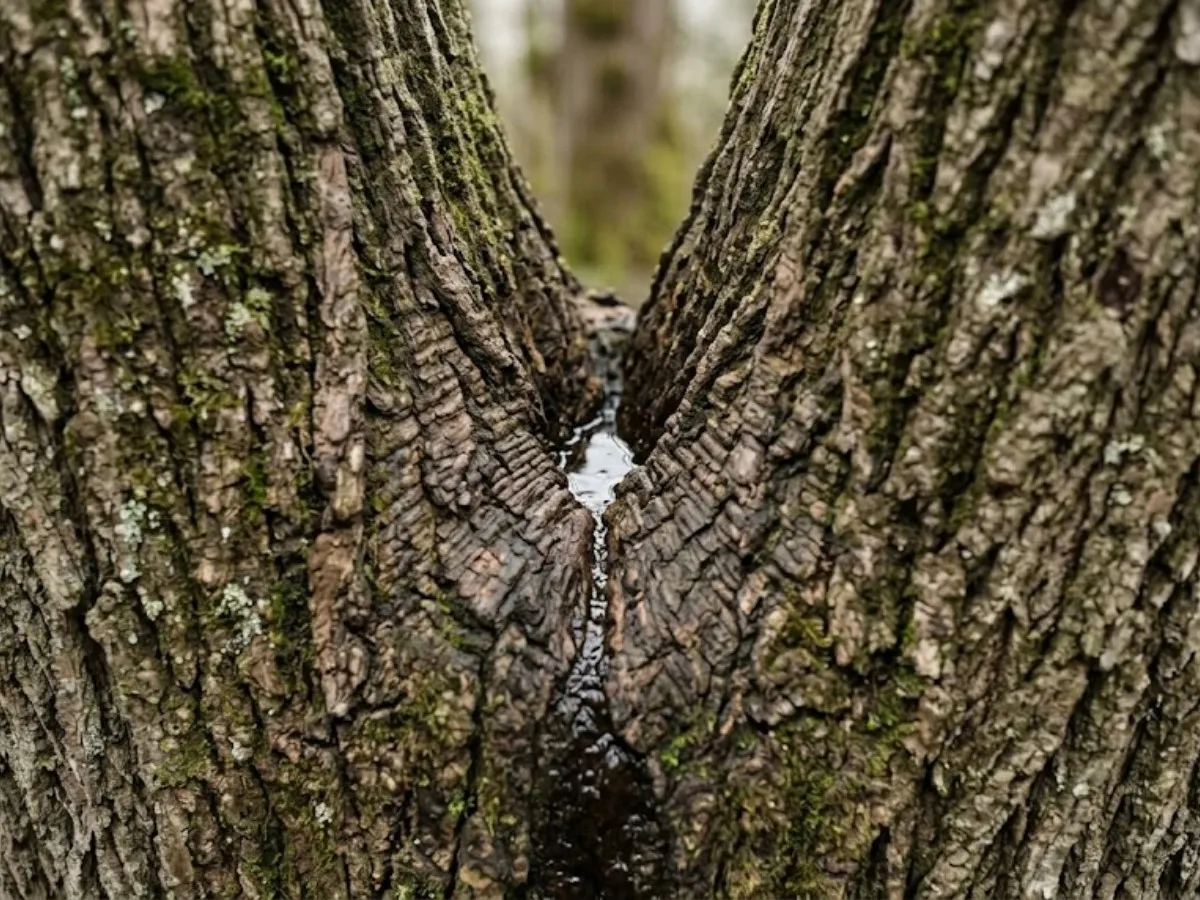
The biology behind why structural defects cause problems:
Included bark: when two stems of similar diameter share a union, bark gets compressed between them as both grow. Unlike the branch collar (which allows callus formation and wound compartmentalization), an included bark union cannot close properly. It is a permanently weak point that often holds for years before failing without warning.
Codominant stems: two stems competing to become the dominant trunk. Each grows in diameter independently, creating an ever-widening wedge of included bark at the union. The larger the stems become, the greater the stored energy in the union — and the more catastrophic the failure when it occurs.
Wound compartmentalization: trees do not heal wounds — they wall them off. A structural cut made at year eight on a two-inch-diameter stem produces a small, fast-compartmentalizing wound. The equivalent decision made at year thirty requires removing a ten-inch-diameter branch whose wound is vulnerable to decay for years.
For a deeper look at how pruning techniques affect tree biology, see our tree pruning guide for Duvall.
What Trees Benefit Most from Structural Pruning in Duvall?
Douglas fir, big-leaf maple, ornamental fruit trees, and Japanese maple are the Duvall species where structural pruning has the highest long-term impact. All four are common on Duvall properties, all four develop specific structural vulnerabilities if their early growth is left unmanaged, and all four respond well to early structural work in ways they cannot recover once mature.
Douglas fir naturally grows with a single dominant leader but readily forms competing codominant stems if a lateral branch grows at a near-vertical angle or if the apical tip is ever damaged. Duvall’s fast growth means this can happen quickly. Establishing and maintaining the dominant leader in years three through fifteen sets the tree up for a century of stable vertical growth; without it, codominant stems with included bark form and the structural liability is established before most homeowners notice.
Big-leaf maple is naturally multi-stemmed, so the structural question is which stems to keep rather than how to establish a single leader. Early structural pruning removes stems with narrow attachment angles and poor spatial distribution while retaining those with wide unions and good architecture. Left unmanaged, the multi-stem base fills with competing growth, producing co-equal stems with severe included bark throughout.
Ornamental fruit trees — apple, pear, cherry, and plum — require annual or biannual structural attention during their first five to ten years to develop either an open-center or modified-central-leader framework. Fruit load adds weight to scaffold branches each season, accelerating stress on poorly structured scaffold unions. A fruit tree with good structural pruning in its early years produces better and stays safer for decades.
Japanese maple is pruned with the greatest precision of any species on Duvall properties because the branching architecture is the ornamental value. Cuts must remove entire branches cleanly at their origin, never mid-branch. The goal is a balanced, open form visible from multiple angles. Because Japanese maples grow slowly and hold cuts visibly for years, poor structural decisions on these trees are both permanent and obvious.
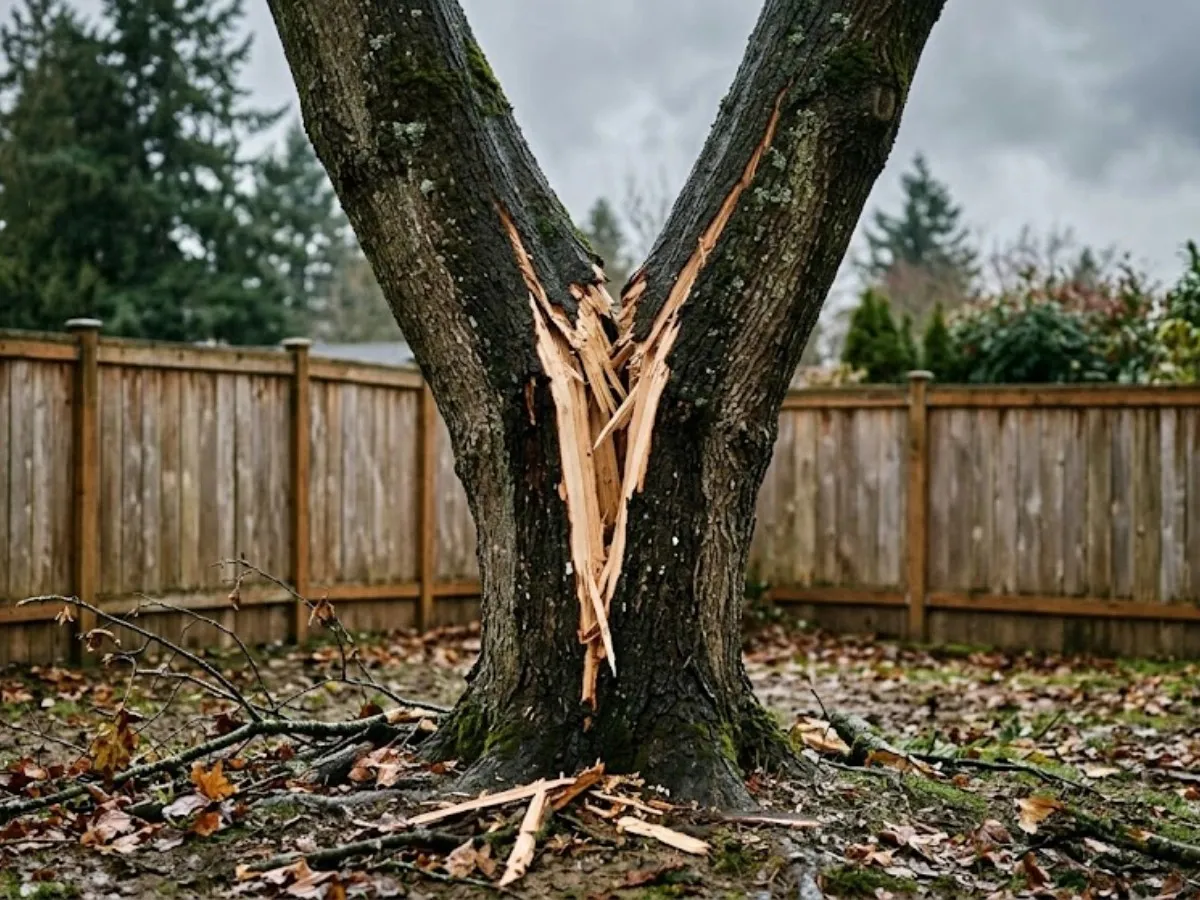
The Closing Window: Why Duvall Trees Need Structural Attention Now
Properties throughout Duvall planted trees in the 1990s and 2000s — Douglas firs, ornamental cherries, Japanese maples, young big-leaf maples, and Western red cedars — and many of those trees are now 15 to 30 feet tall. This cohort is sitting right at the inflection point: structural pruning is still effective, still relatively affordable, and still capable of preventing the defects that are just beginning to form. But that window is closing within the next five to ten years for most of them.
The trees that fail most consistently in Duvall’s winter windstorms are not the oldest trees on the property. They are the 20-to-40-year-old trees that developed codominant stems during their teenage years and were never structurally addressed. The included bark union looks fine from the outside. The structural weakness is invisible until a February storm arrives with 50 mph gusts and the tree splits cleanly at the union — onto a roof, a car, or a fence.
From Cherry Valley Road, we see which trees on Duvall properties were structurally pruned in their early years and which were not. The structural difference between a 25-year-old Douglas fir with a clean dominant leader and one with two competing stems of equal diameter is not a cosmetic issue. It is a long-term safety profile that was set by decisions made — or not made — fifteen years ago.
The most important structural pruning call on a Duvall property is the one made before you know you need it.
Structural Tree Pruning Near Duvall: Where We Work
Tree Ninjas is based at 31524 NE Cherry Valley Rd and provides certified arborist structural pruning throughout Duvall and the surrounding King County and Snohomish County communities. Our crews regularly work in Duvall and the Cherry Valley corridor, Carnation and the lower Snoqualmie Valley, Monroe and the Highway 2 communities, and Cottage Lake and the Woodinville area.
For the full service area, see our Washington locations page.
Get a Free Structural Pruning Assessment in Duvall
Structural pruning decisions are made on-site — the right course of action depends on what the tree’s current scaffold looks like. Tree Ninjas provides free on-site assessments for structural pruning throughout Duvall and King County.
Call or text: (206) 601-9390
Or request a quote at treeninjaspnw.com/contact-us.
Contact Tree Ninjas
Tree Ninjas
31524 NE Cherry Valley Rd
Duvall, WA 98019
Phone: (206) 601-9390
Hours: Available 24/7 for emergency service; office hours Monday through Friday, 8 am to 5 pm
Serving Duvall, Carnation, Monroe, Cottage Lake, and surrounding King County and Snohomish County communities.
