What's the Difference Between Stump Grinding and Removal?
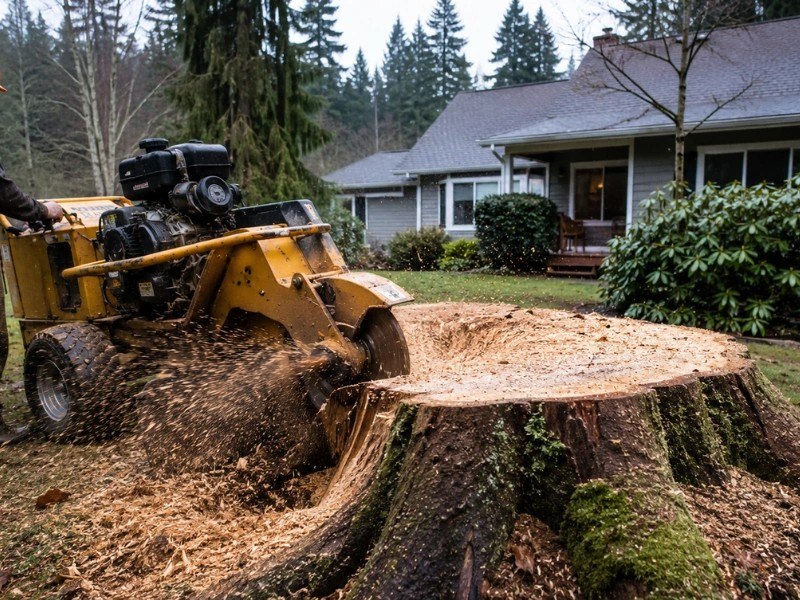
Stump grinding removes the visible stump to 6 to 12 inches below grade, leaving the root system to decay underground. Full removal excavates the stump and root ball entirely. For most Snohomish residential situations, grinding is the right choice — faster, less disruptive, and significantly less expensive. Tree Ninjas provides stump grinding throughout Snohomish and Snohomish County.
By Daniel Montgomery, Co-Founder, Tree Ninjas · Last updated August 2026
Key Takeaways
Stump grinding in Snohomish runs $75 to $400 for most stumps; large evergreens cost more.
Grinding leaves roots underground to decay; full removal excavates the entire root ball.
Standard grinding depth is 6 to 12 inches below grade, enough for lawn and landscaping.
Douglas fir and cedar stumps in Snohomish are the region’s largest and densest to grind.
Stumps are almost always left behind when trees are removed, and they create a specific short list of problems: they’re mowing hazards, they take up usable yard space, they’re trip hazards on high-traffic properties, and — with Douglas fir and cedar in Snohomish — they’re large enough to be architectural features you didn’t ask for. Grinding removes that problem in a single visit.
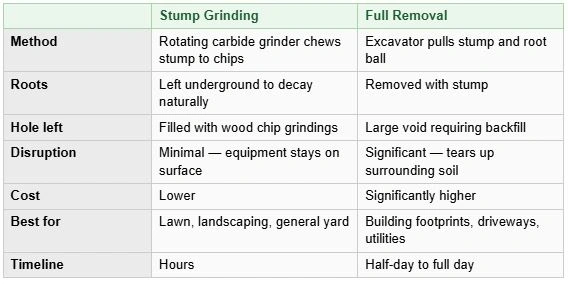
When to choose grinding: for the vast majority of Snohomish residential stump situations — old stumps in lawns, stumps left after storm damage, stumps in planting beds — grinding is the right choice. The remaining roots decay underground over one to seven years depending on species, stump size, and soil moisture.
When to choose full removal: building a structure or driveway over or near the root zone; installing buried utilities through the root area; planting a new tree in the exact same location where very deep root clearing is needed; or when the stump is from a tree with a soil-borne disease where root-to-root contact is a transmission risk.
What Does Stump Grinding Cost in Snohomish?
Stump grinding in Snohomish is typically quoted by stump diameter, measured at the widest point at ground level. Tree Ninjas provides free on-site estimates throughout Snohomish and Snohomish County.
Cost by stump diameter:
Small stump (under 12 inches): $75 to $200 — small ornamentals, fruit trees, and young conifers
Medium stump (12 to 24 inches): $150 to $400 — established shade trees, mid-size conifers
Large stump (24 to 36 inches): $300 to $700 — mature shade trees, larger firs and cedars
Very large evergreen stump (36 inches and over): $500 to $1,500 or more — the mature Douglas firs and Western red cedars common throughout Snohomish County
What affects cost beyond diameter:
Root flare extension: many large Snohomish County conifers have significant buttress root flares that extend 2 to 4 feet from the trunk center; the actual grinding area is larger than the trunk diameter alone
Access: stumps close to fences, foundations, or landscaping require slower, more precise machine operation
Grindings removal: hauling grindings off-site adds to cost; leaving grindings in-place is included in the standard grinding price
Multiple stumps: additional stumps on the same job are typically discounted from the single-stump rate
How Deep Do You Grind the Stump?
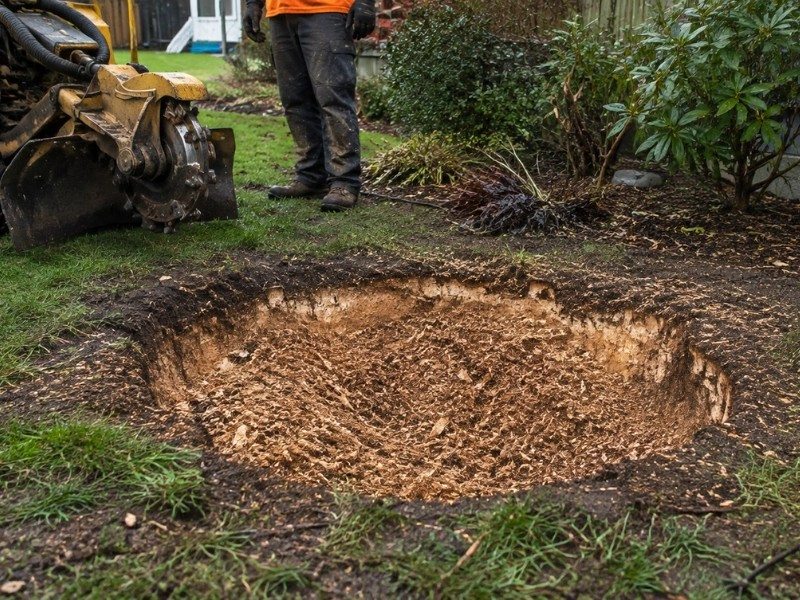
Standard stump grinding on a Snohomish residential property goes 6 to 12 inches below the surrounding grade — meaning the highest remaining wood is 6 to 12 inches below the lawn surface.
What each depth enables:
6 inches below grade: sufficient for seeding or sodding over the area; grass can be established, though some settling may occur over one to two years as grindings decompose
10 to 12 inches below grade: the standard for most landscaping applications; adequate for planting over the area including shrubs with shallow root systems
12 to 18+ inches below grade: recommended if planting a new tree in approximately the same location; deep enough that the new tree’s establishment roots won’t immediately encounter old stump material; typically an upcharge from standard depth
The root depth question: stump grinding removes the crown of the stump and grinds down through the first visible root mass, but does not remove the lateral roots extending outward. Those roots — in a mature Douglas fir, potentially extending 20 to 30 feet in all directions — are left underground to decay. In Snohomish’s wet climate, decay is reasonably fast, but large conifer roots can take five to ten years to fully break down.
For building sites where subsurface organic material is a concern, full grubbing with an excavator is the correct solution rather than deep stump grinding.
Do You Grind Large Evergreen Stumps?
Yes — large Douglas fir and Western red cedar stumps are among the most common stump grinding jobs in Snohomish County, and they require different planning than small ornamental stumps.
Douglas fir stumps: mature Douglas firs produce stumps that can be 30 to 48 inches in diameter or larger, with significant buttress root flares that extend the effective grinding area well beyond the trunk measurement. Douglas fir wood is dense and slow to grind relative to its volume. The root system extends wide and relatively shallow — Snohomish’s alluvial soils produce extensive lateral surface roots that are part of the grinding scope when visible in the grinding area.
Western red cedar stumps: cedar produces similarly large stumps and presents an additional consideration — Western red cedar wood contains natural preservatives (thujaplicin and related compounds) that significantly slow biological decay. A cedar stump left unground can persist visibly for decades in the Pacific Northwest, even in Snohomish’s moist climate. Grinding cedar is the reliable way to eliminate the stump; waiting for natural decay is not a practical timeline for most homeowners.
Surface root systems: both species develop extensive surface roots in Snohomish’s alluvial soils. Roots visible at or near the surface within the immediate grinding area are included in the grinding scope. Roots running under lawns and pavement farther from the stump are left in-ground.
Do You Clean Up the Grindings?
Yes — cleanup is included with every stump grinding job. After grinding, Tree Ninjas levels the grindings and leaves the area clean. What happens to the grindings afterward is the homeowner’s choice.
Three options for the grindings:
Leave grindings in-place (standard, included): the grindings fill the hole and are leveled flush with the surrounding area; over one to three years the grindings decompose and the surface may settle slightly; seeding or sodding can typically be done within a few weeks of grinding
Spread grindings as mulch on-site (no extra cost): grindings can be spread over planting beds, a compost area, or a woodland edge on the property; Douglas fir and cedar grindings make adequate mulch; cedar grindings have mild pest-deterrent properties
Haul grindings off-site (add-on): if you want clean soil fill immediately — to level the area precisely, replant with high-quality topsoil, or prefer a clean result — grindings can be hauled off-site and replaced with topsoil or fill
Root decay and settling: homeowners who leave grindings in-place and seed over should be aware that the area may need overseeding one to two years after grinding as decomposition causes settling. This is normal and expected, not a sign of a problem with the grind quality.
Stump Grinding in Snohomish: What Makes It Different Here
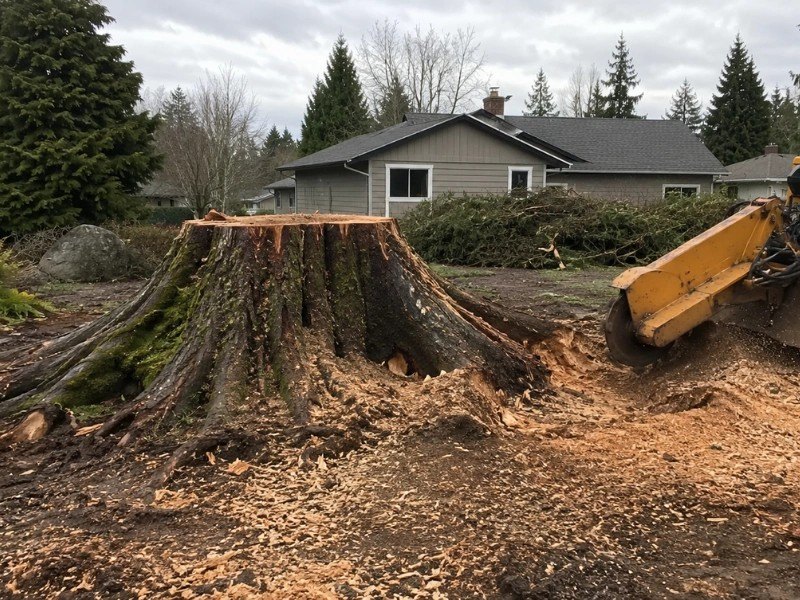
Snohomish’s evergreen stump profile. The concentration of mature Douglas fir and Western red cedar on residential properties in Snohomish means stump grinding here skews toward large-diameter, high-density work more than in communities where ornamentals dominate. Equipment that handles a 12-inch ornamental cherry stump in a few minutes will take significantly longer on a 40-inch buttress-flanged fir stump with a 5-foot visible root zone.
Root flare in alluvial soils. Snohomish’s alluvial soils develop extensive surface root systems on large conifers. The visible “grinding area” on a large fir is rarely limited to the trunk diameter — it includes the root flare buttresses, which can extend the effective working diameter by 50 to 100 percent for the largest trees.
Cedar preservation chemistry. Western red cedar’s natural preservatives make it the longest-persisting stump species in the Pacific Northwest. Homeowners who inherited a cedar stump from a removal done years ago and notice it still looks structurally intact are experiencing this chemistry directly. Grinding is the practical answer.
Stump grinding after storm damage. Many Snohomish stump grinding jobs follow storm removal — the same gap winds from the Skykomish Canyon that create emergency removal needs also leave stumps. For tree removal throughout Snohomish, see our tree removal guide for Snohomish.
Stump Grinding Near Snohomish: Where We Work
Tree Ninjas provides stump grinding throughout Snohomish and Snohomish County. Our crews regularly serve Snohomish and surrounding neighborhoods, Lake Stevens, Monroe and the Highway 2 corridor, and Everett.
For the full service area, see our Washington locations page.
Tree Ninjas provides free on-site estimates for stump grinding throughout Snohomish County.
Phone: (206) 601-9390 | treeninjaspnw.com/contact-us
Contact Tree Ninjas
Tree Ninjas
31524 NE Cherry Valley Rd
Duvall, WA 98019
Phone: (206) 601-9390
Hours: Available 24/7 for emergency service; office hours Monday through Friday, 8am to 5pm
Serving Snohomish, Lake Stevens, Monroe, Everett, and surrounding Snohomish County and King County communities.
