When Should a Tree Be Removed in Duvall, WA?
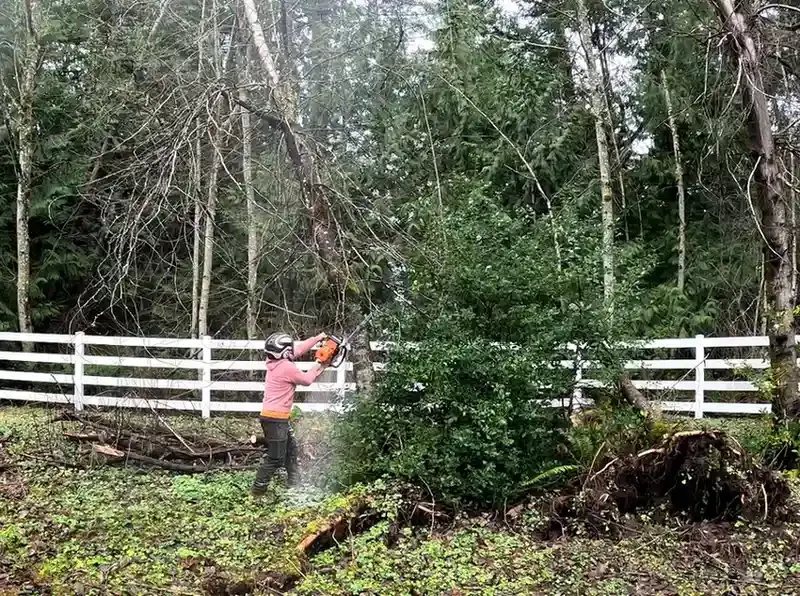
A tree should be removed in Duvall, WA when it poses a structural hazard, shows irreversible decline, or has died. The threshold is risk, not just health — many unhealthy trees can be managed with pruning, while some structurally sound trees must be removed due to location conflicts. Tree Ninjas provides free on-site assessments throughout Duvall and surrounding King County communities.
By Daniel Montgomery, Co-Founder, Tree Ninjas · Last updated August 2026
Key Takeaways
Duvall tree removal typically costs $400 to $2,200; large trees and crane work run significantly higher.
Duvall’s tree permit (DMC 14.40) applies to trees 10 inches DBH or larger on developed lots.
Homeowners insurance covers removal when a tree damages an insured structure, not preventive removal.
Safe large tree removal works top-down in controlled sections with rigging on every major cut.
Duvall’s Cherry Valley Road corridor grows some of the largest Douglas firs and Western red cedars in the Snoqualmie River valley — and the same conditions that produce those trees create the hazard conditions that eventually require removal. Root plate failure in saturated alluvial soils, included bark in fast-growing codominant stems, and progressive crown decline are the three removal drivers we address most often in Duvall.
Six indicators a Duvall tree may need removal:
Confirmed dead: brown needles clinging to a conifer, no leaf buds by April on a deciduous tree, or a scratch test showing brown dry inner wood
Advanced codominant stems: two competing leaders of equal or near-equal diameter with included bark visibly forming; pruning can no longer address the structural risk
Root plate heaving or new lean: a tree that has changed its lean, or where soil is humping at the base — root plate failure beginning in Cherry Valley’s saturated clay-loam soils
Major crown loss: more than 50 percent of live crown lost to storm, disease, or lightning; the remaining structure cannot sustain the tree long-term
Active structural decay: large fungal conks emerging from the trunk or major root zones; these indicate internal wood decay that has progressed well beyond the surface
Location conflict: encroachment on the foundation, septic field, or utility lines that cannot be resolved with pruning — particularly common along the PSE corridor on Cherry Valley Road
How Much Does Tree Removal Cost in Duvall?
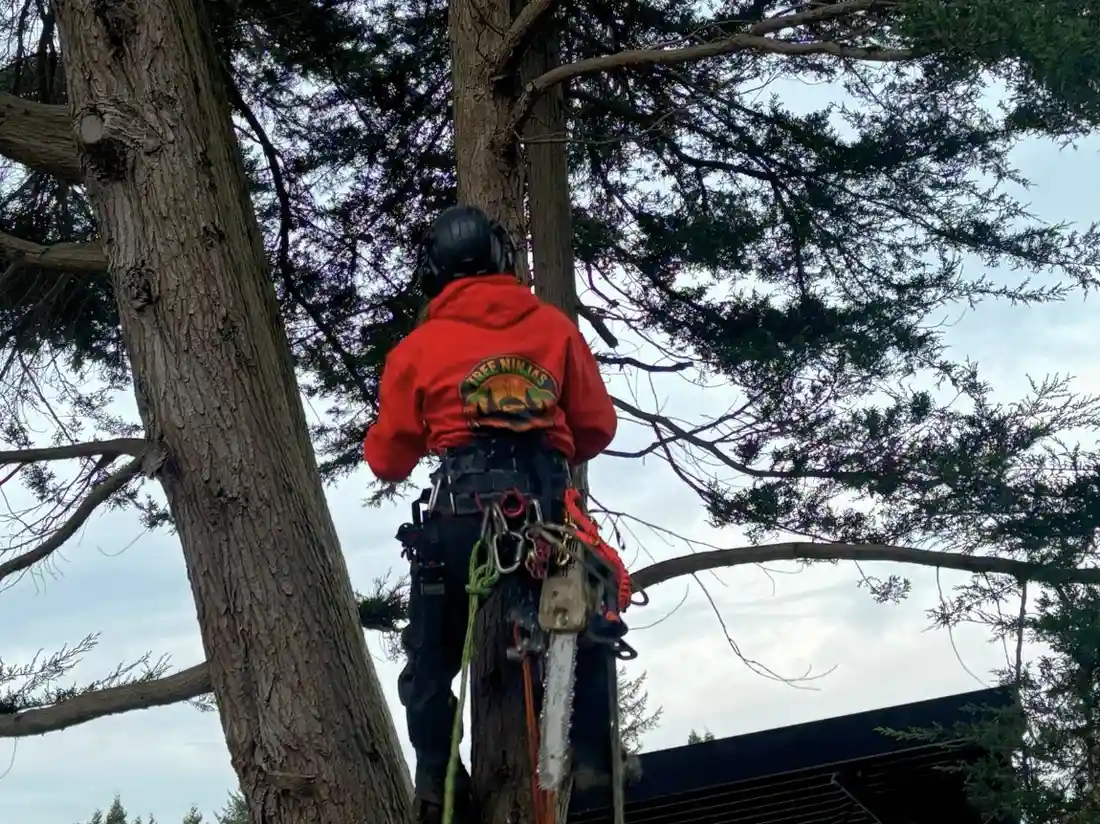
Tree removal in Duvall typically costs between $400 and $2,200 for standard residential trees. Large trees — 60 feet and over — run $1,200 to $3,500. Crane-required removals and very large trees near structures cost $3,000 to $7,000 or more. Tree Ninjas provides free on-site estimates throughout Duvall, Carnation, Cottage Lake, and surrounding King County.
What drives cost in Duvall:
Tree size and height: a 90-foot Douglas fir requires fundamentally different equipment than a 30-foot ornamental cherry
Proximity to structures: a tree over a roofline requires precision sectional work and often crane assistance, adding significantly to cost
Site access: narrow driveways, outbuildings, or fenced Cherry Valley Road yards can limit equipment staging; crane positioning may require road coordination
Wood condition: dead conifers with deteriorated wood require extra care at each cut because brittle wood behaves unpredictably
Stump grinding: typically quoted separately; add $150 to $400 depending on stump diameter
For a full breakdown by tree size and Duvall-specific crane logistics, see our large tree removal guide for Duvall.
Do I Need a Permit to Remove a Tree in Duvall?
Yes, for most trees on developed lots within Duvall city limits. Duvall’s tree preservation ordinance.
Yes, for most trees on developed lots within Duvall city limits. Duvall’s tree preservation ordinance (Duvall Municipal Code Chapter 14.40) requires a permit to remove any tree 10 inches or more in diameter at breast height.
Key rules under DMC Chapter 14.40:
10-inch DBH threshold: applies to all trees 10 inches or larger on developed residential lots within city limits
Two-tree annual allowance: homeowners may remove up to two significant trees per calendar year without replacement; additional trees require replacement planting
Imminent hazard exception: a tree posing immediate danger may be removed without a permit; document the situation and notify the city afterward
Red alder exemption: red alder is generally exempt from the permit requirement regardless of size
Contact: duvallwa.gov/441/Tree-Removal
Outside Duvall city limits: properties in unincorporated King County follow different rules. Most standard residential tree removal on developed parcels does not require a permit, though critical areas (wetlands, steep slopes, Type 2 streams) trigger additional county review. Tree Ninjas handles permit documentation as part of the removal process for Duvall city properties.
Does Insurance Cover Tree Removal in Washington?
Whether homeowners insurance covers tree removal in Duvall depends on what happened before the removal — specifically, whether the tree caused damage to an insured structure.
What is typically covered:
A tree falls on your home, garage, or fence during a storm: structural damage and debris removal are covered under dwelling and other structures coverage, up to your policy’s per-tree debris removal limit (typically $500 to $1,000)
A neighbor’s healthy tree falls on your structure in a storm: your insurance covers your structure; a healthy tree falling in a storm is generally not the neighbor’s liability under Washington case law (Gostina v. Ryland, 116 Wash. 228, 1921)
Vehicle damage from a falling tree: covered under comprehensive auto coverage
What is not covered:
Preventive removal: removing a standing dead, dying, or hazardous tree before it falls is not covered; this is maintenance, not loss
Fallen tree without structural damage: most policies do not cover debris removal when a tree falls without damaging an insured structure
Your tree falls on a neighbor’s property: your liability coverage applies if you were negligent — meaning you knew the tree was hazardous and failed to act
The known-hazard problem: if a tree that was visibly dead or documented as hazardous falls on a structure, the insurer may investigate and invoke a “negligence” or “known hazard” exclusion if they find evidence you were aware of the condition. A tree that has been confirmed dead, reported by a neighbor, or documented by an arborist as hazardous becomes a liability if left standing. Removing it proactively eliminates this risk.
How Do You Safely Remove a Large Tree?
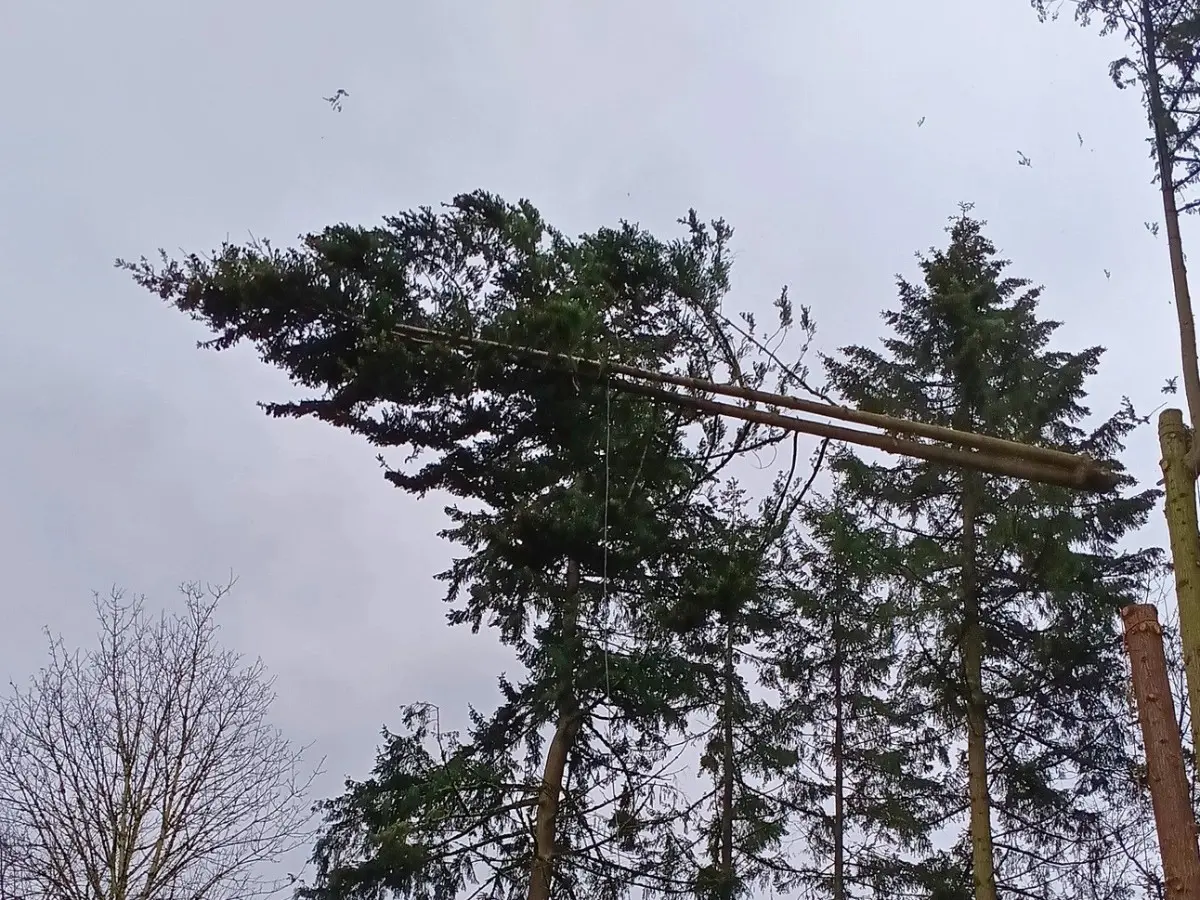
Safe large tree removal in Duvall follows a top-down, section-by-section sequence. No large tree should be directionally felled from the base in a residential setting — the fall zone of a 90-foot Douglas fir is rarely available on a Cherry Valley Road property, and the consequences of an error are significant.
Assessment and planning. The certified arborist evaluates height, wood condition, lean, root plate stability, proximity to structures and PSE utility lines, and equipment access options.
Site preparation. The work zone is cleared; drop zones and rigging points are established and communicated to the full crew.
Top-down crown work. The arborist begins at the top, removing widow-makers and clearing top sections before any work begins on the main stem. Removing hazardous overhead material first is non-negotiable.
Sectional trunk removal. Each trunk section is cut and lowered under controlled rigging tension; wood condition, rigging load, and landing zone are confirmed before each cut.
Stump cut. The trunk is brought to ground level; stump grinding is scheduled as a follow-up.
Cleanup. All branch material is chipped; log rounds are handled per your preference.
For a full breakdown of equipment, crane logistics, and species-specific considerations, see our large tree removal guide for Duvall.
Tree Removal in Duvall: Local Context
Cherry Valley Road soils and root plates. Duvall’s Snoqualmie River valley soils are deep alluvial clay-loam that hold moisture year-round. Root plates in these saturated conditions provide less lateral resistance than root plates in well-drained soils — which is why Cherry Valley trees can uproot at wind speeds that leave similar trees on drier ground standing. A tree showing early lean in spring should be assessed immediately, not in fall.
PSE utility corridor. Duvall is served by Puget Sound Energy (PSE), and the Cherry Valley Road corridor is one of the most active utility vegetation management zones in King County. Trees with significant encroachment are subject to PSE’s trimming cycles; some are better addressed through full removal than repeated utility trimming. PSE tree trimming resources: pse.com/en/pages/tree-trimming.
Historic downtown. Duvall’s established neighborhoods have mature ornamental trees on narrow lots adjacent to historic structures. These removals require the same crane logistics and precision rigging as any complex Cherry Valley removal, regardless of the tree’s size.
Tree Removal Near Duvall: Where We Work
Tree Ninjas handles tree removal throughout Duvall and the Snoqualmie Valley. Our crews regularly serve Duvall, Carnation, Cottage Lake, and Redmond.
For the full list, see our Washington locations page.
Get a Free Tree Removal Estimate in Duvall
Every removal is site-specific. Height, condition, access, and proximity to structures all determine scope and cost. Tree Ninjas provides free on-site estimates for tree removal throughout Duvall and King County.
Call or text: (206) 601-9390
Or request a quote at treeninjaspnw.com/contact-us. For urgent or after-hours situations, call or text any time — Tree Ninjas provides 24/7 emergency response throughout Duvall and King County.
Contact Tree Ninjas
Tree Ninjas
31524 NE Cherry Valley Rd
Duvall, WA 98019
Phone: (206) 601-9390
Hours: Available 24/7 for emergency service; office hours Monday through Friday, 8am to 5pm
Serving Duvall, Carnation, Cottage Lake, Redmond, and surrounding King County and Snohomish County communities.
