Who Handles Tree Removal Near Me in Redmond, WA?
Searching Tree removal near me and wondering who removes trees near me around here? Someone who checks the tree's diameter before quoting a price. Redmond regulates tree removal more tightly than most Eastside cities, and the trees homeowners most want gone — mature Douglas firs looming over a roofline — are precisely the ones the city protects hardest.
By Daniel Montgomery, Co-Founder, Tree Ninjas · Last updated September 7, 2026
What Permits Does Redmond Require?
Do you need a permit to remove a tree in Redmond? Yes, in most cases — and the answer is stricter than people expect.
Under Redmond Zoning Code 21.72.020, owners of developed single-family lots must obtain a permit before removing any significant tree, and each lot is allowed only a maximum number of removals per year. This isn't a formality you discover afterwards; it's a permit that comes first.
Then there's a second tier. A Landmark tree is a significant tree greater than 30 inches in diameter measured at 4.5 feet above grade. Under RZC 21.72.060, landmark trees shall not be removed unless an exception has been applied for and granted — so that's a Tree Exception Request rather than a routine permit, and it requires an arborist report and/or photo documentation.
A Tree Exception Request is also needed if you want to exceed your lot's annual maximum, or if the proposal doesn't meet the RZC 21.72 standards.
Two things that are genuinely off-limits without more work: trees inside a Native Growth Protection Area or otherwise designated for protection cannot be removed unless they're determined hazardous.
Confirm your specific situation against the City's own tree removal guidance, or with Redmond's Development Services Center at 15670 NE 85th Street or on 425-556-2494, before committing to anything. Rules change and your lot may carry designations you don't know about.
Why Are Large Douglas Firs the Hardest Case?
Because 30 inches of diameter isn't a big tree here — it's a normal mature conifer.
Thirty inches DBH is roughly a 94-inch circumference, which a healthy Douglas fir on the Eastside reaches comfortably. So the practical consequence is this: the mature fir you're worried about is very likely a Landmark tree, which means an Exception with an arborist report rather than a straightforward permit. Anyone searching for which tree service near me removes large Douglas firs should hear that before they hear a price.
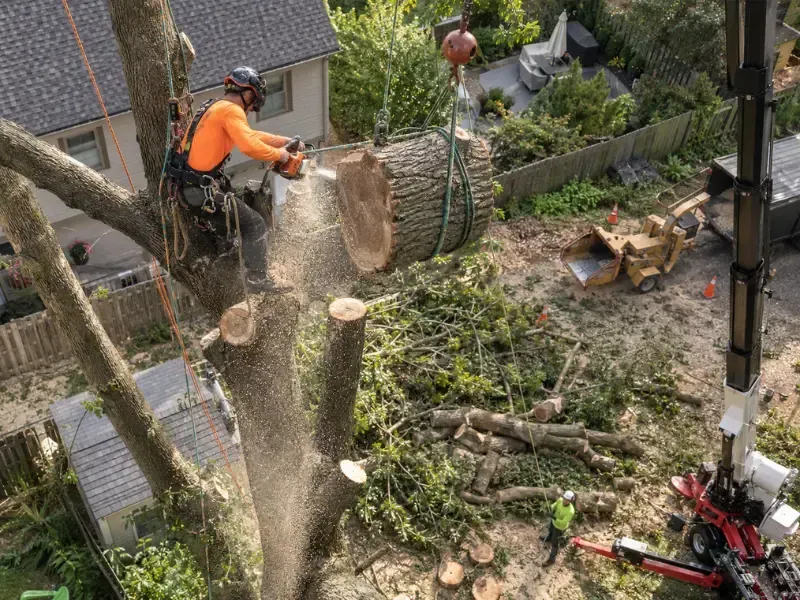
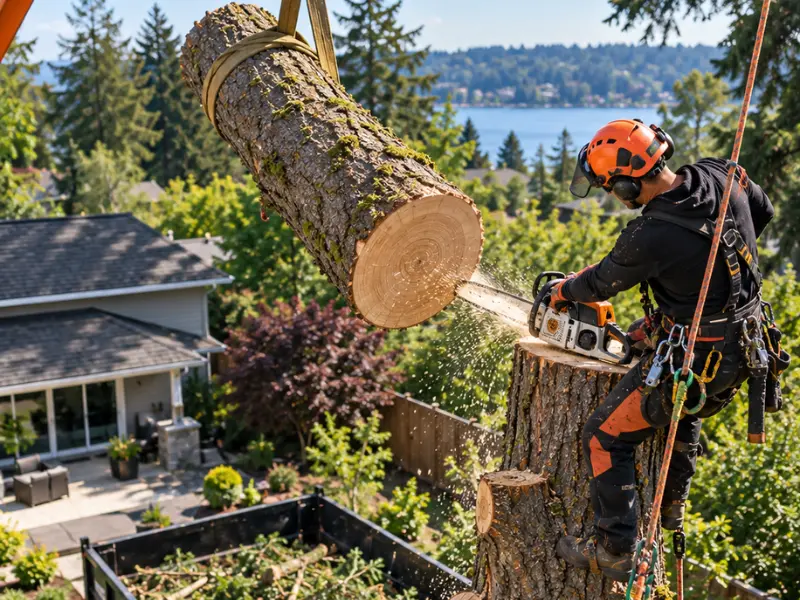
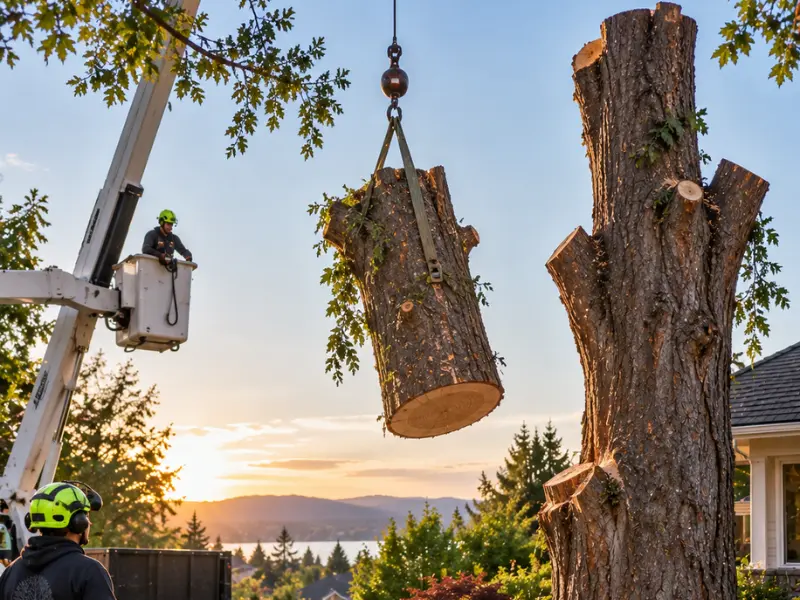
The physical job is different too. Large conifer removal Seattle Eastside WA properties require isn't felling — there's rarely a safe drop zone beside a house. It's sectional dismantling: climbing or accessing the stem, taking it down in controlled pieces, and rigging each piece to the ground rather than letting it fall. That takes longer, needs more equipment and more skill, and costs accordingly.
Which is why a quote for "a big tree" that arrives without anyone looking at the drop zone, the access, or the diameter isn't really a quote.
When Does a Hazard Tree Change the Process?
This is the route most homeowners actually need, and it has its own paperwork.
Redmond requires a Hazard Tree Removal Declaration form for hazardous trees, including a tree health assessment completed by a certified arborist, submitted to and reviewed by the City before removal. In place of a full arborist report, staff may accept photographs of a tree that is dead, dying or diseased.
The important part for a homeowner: hazardous, dead or otherwise dangerous trees are not counted against your annual removal limit. So a genuinely failing tree doesn't consume the allowance you might want for something else.
But note the sequence — assessment and City review come before removal, not after. Which means a leaning tree that isn't actively falling is a paperwork job first, and a same-day removal on a healthy tree because it "looks dangerous" is the thing that creates problems.
What About Storm Damage and Emergencies?
Windstorms are the Eastside's defining tree event, and they change the calculus.
An actively dangerous situation — a tree down on a structure, a stem split and hanging, a limb resting on a service line — is a different category from a planned removal. Redmond's code contemplates imminently dangerous situations, and the practical order of operations is: make it safe, document everything with photographs before anything moves, then deal with the permitting.
Photograph it before you clear it. That's the single most useful thing you can do, for the City process and for an insurance claim.
Three safety points that matter more than speed. Anything touching or near a power line is the utility's call, not a tree crew's — call them first. A tree under tension or compression after a partial failure stores energy and does not behave like a standing tree. And a root plate that has lifted means the tree is no longer anchored, whatever it looks like from the street.
Emergency tree removal King County WA homeowners need after a storm is triage: stabilise, document, then schedule the full removal properly.
What Credentials Should You Check?
Two separate things, and both are checkable.
Contractor registration. Washington requires construction contractors to register with Labor & Industries, and the state's Verify a Contractor tool is free and shows whether registration is active right now, the bond, liability insurance, and — the one that matters most to you — the workers' compensation account. Tree work is genuinely high-hazard, and an uninsured injury in your garden does not stay someone else's problem.
Arborist certification. This is separate from registration and it isn't decorative in Redmond, because the City's hazard tree process specifically requires an assessment by a certified arborist. The recognised credential is the ISA Certified Arborist, awarded by the International Society of Arboriculture, which maintains a public registry you can search by name.
So the useful question isn't "are you certified?" but "which certification, held by whom, and what's the number?" — because it's the certificate that signs the report your permit application depends on.
How Much Does Tree Removal Cost?
How much does tree removal cost comes down to five things, and species is barely one of them.
Size, chiefly diameter and height. Access — whether equipment can reach the tree or everything is carried by hand. Targets — what's underneath, since a tree over a lawn is felled and a tree over a roof is dismantled piece by piece. Condition, because a dead or compromised stem can't be safely climbed and may need different equipment. And cleanup scope: chip and haul, leave rounds for firewood, and stump grinding are separate decisions.
How much does it cost to remove a large tree in Washington is therefore a wide range rather than a figure, and any quote given over the phone for a mature conifer beside a house is a guess. Add the permit or Exception process, and an arborist report where one is required.
We offer free estimates, and for tree removal Redmond WA homeowners are planning, that means someone actually looking at the drop zone and measuring the trunk.
Serving Redmond, Duvall, Sammamish, Bellevue, Carnation, Issaquah and the wider Eastside — see our tree removal service page, locations including Redmond, completed work in the portfolio, and more about us.
If you're comparing the best tree removal company near Redmond WA, or wondering who does emergency tree removal on the Seattle Eastside, ask one question first: is my tree over 30 inches across? Everything else follows from that.
Frequently Asked Questions
1. How much does tree removal cost in the Redmond area?
Five factors: size, particularly diameter and height; access, meaning whether equipment can reach the tree or material is carried by hand; what sits underneath, since a tree over open lawn can be felled while one over a roof must be dismantled in rigged sections; the tree's condition, because a dead stem may not be safely climbable; and how much cleanup you want, with chipping, leaving rounds, and stump grinding all priced separately. Add the Redmond permit or Exception process, plus an arborist report where required. Estimates are free.
2. Do you offer free tree removal estimates?
Yes. For anything substantial that means an on-site visit rather than a phone figure, because the things that drive the price — trunk diameter, what's beneath the canopy, whether equipment can reach the tree, and the state of the stem — can't be assessed from a description. On a mature conifer we'll also measure the diameter at 4.5 feet, since that single measurement determines whether Redmond treats it as a significant tree or a Landmark tree, and the permitting route differs.
3. Do I need a permit to remove a tree in Redmond?
For most trees, yes. Redmond Zoning Code 21.72.020 requires owners of developed single-family lots to obtain a permit before removing any significant tree, with a maximum number of removals allowed per lot each year. If the tree exceeds 30 inches in diameter at 4.5 feet it's a Landmark tree, and RZC 21.72.060 provides that landmark trees shall not be removed unless an exception has been applied for and granted. Trees in Native Growth Protection Areas cannot be removed unless hazardous. Confirm your property with Development Services on 425-556-2494.
4. Do you offer 24/7 emergency tree removal after windstorms?
Storm response is triage rather than a standard removal: make the situation safe, photograph everything before anything is moved, then handle permitting and the full removal properly afterwards. Three things take priority over speed — anything touching or near a power line is the utility's call and they should be contacted first; a partially failed stem under tension stores energy and won't behave like a standing tree; and a lifted root plate means the tree is no longer anchored regardless of how it looks. Call to describe what's happened rather than booking online.
5. Are you an ISA Certified Arborist, licensed, and insured?
Two distinct things worth checking on any tree company. Contractor registration with Washington Labor & Industries, verifiable free through the state lookup, which shows active status, bond, liability insurance and the workers' compensation account — that last one matters because tree work is high-hazard and an uninsured injury on your property doesn't stay the contractor's problem. Separately, arborist certification: the ISA Certified Arborist credential is issued by the International Society of Arboriculture and searchable in a public registry. It matters practically in Redmond, because the City's hazard tree declaration requires an assessment by a certified arborist.
Contact Tree Ninjas
Tree Ninjas 31524 NE Cherry Valley Rd Phone: (206) 601-9390 Email: [email protected] Serving Redmond, Duvall, Sammamish, Bellevue, Carnation, Issaquah and the Greater Seattle area. Locally owned, licensed, bonded and insured.
Got a big fir over the house? Get a free estimate or call (206) 601-9390 — we'll measure the trunk and tell you which Redmond process applies before we talk price.
