How Much Does Tree Removal Cost in Snohomish, WA?
Tree removal in Snohomish, WA typically costs $400 to $2,200 for standard residential trees, with large conifers and crane-required work running $1,200 to $5,000 or more. Cost depends on tree size, proximity to structures, and site access. Tree Ninjas handles tree removal throughout Snohomish and Snohomish County — including emergency, hazardous, large, and dead tree removals.
By Daniel Montgomery, Co-Founder, Tree Ninjas · Last updated August 2026
Key Takeaways
Tree removal in Snohomish costs $400 to $2,200 for standard trees; large work runs significantly higher.
Dead and hazardous trees are exempt from City of Snohomish permit requirements under SMC 14.120.
Trees cause nearly half of all Snohomish County power outages; hazardous removal protects your home.
Tree Ninjas provides 24/7 emergency tree removal throughout Snohomish and Snohomish County.
Snohomish presents a specific combination of tree removal challenges: a historic downtown with mature ornamentals on narrow Victorian-era lots, river bluff properties where steep terrain limits equipment access, second-growth Douglas fir and Western red cedar that regularly reach 80 to 120 feet at maturity, and an active SnoPUD utility corridor where trees account for nearly half of all power outages annually. This guide covers the most common tree removal questions for Snohomish homeowners.
Tree removal cost breakdown for Snohomish, WA:
Standard residential tree (under 60 feet): $400 to $2,200 for most accessible removal jobs
Large conifer (60 to 100 feet): $1,200 to $3,500 for Douglas fir, Western red cedar, and western hemlock
Very large or crane-required: $3,000 to $5,000 or more for mature conifers near structures, river bluff properties, or historic district narrow-lot removals
Emergency/after-hours premium: 50 to 100 percent above standard rates for immediate response
Stump grinding: typically quoted separately; add $150 to $400 depending on stump diameter
When Is a Tree Hazardous Enough to Remove in Snohomish?
A tree should be removed when its structural condition, location, or site context creates risk that cannot be managed through pruning or monitoring. In Snohomish, the hazard threshold is driven more often by structural defects than by disease alone — Douglas fir’s narrow root plates and Snohomish County’s saturated alluvial soils mean structural failure risk is higher here than in drier regions.
Six indicators that a Snohomish tree is hazardous enough to remove:
Dead or confirmed dying: brown needles clinging to a conifer, no leaf buds by April on a deciduous tree, or a scratch test showing brown dry inner wood
Advanced codominant stems: two competing leaders of equal diameter with included bark forming between them; pruning cannot correct this at an advanced stage
Significant lean or root plate change: a tree that has leaned noticeably within a season, or soil humping at the base indicating root plate movement in Snohomish County’s wet clay soils
Active structural decay: large fungal conks emerging from the trunk or major root zones; indicate internal wood decay well into the structural core
Major crown failure: loss of more than 50 percent of live crown to storm, lightning, or disease
Location conflict: the tree is positioned over a structure, within fall distance of occupied space, or interfering with SnoPUD distribution lines in a way that cannot be resolved through trimming
For a comprehensive guide to hazard tree warning signs and the specific structural failure patterns common in Snohomish County, see our hazardous tree removal guide for Snohomish.
Do I Need a Permit to Remove a Tree in Snohomish?
Permit requirements depend on whether you are within the City of Snohomish city limits or in unincorporated Snohomish County — and whether the tree is dead or hazardous.
City of Snohomish (SMC Chapter 14.120): the city’s tree preservation standards apply to tree removal within city limits. Hazardous, dead, or dying trees can be removed through a Hazard Tree declaration with certified arborist documentation. For significant healthy trees, a permit application may be required. Contact City of Snohomish Planning at 360-282-3167 or [email protected] to confirm requirements.
Unincorporated Snohomish County (SCC 30.91H.040): a hazardous tree can be removed without a permit even in critical areas. A TRAQ-qualified arborist letter is recommended when the tree is in an NGPA or CAPA to document the hazard condition.
Tree Ninjas provides certified arborist documentation for city hazard declarations and county removals as part of the removal process. For full permit detail see our hazardous tree removal guide.
Can You Remove Large Firs and Cedars Near the House in Snohomish?
Yes — removing large Douglas firs and Western red cedars in close proximity to Snohomish homes is core work for Tree Ninjas, and it requires a different approach than removing a tree in an open space.
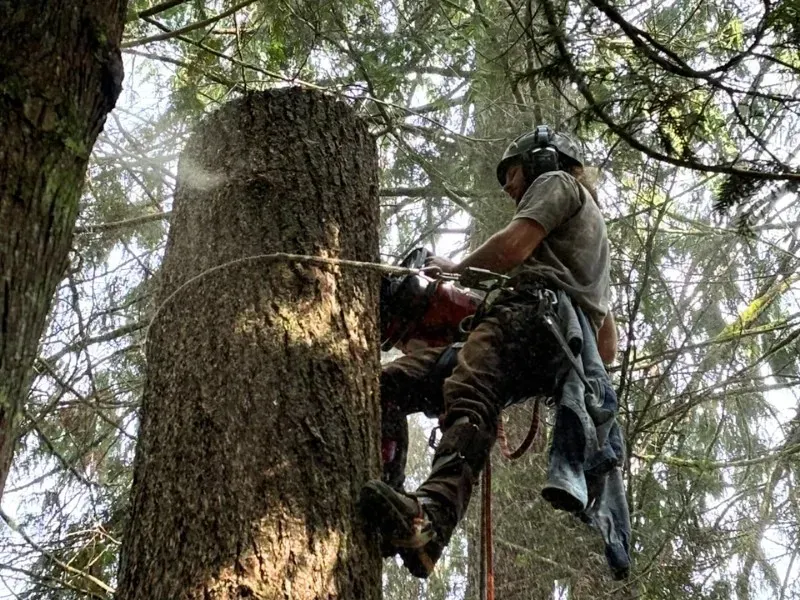
Douglas fir at 80 to 100 feet cannot be directionally felled when a structure is nearby. The removal is done from the top down in controlled sections, with each section rigged and lowered before the next cut is made. For very large trees positioned directly over or within fall distance of a structure, crane-assisted removal is the most controlled method.
Snohomish-specific factors for large conifer removal:
River bluff terrain: limited crane access and steep fall zones below; more planning required than equivalent removals on flat ground
Historic district narrow lots: removing a large ornamental or conifer from a narrow First Street lot requires road coordination, sometimes including temporary lane closures for crane placement
Dead conifer caution: Snohomish’s moist climate means dead Douglas firs can hold their needles for one to three years after death, appearing structurally sound while having brittle, punky wood throughout; these removals require extra care at every cut
SnoPUD line proximity: trees within fall distance of SnoPUD distribution lines require additional planning and sometimes utility coordination before work begins
For a full breakdown of the removal process, cost ranges by size, and equipment specifics, see our large tree removal guide for Snohomish.
Do You Offer Emergency Storm Tree Removal in Snohomish?
Yes. Tree Ninjas provides 24/7 emergency tree removal throughout Snohomish and Snohomish County. Snohomish’s position in the eastern Puget Sound region means it receives both Pacific frontal storm systems and periodically high winds from the Cascade foothills — producing multiple high-risk wind events each year between November and March.
What to do when a storm drops a tree in Snohomish:
Tree or large branch on or near a SnoPUD power line: call 911 immediately; dispatchers have a direct link to SnoPUD’s 24/7 line crew. Maintain at least 30 feet of clearance from any downed line.
Tree fallen on a structure: secure the interior from weather and contact Tree Ninjas for emergency removal assessment. Do not attempt to cut sections of a tree loading a roof — the structural dynamics change with each cut.
Tree partially failed or leaning against a structure: the most time-sensitive situation; a partially leaning tree has unpredictable failure timing and should be treated as an emergency.
SnoPUD reports that trees cause nearly half of all power outages in their service area annually. Pre-storm crown cleaning and hazard tree removal are the most effective mitigation available.
For full emergency service information, see our 24/7 emergency tree service guide and storm damage tree removal guide.
Why Tree Removal in Snohomish Is Different
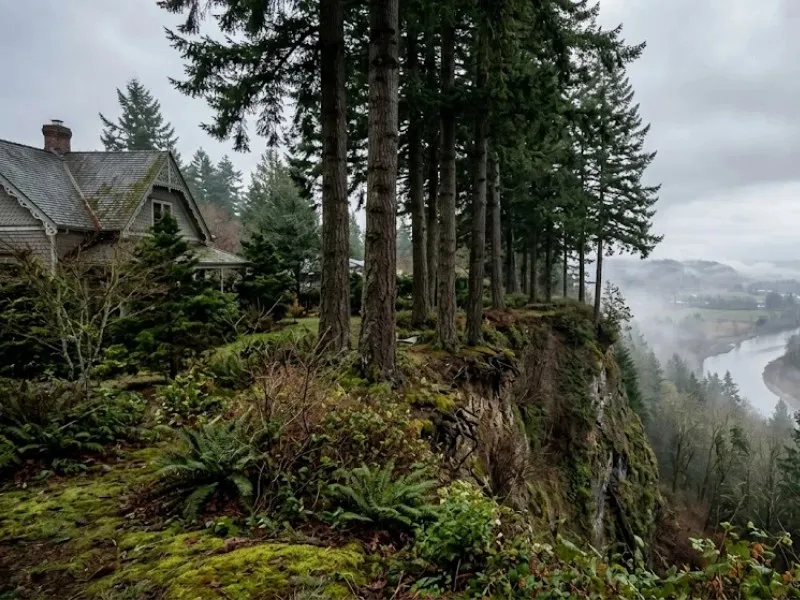
The river bluff. Snohomish sits on a bluff above the Snohomish River at its confluence with the Pilchuck Creek. Properties on or near the bluff face equipment access limitations that flat Puget Sound lots don’t: crane outriggers need stable, level ground that the bluff terrain often doesn’t provide; steep slopes below increase the consequence of any uncontrolled drop. Bluff-adjacent jobs require more planning and typically more cost than equivalent removals elsewhere.
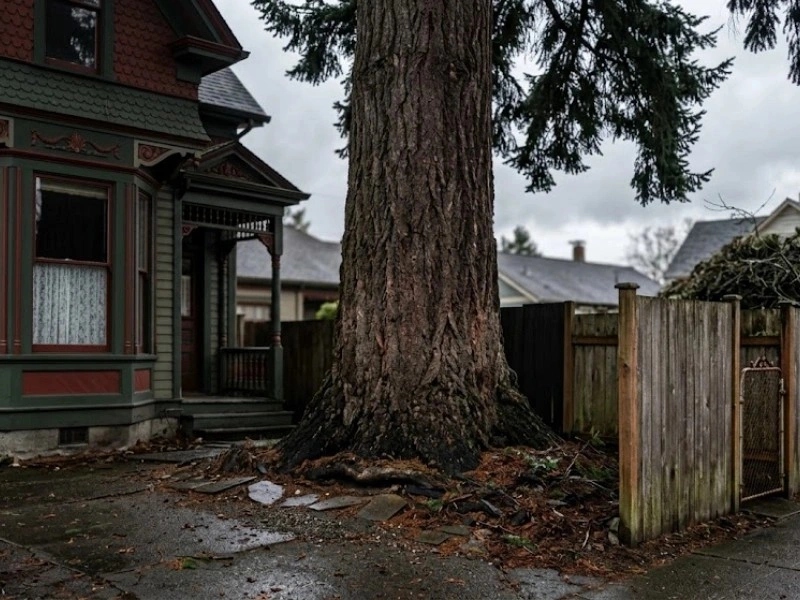
The historic district. Downtown Snohomish’s Victorian-era neighborhood has mature ornamental trees — many approaching end of natural lifespan — on narrow lots directly adjacent to century-old structures. Removing a 60-foot ornamental from a narrow First Street lot is crane-and-precision work regardless of size. Road closure applications, period-sensitive landscaping, and adjacent structure clearances add time and planning to jobs that would be simple in a rural setting.
SnoPUD utility territory. Snohomish is served by Snohomish County PUD (SnoPUD), not PSE. SnoPUD trims approximately 500 miles of line per year specifically because of tree-related outage risk. Trees within fall distance of SnoPUD distribution lines require identification before any removal work begins; in some cases SnoPUD involvement is required to de-energize sections or provide protective equipment for the work zone.
Tree Removal Near Snohomish: Where We Work
Tree Ninjas provides tree removal throughout Snohomish and Snohomish County. Our crews regularly serve Snohomish and surrounding neighborhoods, Lake Stevens, Monroe and the Highway 2 corridor, and Everett.
For the full service area, see our Washington locations page.
Get a Free Tree Removal Estimate in Snohomish
Tree height, wood condition, proximity to structures, and SnoPUD line clearance all affect scope and cost. Tree Ninjas provides free on-site estimates for tree removal throughout Snohomish and Snohomish County.
Call or text: (206) 601-9390
Or request a quote at treeninjaspnw.com/contact-us. For urgent or after-hours situations, call or text any time — Tree Ninjas provides 24/7 emergency response throughout Snohomish and Snohomish County.
Contact Tree Ninjas
Tree Ninjas
31524 NE Cherry Valley Rd
Duvall, WA 98019
Phone: (206) 601-9390
Hours: Available 24/7 for emergency service; office hours Monday through Friday, 8am to 5pm
Serving Snohomish, Lake Stevens, Monroe, Everett, Mukilteo, and surrounding Snohomish County and King County communities.
