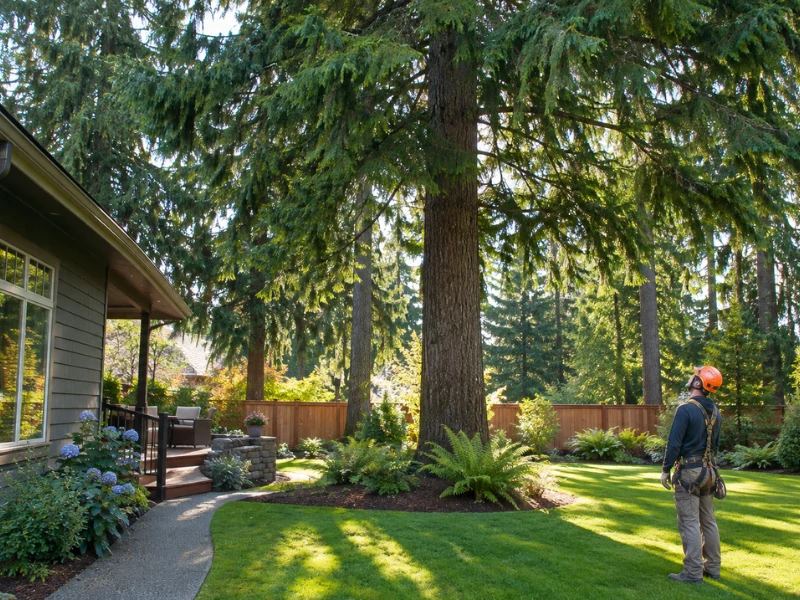
How Can Tree Trimming Bring Light Into A Shaded Yard?
Tree trimming brings light into a shaded yard by taking out the right branches in the right places, not by hacking a tree back. Most of the time, that means thinning the crown, lifting the lowest limbs or opening a window toward the sun. Big firs and cedars keep a lot of Eastside yards in shade all year. So for tree trimming in Redmond, WA, a careful plan can make a real difference without harming the trees you love.
By Daniel Montgomery, Co-Founder, Tree Ninjas · Last updated November 20, 2026
Why do conifer yards around Redmond stay so dark?
They stay dark because evergreens block light all year, and our winter sun barely clears the treetops. A maple lets the sun through once its leaves drop. A Douglas fir or western red cedar never takes a break.
A few local things make it worse:
Tall trees right by the house. A lot of Eastside lots were carved out of second-growth forest. Huge firs often stand just a few yards off the back deck.
That low winter sun. In December, the sun hangs low in the southern sky. Even a tree well south of your yard can throw a long shadow right across it.
Thick, layered canopies. Firs and cedars hold their needles in dense layers, and very little light filters through the middle.
The neighbour's trees. Quite often, the tree doing the most shading isn't even on your lot.
Shade brings side effects, too. Lawns thin out and moss moves in, flower beds stay soggy and the slugs love it, and roofs and decks go green faster. So more light usually pays off in more ways than a sunnier patio.
Before anyone cuts anything, spend a day or two watching where the shadows fall. Check the morning, midday and late afternoon. You might be surprised. The worst offender often isn't the tree you'd have pointed at.
What does trimming for light actually change?
Trimming for light changes how sunlight reaches the ground, either by letting it through the crown or by letting it sneak in underneath. Each technique does a different job, so the right one depends on where your light is coming from.
Technique | What it does | Best for | Limits |
|---|---|---|---|
Crown thinning | Removes selected inner branches so light filters through | Dense broadleaf trees and some conifers | Small gains on very dense conifers |
Crown raising | Removes the lowest limbs so light slants in underneath | Low winter sun, lawns, patios, walkways | Must leave plenty of live crown above |
Windowing | Opens a gap through part of the crown | A view or a specific patch of sun | Needs careful branch selection to look natural |
Crown cleaning | Removes dead, dying and broken branches | Every tree, before anything else | Light gain is modest on its own |
The USDA Forest Service guide How to Prune Trees describes crown thinning as a way to increase light penetration and air movement through the crown. On a dense fir, though, thinning by itself rarely lights up a whole lawn. That's why the best results usually come from pairing a light thin with a lift. It beats taking a lot out of any one part of the tree.
Want a clear plan for a shaded yard?
Call: (206) 736-3757
WA License: TREENNL752Q1
Free estimates on trimming and pruning
When does crown raising and limbing up help more than thinning?
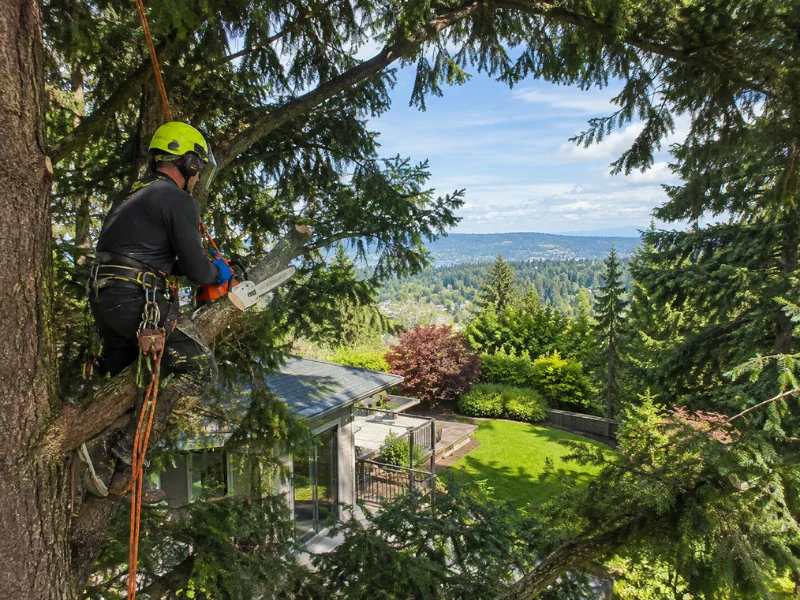
Crown raising and limbing up help most when the sun comes in low. That's pretty much what we get from fall through spring. Take off the lowest limbs, and that slanting light can finally reach the ground under the canopy.
Lifting the crown fixes some everyday annoyances as well:
clearance over driveways, roofs, sidewalks and play areas
airflow for lawns and beds that never seem to dry out
sightlines from the windows and across the yard
Still, there's a limit to how far you can go. The same USDA guide says that after crown raising, the living crown should still make up at least two-thirds of the tree's total height. On a 90-foot fir, that means green branches should still reach down to around 30 feet. So a big lift usually happens in stages over a few years, not in one go.
Conifers also lean on their lower limbs more than most people realise. Those branches help taper and strengthen the trunk. Lift a tree too high, too fast, and it can end up top-heavy right when our winter windstorms roll in.
Can opening a view be done without harming the tree?
Yes, opening a view is often possible, as long as the work is selective and not drastic. We get asked all the time whether you can trim a tree to improve a view. Usually the honest answer is "partly", and partly tends to be enough.
A responsible view trim leans on three tools:
Windowing takes out a few chosen branches to frame the view through the crown.
Thinning along the view line makes the canopy feel lighter without changing the tree's shape.
Lifting clears the bottom of the sightline, which often opens up more than people expect.
One thing we won't do is top a tree. Topping chops big upright stems back to stubs, and the USDA guide flags it as a harmful practice. It usually backfires anyway. A topped conifer sends up a bunch of weak new leaders that block the view all over again.
Redmond's tree code agrees. Under RZC 21.72.110, pruning protected trees has to follow arboricultural best practices. And excessive pruning isn't allowed unless it's needed to protect life and property. So any view plan has to work within what the tree, and the city, will put up with.
What if the view is blocked by a neighbour's tree?
Then start with a friendly chat, not a chainsaw. In Washington, you generally can't cut a neighbour's tree without their permission. A shared plan often goes over well, though. Plenty of neighbours are happy to have a tree thinned or lifted when someone else is organising it and the tree stays healthy. Just get the agreement in writing before the crew shows up, so everyone's on the same page.
How should a light or view trim be planned?
Plan it around the tree's health first and your goal second. Do it that way round, and the result lasts instead of fading after a season or two.
A sensible plan usually goes something like this:
Map the light or the view. Note where shade falls in winter and summer, and which branches block the sightline.
Pick the right trees. Sometimes trimming the neighbour's fir, with their blessing, does more than cutting your own.
Clean first. Dead and broken limbs come out before anything else, since they add nothing.
Combine techniques lightly. A modest thin plus a modest lift usually beats a heavy cut of either.
Stage the big changes. Spread a large lift or view opening over two or three years.
Timing matters too. The USDA guide notes that conifers can be pruned any time of year. Even so, dormant-season pruning can cut down on sap and resin flow. That's why late fall through winter is often a good window for light and view work on Eastside firs and cedars.
Once the work's done, give it a full season before you judge it. Light shifts a lot between November and May. The yard might look only a little brighter in winter, then noticeably sunnier by spring. Spring is also the right time to decide whether a second, smaller stage is worth it.
Where do we offer tree trimming around Redmond and Kirkland?
We offer tree trimming near Redmond and Kirkland, WA, and right across the Eastside. Light and view problems tend to be worst in older, heavily wooded neighbourhoods. Think Grass Lawn and Overlake in Redmond, or Finn Hill and Bridle Trails in Kirkland.
For more on the areas close by:
our Redmond tree services page covers Education Hill, Union Hill and the rest of the city
our Sammamish page covers the plateau east of Lake Sammamish
our Cottage Lake page covers bigger wooded lots north of Redmond
our Bellevue page covers homes to the south
You'll find the full range of services on our tree trimming and tree pruning pages. Good tree trimming should give a shaded yard its light back while keeping the trees that make the Eastside feel like the Eastside.
Frequently asked questions
1. The yard gets no sun - how much can actually be done about it?
Usually quite a lot, because the answer to how you let more light into a shaded yard is a mix of a light thin, a modest crown lift and clearing dead wood across the trees that cast the most shade. Letting light back into a yard shaded by large conifers won't turn it into a sunny meadow, but most yards pick up several extra hours of useful light, especially in spring and fall.
2. What is crown raising, and what does it change on the ground?
Crown raising removes a tree's lowest branches so the canopy starts higher up the trunk. On the ground, you get more slanting light under the tree, better airflow for lawns and beds, and more headroom over paths, driveways and patios.
3. How much can come off a mature conifer before it is too much?
As a rule, about a quarter of the live crown is the most that should come off in one season, and less on older or stressed trees. How much can be taken off a conifer safely also depends on where it comes from, because heavy cuts from the top or one side can throw the tree off balance.
4. Will the tree fill back in, and how quickly?
Thinned areas inside the crown fill back in slowly over three to five years as the remaining branches grow, so a light thin usually needs repeating. Lower limbs removed from a conifer don't grow back, which is why a lift gets planned carefully before any cuts are made.
5. Is removal sometimes the honest answer rather than more trimming?
Yes, when a tree is too close to the house, in poor health or would need so much cut that it becomes unstable, removal can be the safer and more honest choice. In Redmond, removing a significant tree usually needs a city permit and replacement planting, so it's worth checking before you decide.
Visit or Call Us
Tree Ninjas
Address: 31524 NE Cherry Valley Rd
Phone: (206) 736-3757
WA License: TREENNL752Q1
Licensed, bonded and insured tree service
Serving Redmond, Kirkland, Sammamish, Bellevue, Cottage Lake and the wider Eastside. Call for a free estimate, or use our contact page to book a visit.
