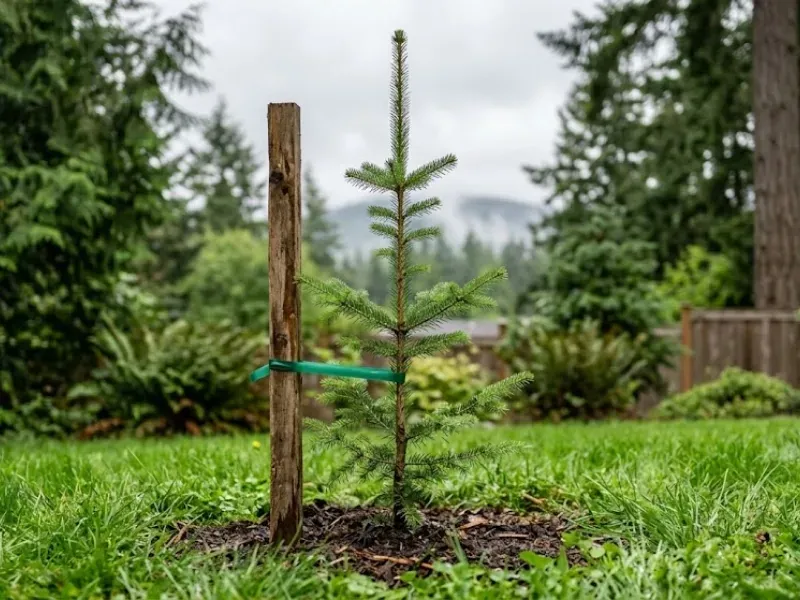
When Should You Start Training a Young Tree in Monroe, WA?
Young tree training is the practice of shaping a tree’s structure during its formative years through light, targeted cuts that direct growth before defects can form. In Monroe, WA, training should begin one to two years after planting, once the root system is established. Early training — selecting the central leader, establishing scaffold branch spacing, and removing competing growth — shapes permanent architecture while corrections are still small, inexpensive, and fully effective. Tree Ninjas provides young tree training throughout Monroe and Snohomish County.
By Daniel Montgomery, Co-Founder, Tree Ninjas · Last updated July 2026
Key Takeaways
Young tree training should begin one to two years after planting in Monroe, WA.
Scaffold selection and leader training benefit from a certified arborist; small branch removal can be DIY.
Monroe’s fast Skykomish Valley growth rates compress training windows compared to drier PNW regions.
Training every two to three years costs far less than corrective work on a mature tree later.
Young tree training is different from structural pruning — though the two are closely related. Structural pruning corrects problems that have already developed. Training shapes the tree before problems form, using very small cuts that direct the tree’s energy while it is most responsive. The first five to ten years after planting are the window when one or two arborist visits can determine the tree’s structural character for its entire life. In Monroe’s Skykomish Valley, where trees grow faster than in most Puget Sound communities, that window opens and closes more quickly than homeowners expect.
How Long Should You Train a Young Tree?
Active training typically spans five to ten years from the first training visit, with the most important decisions happening in the first three to five years. After that, the tree’s permanent scaffold is largely established and maintenance pruning replaces training. The specific duration varies by species and how quickly the tree develops.
Training timeline for common Monroe species:
Douglas fir and Western red cedar (years 1 to 7): conifers with a strong natural leader need relatively little training; mainly removing competing vertical growth that threatens the leader and clearing lowest scaffolds as the tree gains height
Big-leaf maple and ornamental maples (years 1 to 8): fast-growing, multi-stem-prone; the first three years set the form entirely; training involves leader selection, scaffold spacing, and suppressing the vigorous competing growth these species produce in Monroe’s moist climate
Ornamental fruit trees — apple, pear, cherry (years 1 to 10): the most training-intensive group, requiring annual or biannual attention in early years to develop either an open-center or central-leader form
After year ten: the scaffold is set; corrective work replaces training; the window for low-cost decisions has closed
A training visit on a two-to-three-year-old tree costs $150 to $300. The same structural correction on a twenty-year-old tree — if it can even be made — costs $500 to $1,200 or more. For more on what structural work looks like when training was skipped, see our structural pruning guide for Monroe.
Can I Train a Young Tree Myself?
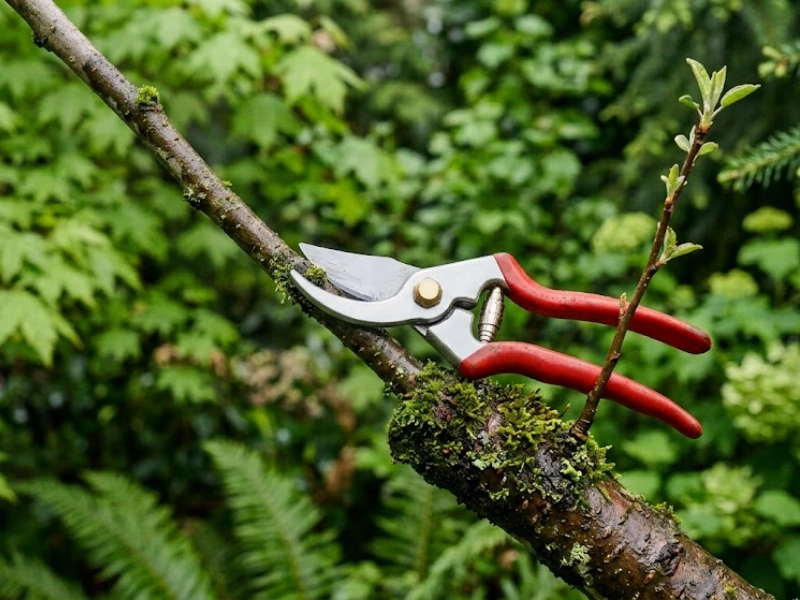
Some young tree training can be done by a knowledgeable homeowner — and some decisions should be left to a certified arborist. The distinction comes down to what the cut accomplishes and what happens if you get it wrong.
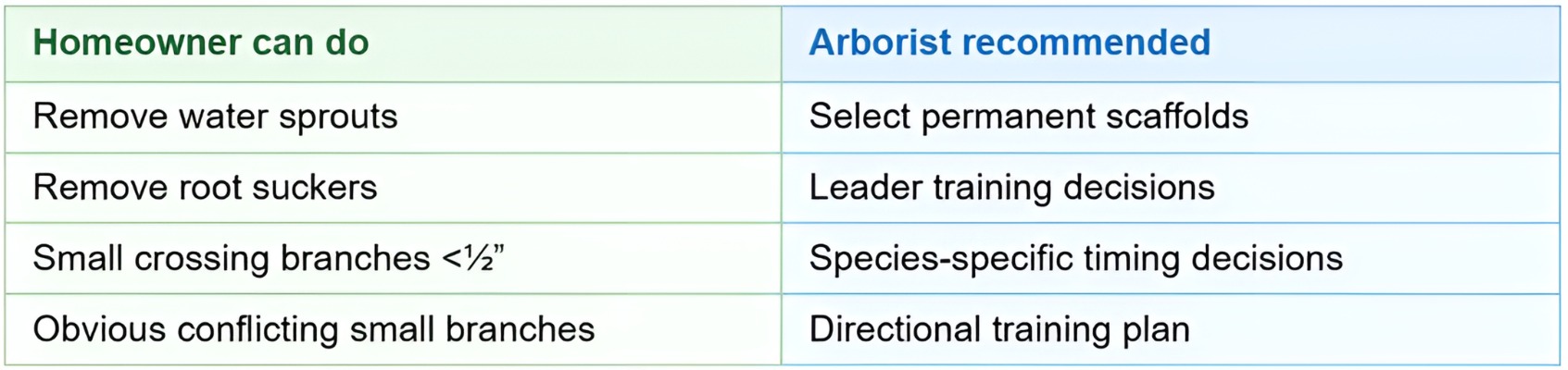
What homeowners can reasonably do on young trees:
Remove water sprouts: vigorous vertical shoots from scaffold branches; easy to identify, small in diameter; should be removed while young
Remove root suckers: shoots emerging from the soil at the tree’s base; remove by pulling rather than cutting where possible to discourage regrowth
Remove small crossing branches: under 1/2 inch diameter where two branches are rubbing
Remove branches growing toward structures: while under 1/2 inch diameter and clearly in conflict with the planting space
What benefits from a certified arborist:
Selecting permanent scaffold branches: which of the strong lateral branches on a young tree becomes a permanent scaffold is the most consequential decision in young tree training. A wrong choice at year three shows up as a structural problem at year twenty that cannot be undone.
Leader training decisions: whether the tree has a dominant leader, what to do if two leaders are competing, how to establish directionality
Species-specific timing and technique: stone fruits in Monroe require dry-summer-only pruning; ornamental maples have specific training requirements different from shade maples
What Tools Are Needed for Young Tree Training?
Young tree training uses lighter equipment than any other tree service — which is part of why the cost is low and the work can begin early.
The core toolkit for young tree training:
Bypass hand pruners: the primary tool; used for all branches under 1/2 inch diameter; bypass (not anvil) type because the blade passes cleanly through the branch without crushing tissue, which matters for wound compartmentalization; keep blades sharp and clean between trees
Lightweight loppers: for branches 1/2 to 1.5 inches; rarely needed on trees in their first three to four years; used more in years five through ten
Flexible tree ties: if the young tree needs directional guidance, flexible ties attached to a stake can train a leaning leader back to vertical; never use wire or rigid ties directly against bark
Clean cloth and rubbing alcohol: clean tool blades between trees to avoid spreading fungal and bacterial diseases; particularly important for stone fruits in Monroe’s moist climate
What you do not need: wound sealants, tree wound dressings, or pruning paint. Current ISA guidance is clear that these products do not accelerate wound closure and in many cases impede the tree’s own compartmentalization response. Leave cuts clean and exposed.
Does Young Tree Training Affect Growth Rate?
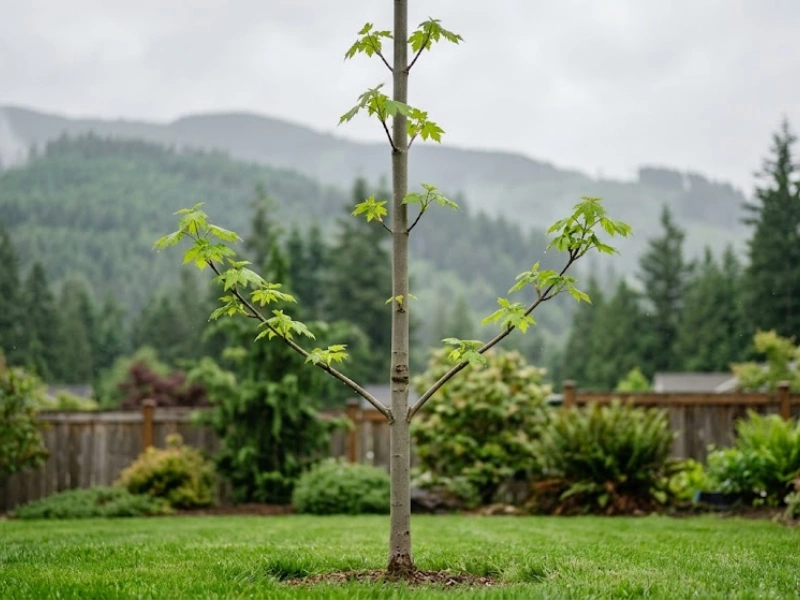
Counter-intuitively, proper young tree training can slightly accelerate functional development — not by making the tree grow faster overall, but by directing its energy more efficiently. When competing shoots, water sprouts, and unwanted branches are removed, the tree concentrates its photosynthetic output on the scaffold being developed. Scaffold branches grow more vigorously and the tree establishes its permanent structure faster than one left to sort itself out.
The caveat: this applies to proper training that stays within ANSI A300’s 25 percent live-crown removal limit. Removing more than 25 percent of a young tree’s live canopy in a single visit slows overall growth significantly as the tree responds to stress by producing replacement foliage rather than developing roots and scaffold structure.
In Monroe’s Skykomish Valley climate, properly trained young trees show visibly directed growth within a single growing season. A young big-leaf maple trained in late January will show noticeably more concentrated scaffold growth by mid-July than the same tree left unmanaged. The training response is faster and more visible here than in slower-growing regions — which also means the window is more compact and the cost of delay is steeper.
When Is the Best Time to Train Newly Planted Trees in Monroe, WA?
Late winter — January through early March — is the best training window for most species in Monroe. The tree is dormant, structure is fully visible, and the spring growth flush compartmentalizes training cuts quickly and responds to the decisions made during dormancy.
Timing guide for young tree training in Monroe:
Late winter (January to March): optimal for most deciduous species and conifers; full structural visibility, fast wound response, spring growth reinforces training decisions made during dormancy
Late spring through early summer (May to July): acceptable for removing water sprouts and root suckers while they are actively visible; not appropriate for scaffold selection decisions on most species
Dry summer (July to August): the required window for training stone fruits — apple, cherry, pear, plum; bacterial canker and fire blight spread through pruning wounds during wet conditions, making dry-season work mandatory for these species in Monroe’s climate
Fall (September to November): avoid for training just as for all other pruning in the Pacific Northwest; wound compartmentalization slows and the wet season means cuts remain vulnerable for months
Practical note: in Monroe, the late January to mid-February window is often drier than March — getting training visits done early takes advantage of both the best soil access conditions and the longest lead time before the spring growth response. For a full seasonal guide for Washington state, see our Pacific Northwest timing post.
Young Tree Training Near Monroe: Where We Work
Tree Ninjas provides young tree training and certified arborist care throughout Monroe and the Sky Valley corridor. Our crews regularly serve Monroe and the Skykomish Valley communities, Snohomish, Duvall and the upper Snoqualmie Valley, and Sultan.
For the full service area, see our Washington locations page.
Get a Free Young Tree Training Consultation in Monroe
The most important training decisions happen in years two through five. Tree Ninjas provides free on-site young tree consultations throughout Monroe and Snohomish County — and a single scaffold selection visit in year three is worth more than any corrective work we could do in year twenty.
Call or text: (206) 601-9390
Or request a consultation at treeninjaspnw.com/contact-us.
Contact Tree Ninjas
Tree Ninjas
31524 NE Cherry Valley Rd
Duvall, WA 98019
Phone: (206) 601-9390
Hours: Available 24/7 for emergency service; office hours Monday through Friday, 8am to 5pm
Serving Monroe, Sultan, Snohomish, Duvall, and surrounding Snohomish County and King County communities.
