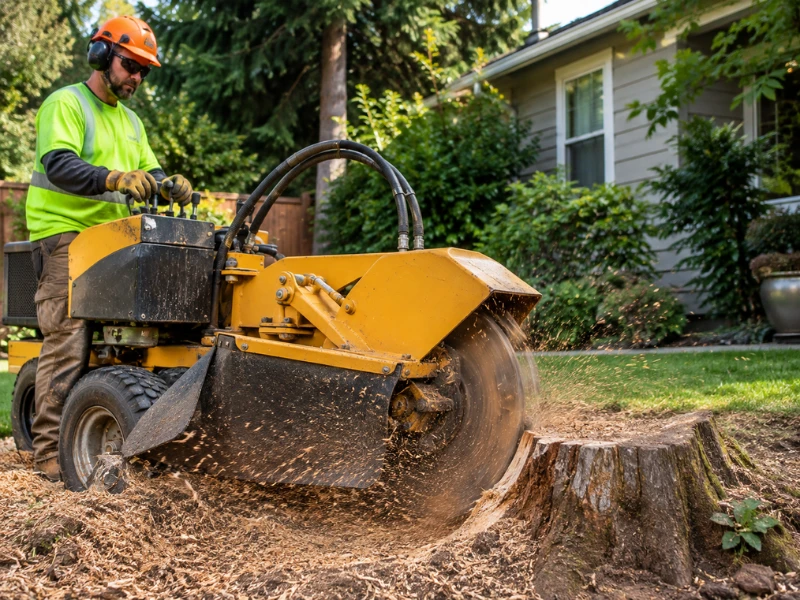
How Does Stump Grinding Work On Duvall Acreage?
Stump grinding on Duvall acreage works best as a planned job, not a stump-by-stump scramble. First, we walk the property with you and decide which stumps are worth grinding and which can stay. Then we call in utility locates, flag the septic system and well lines, and bring the machine that fits your gates and ground. Tree Ninjas works out of Cherry Valley Road, so rural lots like yours are most of what we see.
By Daniel Montgomery, Co-Founder · Last updated November 13, 2026
How does stump grinding change on a larger property?
It changes because a big lot has more stumps, more buried surprises and more ground to cross. On a city lot, there's usually one stump, a short walk from the truck and a clear idea of what's underground. Out here, that's rarely the case.
When people call us about grinding stumps on an acreage property near Duvall Washington, they're usually dealing with a mix like this:
Stumps from a recent removal near the house or driveway
Storm-drop stumps scattered along a fence line or tree line
Old cut stumps left from clearing a pasture or building site years ago
Big cedar stumps from early logging, sometimes with springboard notches still in the side
Because of that mix, we don't start with the grinder. Instead, we start with a walk. We note every stump, where it sits and what's around it, so you get one clear estimate instead of a pile of surprises.
That walk matters most on properties around Cherry Valley, Lake Joy and Novelty Hill, where lots run long and narrow and stumps can sit a few hundred feet from the nearest gate. In those cases, the route the machine takes is as important as the stumps themselves.
Which stumps should you grind, and which can stay?
Grind the stumps that get in the way of how you use the land, and leave the ones that don't. Not every stump on acreage needs to go. In fact, some do more good left alone.
Here's how we usually sort them on a walk-through:
Where the stump sits | Our usual call | Why |
Lawn, play area or near the house | Grind | Mowing, tripping and looks |
Driveway edge or a path you'll gravel | Grind | You need a flat, firm base |
Pasture or field you mow or hay | Grind | Stumps break mowers and hide in tall grass |
Woodland edge or back acreage | Often leave | Habitat for birds, insects and fungi as it rots |
Steep slope or stream bank | Usually leave | Old roots help hold the soil in place |
Over or beside the septic drainfield | Check first | Pipes can sit just under the surface |
Large old-growth cedar stump | Leave as a feature | It's part of the property's history |
Also, think about where you'll be in five years. If a corner of the property is going to become a garden, a shop or a horse paddock, it's easier to grind those stumps now while the crew and machine are already on site.
On the other hand, be careful near streams and wetlands. King County has buffer rules for those areas, so we'll flag any stump that sits close to water before we touch the ground around it.
What has to happen before the grinder arrives?
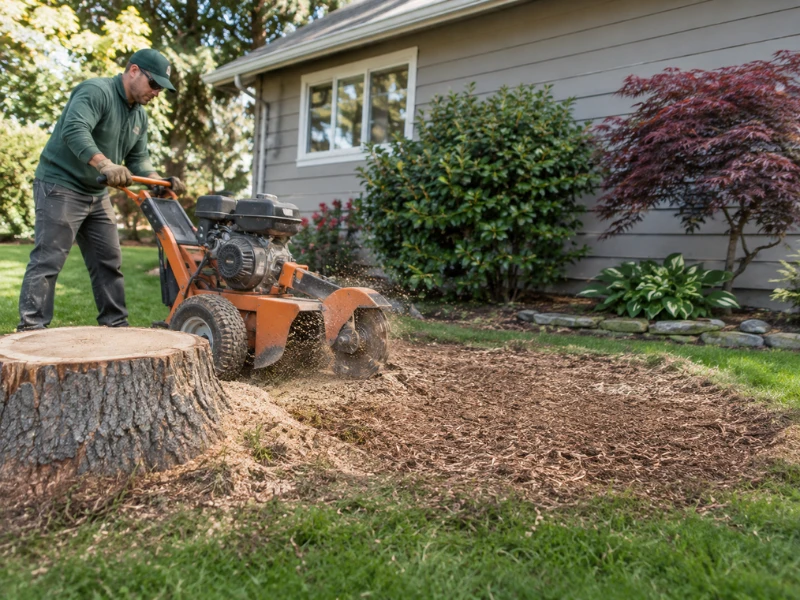
A utility locate has to happen first, and it's the law. Washington's dig law requires anyone digging to call 811 at least two business days before work starts, according to the Washington Utilities and Transportation Commission. A grinder cuts below the surface, so we treat every stump job the same way.
However, 811 only marks public utility lines. On acreage, a lot of what's buried is private, and nobody else will mark it. So before grinding day, it helps if you flag these:
Septic tank, drainfield and reserve area
Well head and the water line running to the house
Power or water lines feeding a barn, shop or gate opener
Irrigation lines and sprinkler heads
Buried dog fence wire
The septic system needs the most care. King County's septic guidance says to keep vehicles off the drainfield, and that applies to heavy machines too. As a result, we route the grinder around it and lay mats where we have to cross nearby.
Got stumps scattered across your property?
Call or text: (206) 736-3757
Email: [email protected]
Free estimate, with every stump walked and marked.
How does wet Snoqualmie Valley ground affect the job?
Wet ground affects how we get the machine to the stump more than the grinding itself. Much of the land around Duvall sits on the Snoqualmie River floodplain or on slopes that drain toward Cherry Creek. From late fall into spring, that ground stays soft and holds water.
So a heavy machine crossing a soggy lawn can leave ruts that take a season to settle. To avoid that, we do a few things:
Lay ground mats across lawns and soft spots
Pick a lighter machine when the ground is saturated
Take the long, firm route instead of the short, muddy one
Still, stump grinding in Duvall WA doesn't have to wait for summer. Stumps in wooded areas, pastures and gravel areas can be ground year-round with little impact. Meanwhile, stumps in a finished lawn are often worth scheduling for a drier stretch, usually late spring through early fall.
Likewise, standing water matters after the grind. A fresh hole on low ground can fill with rain within a day. That's why we leave the spot level and tidy, rather than open, when we're working in a wet season.
How do gates and access shape the job?
Access decides which machine we can bring, so it shapes the whole job. Most compact grinders fit through a standard 36-inch garden gate. Larger tracked machines are faster on big stumps, but they need more room and firmer ground to get in.
Before we arrive, it helps to know:
The narrowest gate on the way to each stump
Any slopes steeper than you'd want to push a wheelbarrow up
Where a trailer can park off the road, since many rural roads have no shoulder
If a fence panel blocks the only easy route, we can often take it down and put it back the same day. Similarly, on long gravel driveways, we'll check for low branches and soft edges before backing a trailer in.
Getting this right up front keeps your yard in good shape. It also means the crew spends its time grinding, not fighting the route.
Where do we grind stumps around Duvall?
We grind stumps across the Snoqualmie Valley and the hills around it, starting from our base on NE Cherry Valley Road. Most of our acreage jobs are a short drive from the shop, which makes it easier to work around weather and soft ground.
If you're searching for stump grinding near Duvall and Woodinville WA, these are the areas our crews cover most:
Duvall, including Cherry Valley, Lake Joy and Novelty Hill
Carnation and Fall City
Cottage Lake and Woodinville
Redmond and Monroe
Our stump grinding service page covers what's included on every job. If you want the basics on how a single stump is handled, our earlier Duvall stump grinding guide walks through it. Also, if the stumps are part of a bigger project, our land clearing crew can handle the site as a whole, and our guide to tree removal on rural Duvall properties covers the work before the stump. Finally, you can browse recent jobs in our portfolio.
Frequently asked questions
1. Grinding or full removal - what is the actual difference?
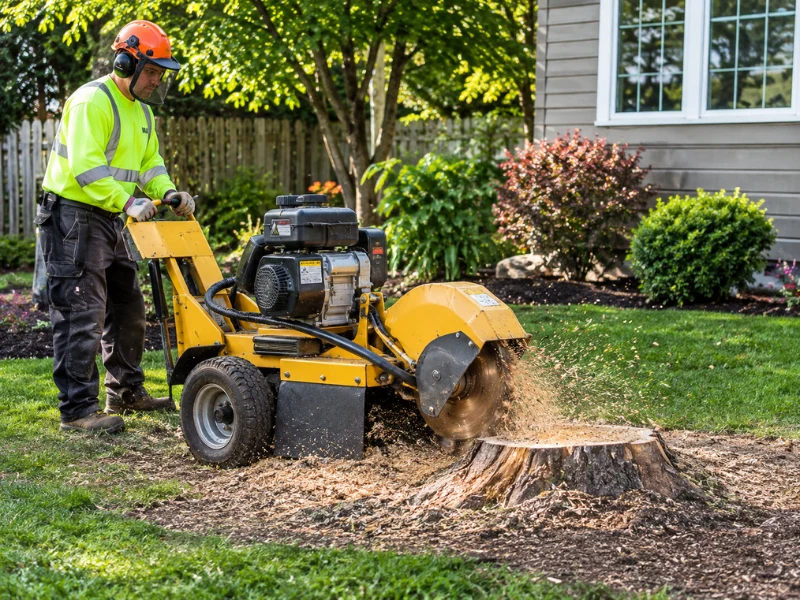
Grinding shreds the stump and surface roots below ground, while full removal digs out the whole stump and root ball with an excavator and leaves a much bigger hole. Weighing grinding against full removal, most yards only need grinding unless you're building on that exact spot, which is the practical side of what is the difference between stump grinding and removal.
2. How deep does grinding go, and what is left underground?
Our usual grinding depth is six to twelve inches below grade, and we go deeper when a new tree or hardscape is going in. That covers how deep is a stump ground on most jobs, while the deeper roots stay in the soil and break down over several years.
3. Can you plant grass or a new tree over a ground stump?
Yes, grass takes well once the chips are cleared and the hole is filled with fresh topsoil. For a tree, replanting over a ground stump works best a few feet off the old center, because anyone wondering can you plant where a stump was ground will find the leftover roots are densest right in the middle.
4. What happens to the grindings - do they stay or go?
We haul the grindings away by default, so the site is clean when we leave. On acreage, many owners choose to keep the pile for trails, paths or beds instead, and we'll spread it where you want it.
5. How long does a large conifer stump take?
Most large conifer stumps take one to three hours, with wide Douglas fir and cedar root flares at the long end. Rocks in the root zone and tight access can add time, and we'll flag both during the estimate.
Visit or Call Us
Tree Ninjas
Address: 31524 NE Cherry Valley Rd, Duvall, WA
Phone: (206) 736-3757
Email: [email protected]
Hours: Monday to Friday, 8:00 am to 5:00 pm
Locally owned, licensed, bonded and insured tree service (WA License TREENNL752Q1).
Serving Duvall, Carnation, Fall City, Cottage Lake, Woodinville, Redmond and Monroe. Call for a free estimate, or use our contact page to book a visit.
