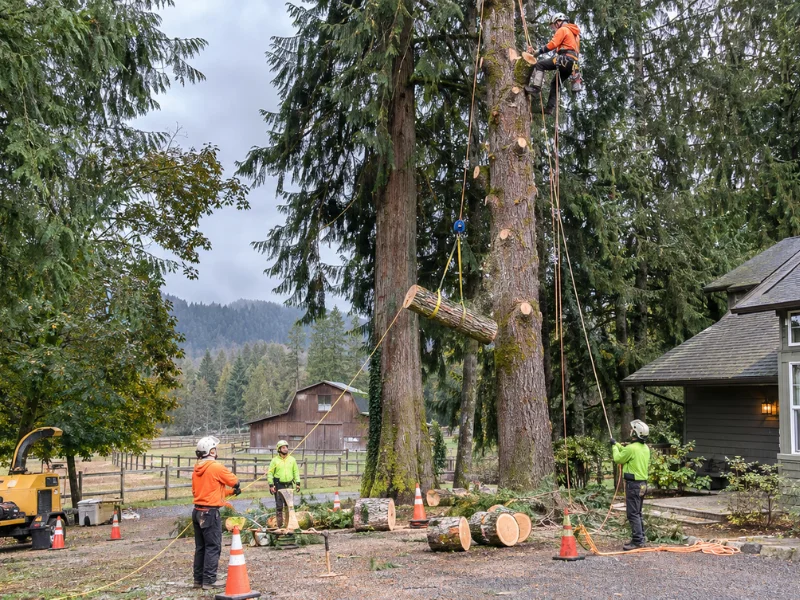
What Tree Removal Involves On Rural Duvall Properties?
Tree removal on a rural Duvall property involves more than cutting and hauling. Before any saw starts, we check what's weakening the tree and where the property lines and septic field sit. We also plan how the wood will be handled and how equipment will reach the tree without damaging the ground. At Tree Ninjas, that planning is what keeps big jobs on acreage safe and tidy.
By Daniel Montgomery, Co-Founder, Tree Ninjas · Last updated November 12, 2026
What weakens big conifers on Duvall properties?
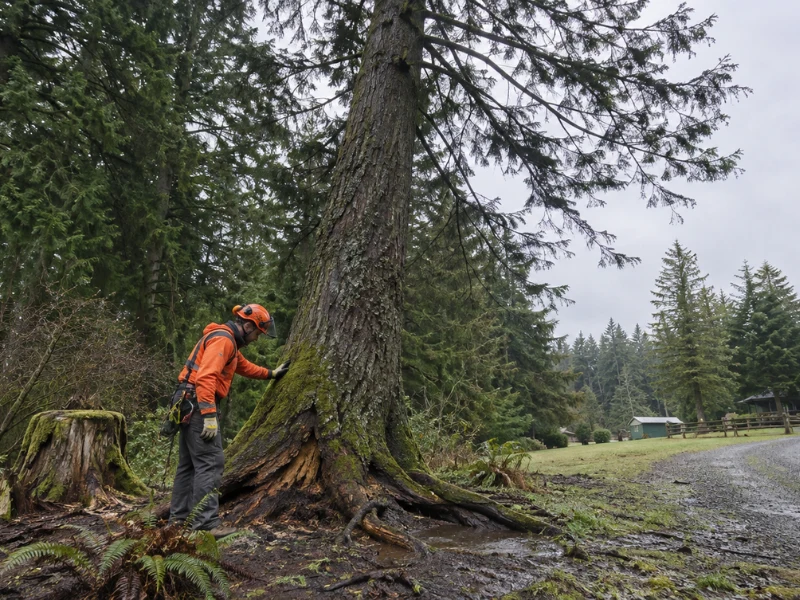
Big conifers around Duvall are most often weakened by root disease, wet soil and sudden exposure to wind. In most cases, two of those three are working together by the time a tree becomes a problem.
First, root rot is the one people miss. Much of the valley was logged decades ago. As a result, old stumps can carry root disease into the trees that replaced them. A U.S. Forest Service study of a western Washington Douglas-fir plantation found that laminated root rot losses tracked closely with infected stumps from the previous stand. So a healthy-looking fir can sit on decaying roots.
Here's how the common causes compare:
What weakens the tree | What it does | What we look for |
Root rot | Decays the roots that anchor the tree | Thin crowns, nearby fallen firs with root balls snapped off short |
Saturated valley soil | Loosens the soil's grip during long rains | Low, wet ground near the river and drainage ditches |
New wind exposure | Leaves trees standing alone after neighbors are cleared | Trees on the edge of recent clearing or new building sites |
Old topping | Grows weak new leaders from one cut point | Several tops sprouting from a single spot high in the tree |
Wind is usually the final trigger. For example, firs left along a newly cleared edge catch gusts they never grew to resist, especially once fall rains soak the soil.
In short, a tree's surroundings matter as much as its size. That's why we walk the whole stand, not just the tree you called about.
What happens to the wood after tree removal?
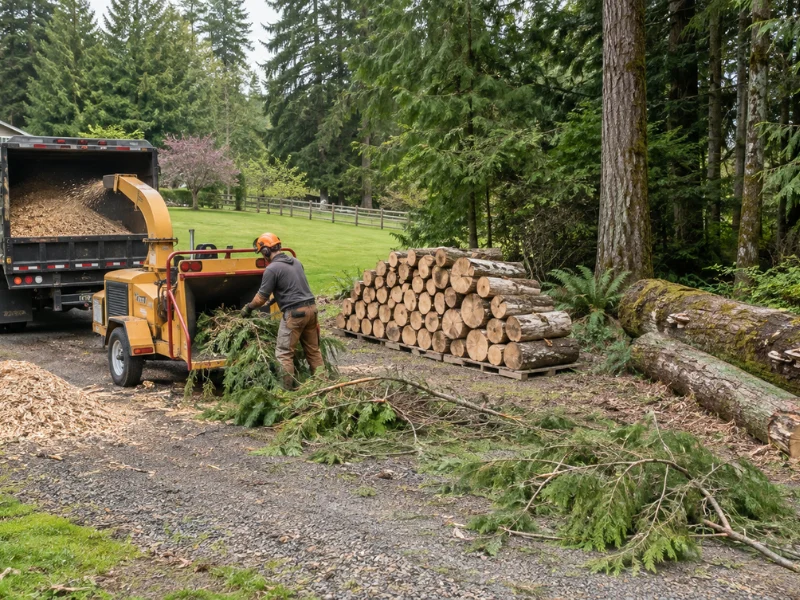
After tree removal, the wood can be chipped, cut into rounds, left as habitat or hauled away. Because of that, the choice changes both the cost and the look of the property. On acreage, many owners keep at least some of it.
On larger properties, though, here are the usual options:
Chips: branches go through the chipper and can be spread on trails, beds or a muddy driveway
Firewood rounds: trunk sections cut to length and left in a pile for splitting
Habitat logs: a few large logs left in the woods, where they slowly feed the soil
Full haul-away: everything loaded and removed, which takes more trips and more time
Merchantable logs: on larger stands, straight firs may have log value through a logging job
Finally, there's the stump. Most people grind it out so the area can be mowed or replanted. Otherwise, a tall stump can be left on purpose as a wildlife snag when it's well away from buildings. Our guide to stump grinding in Duvall explains how deep we grind and what's left behind.
How do property lines and shared trees affect tree removal?
Property lines affect tree removal because a tree on or near the line may legally belong to a neighbor, too. Cutting it without agreement can turn into an expensive dispute.
In fact, Washington takes this seriously. Under the state's timber trespass law, cutting a tree on someone else's land without authority can bring triple damages. So before we schedule any boundary tree, we ask a few questions:
Where is the trunk? A trunk that straddles the line is usually shared by both owners
Has the neighbor agreed? Written agreement avoids most problems later
Where will it fall or be lowered? Pieces may need to land on the neighbor's side
Is there a survey? Fences on rural lots don't always sit on the actual line
However, Duvall's own rules on removals and replacement planting apply inside city limits. Our Duvall tree service schedule post covers how those rules shape long-term planning.
How should you prepare a property for tree removal day?
Prepare the property by clearing a path, marking what's buried and telling the neighbors. After all, most delays on rural jobs come from things nobody could see from the driveway.
Here's what helps the most:
Mark the septic system: drainfield lines are shallow, and heavy equipment can crush them
Point out wells and water lines: especially lines running from a well house to the home
Move vehicles and equipment: trucks, trailers and tractors parked near the work area
Open gates and clear the drive: the crew needs room for a chipper and a truck
Secure animals: dogs, chickens and livestock should be away from the drop zone
Also, let neighbors know about the noise and traffic, especially on shared private roads. Similarly, tell us about any trail, culvert or bridge the crew will cross, since some can't take the weight of a loaded truck. On narrow roads around Cherry Valley and Big Rock, a chip truck can block the road for a few minutes at a time. A quick heads-up keeps everyone happy.
Where do we provide tree removal around Duvall?
We provide tree removal across Duvall and the Snoqualmie Valley from our base on Cherry Valley Road, so most valley jobs are a short drive away. Tree Ninjas is locally owned, licensed, bonded and insured.
For homeowners looking for tree removal in Duvall WA, our Duvall location page covers all the tree services we offer here. If you need tree removal near Duvall and Carnation WA, we also work regularly in Carnation and down the valley to Fall City. To see how we handle every kind of removal, visit our tree removal services page.
Most of the work we do in the valley involves acreage with large firs and cedars very close to houses, sheds and long driveways. This means that we use the same equipment to remove 2 trees in Carnation as we would for a bigger clearing near Cottage Lake.
Good tree removal will start from the ground up. We will come out to walk the land and look at the trees around the one you are concerned about. We will then provide you with a plan and written quotation.
Frequently asked questions
1. What does it take to bring down a hundred-foot fir safely?
Trees like this are normally rope dropped into segments. You can not fell them straight in an open area that is longer than the tree. Large conifers such as a big Douglas Fir near a house in the Snoqualmie Valley may need to be lifted out in sections using a crane.
2. What changes when the tree is close to the house?
No sections will be felled, the tree will be segmented and dropped into a controlled area. This will have mats to prevent damage to lawns and paths. If the tree is near a house/line the power lines will be made safe first. If someone is asking how do you remove a tree near a house then this will be done slowly with rigging.
3. How do you tell a hazard tree from one that is simply big?
A hazard tree will have a defect and an object in the vicinity. So something like a new lean, bulge at the base, fungi conks, dead crown or splitting. With the house/driveway nearby. Knowing why a tree can be a danger in a windstorm will help with storm damaged trees. A limb tearing or splitting trunk can cause a healthy large tree to become a hazard.
4. Can equipment get in across soft ground in winter?
Yes often. We use ground mats, less heavy equipment and manually move the brush to the chipper. We sometimes plan to do non urgent jobs during dry periods if the ground is too wet.
5. What does removal cost, and what drives the number?
Large tree removal in Duvall tends to be between $1200-$3500 for trees between 60-100ft. Larger trees using a crane or over 100ft near structures can be $4000-$7000+. Most of the cost will depend on how high the tree is, objects nearby, access, crane hours and how much wood will need to be removed.
Visit or Call Us
Tree Ninjas
Address: 31524 NE Cherry Valley Rd, Duvall, WA
Phone: (206) 736-3757 Email: [email protected]
Hours: M - F: 8am - 5pm Locally owned, licensed, bonded and insured tree service (WA License TREENNL752Q1)
Serving Duvall, Carnation, Fall City, Cottage Lake, Monroe, Redmond and Snoqualmie. Call for a free estimate, or use our contact page to book a visit.
