Who Does Stump Grinding Near Me in Kirkland?
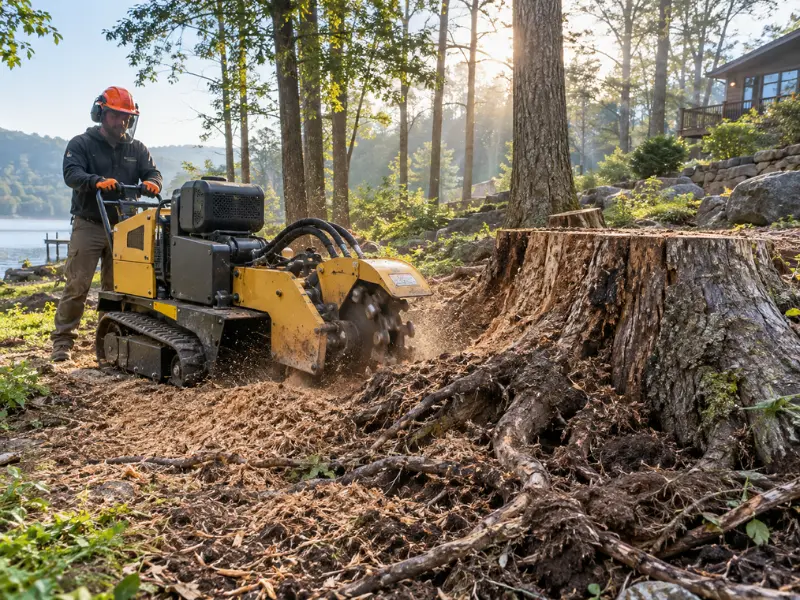
Tree Ninjas does. We're a locally owned, licensed, bonded, and insured crew grinding stumps across Kirkland and the Eastside. Whichever company you call, ask about the stump's diameter first. Stump grinding sounds like one job, but a 12-inch maple stump and a 40-inch Douglas fir stump are not the same visit. Kirkland's tree canopy leans heavily conifer. That changes the equipment, the time, and often the price.
By Daniel Montgomery, Co-Founder · Last updated September 28, 2026
Why Large Conifer Stumps Grind Differently in Kirkland
Size is only part of it. Density and root shape matter just as much.
Conifer wood is denser and more resinous than most deciduous species. A grinder wheel works harder and slower through fir or cedar than through maple or alder of the same diameter. Crews grinding large conifer stumps in Kirkland also have to deal with root flare. Mature Douglas firs and cedars spread a wide, shallow buttress of roots near the surface. That flare is often wider than the trunk itself suggests. Grinding it means working outward in a bigger circle, not just straight down.
That combination, denser wood plus a wider flare, explains two things. A large conifer stump usually takes longer to grind. And it generates more wood chips than a same-diameter deciduous stump would. A quote based on trunk diameter alone can be off if nobody accounts for the species.
Access adds another layer on a mature conifer specifically. A 40-inch Douglas fir stump often sits where the tree grew for decades, which in an established Kirkland yard can mean close to a fence, a retaining wall, or a paved path. Grinding that close to a hard surface means slower, more careful passes rather than the fast, open-ground grinding a mid-yard maple stump allows. That's a second reason a large conifer job runs longer than its diameter alone would suggest.
Should You Grind the Stump Right After Tree Removal?
Usually yes. The reason is mostly about the equipment already being there.
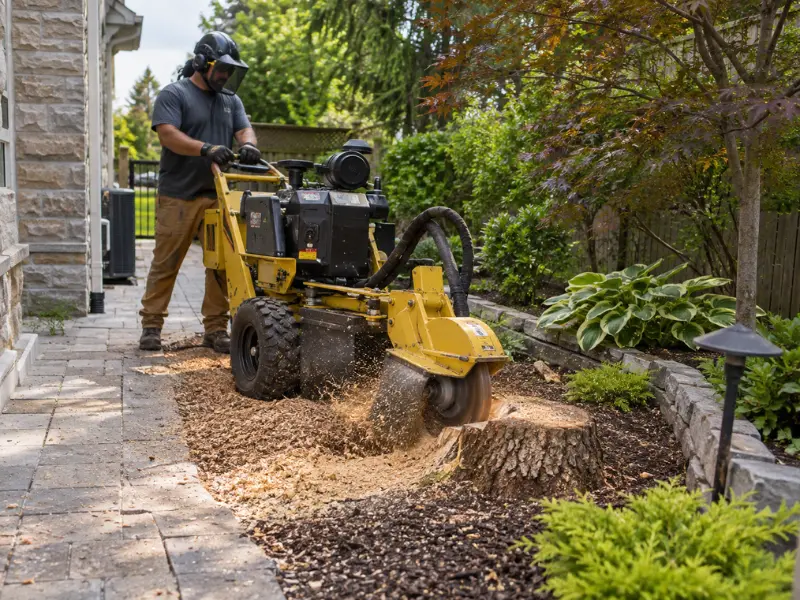
Stump removal after tree removal often happens as a follow-on visit rather than the same day. Removal and grinding use different equipment, and sometimes different crews. Grinding right after removal, while the site is already cleared and staged, is typically more efficient than scheduling a separate mobilization weeks later. There's no technical reason to wait for a stump to start decomposing first. Grinding works on fresh wood just as well as aged wood.
The one reason to delay is access. If removal left the yard torn up, a short gap lets the ground firm up. That can make it easier to get grinding equipment into position without additional damage.
Insurance and liability are worth a mention too. A stump grinder is a separate piece of heavy equipment from a chainsaw or a chipper, and it comes with its own set of risks, mainly thrown debris and buried utility lines. In Washington, digging without first requesting a free utility locate is against state law, and the Utilities and Transportation Commission's Call Before You Dig page explains how to request one by calling 811 at least two business days ahead. Confirm whoever grinds your stump carries coverage for the grinding work itself, not just general tree removal, especially if you're using a different crew than the one that took the tree down.
One more factor worth asking about: stacked stumps from the same job. If a removal took down two or three trees at once, grinding all the stumps in one visit is almost always cheaper than scheduling them separately, since the equipment mobilization cost is the same either way. Ask for a multi-stump price if you're dealing with more than one.
Who Grinds Tree Stumps in Kirkland?
Ask whether they've priced a large conifer stump before, not just a generic one.
Any company you hire should ask about species and diameter before quoting, not after arriving. The company that felled the tree is often the one that grinds the stump. It's still worth confirming they carry the right size grinder for a mature fir or cedar, rather than a machine sized for ornamental trees.
Tree Ninjas is locally owned, licensed, bonded, and insured (WA Licensed · TREENNL752Q1). We serve Kirkland, Redmond, Bellevue, Sammamish, Issaquah, and the wider Eastside. Anyone comparing the best stump grinding service near Kirkland should ask for a diameter-based estimate rather than a flat per-stump price. A single flat rate rarely holds up once fir and cedar stumps are in the mix.
Our crews work Kirkland's older, established neighborhoods as often as newer construction, and the mix matters. A mature lot with decades-old Douglas firs calls for different equipment sizing than a newer property with smaller ornamental trees. We bring the right grinder for the job rather than a one-size machine, which is part of why we ask about species and rough diameter before we ever quote a number.
We grind stumps on Kirkland properties large and small, from single backyard stumps to multi-stump cleanups after a larger removal project. See our stump grinding page, our Kirkland land clearing guide if you're clearing more than one stump, and the full area list on our locations page. Estimates are free.
Frequently Asked Questions
1. How much does stump grinding cost in Kirkland?
Diameter and species drive the price more than anything else. A small deciduous stump is the quickest, least expensive job. A large conifer stump, a mature Douglas fir or cedar, costs more. It takes longer to grind and generates more material to clean up. Access also matters. A stump behind a fence or next to a structure takes more care than one in open lawn. We quote from a look at the actual stump, not a phone estimate.
2. What is the difference between stump grinding and full stump removal?
Grinding shreds the stump and surface roots below ground level with a rotating wheel. The deeper roots are left to decompose naturally over time. Full removal pulls the entire root ball out of the ground instead. Grinding is faster and less disruptive to the surrounding yard, and it's enough for most residential situations. Full removal is worth considering if you're planning to build a structure, pour a foundation, or install something in that exact spot. Grinding alone leaves root material in the ground that can settle as it breaks down.
3. How deep do you grind the stump down?
Typically six to twelve inches below grade. That clears the stump for regrowth and most replanting needs. On a large conifer with a wide root flare, we sometimes grind wider rather than deeper. We follow the flare outward so no raised root edges are left behind near the surface.
4. What happens to the wood chips and can you haul them away?
We haul away all chips and debris by default, leaving the site clean. A large conifer stump produces noticeably more chip volume than a small deciduous one, sometimes enough to fill several yards of it. If you'd rather keep the chips as mulch for garden beds, tell us before we start. We'll leave a pile instead of hauling it off.
5. Can I plant grass or a new tree in the same spot afterwards?
Yes, once the ground is leveled and topped with fresh soil. Fresh grindings can tie up nitrogen in the soil as they decompose. That effect is more noticeable with the larger volume a conifer stump leaves behind. A layer of topsoil over the grindings, rather than planting directly into them, gives grass or a new tree a better start.
Contact Tree Ninjas
Tree Ninjas 31524 NE Cherry Valley Rd, Duvall, WA 98019 Phone: (206) 736-3757 Hours: Monday–Friday, 8:00 AM – 5:00 PM Locally owned, licensed, bonded and insured (WA Licensed · TREENNL752Q1), serving Kirkland, Redmond, Bellevue, Sammamish, Issaquah, Duvall, and the wider Eastside.
Have a large fir or cedar stump to deal with? Request a free estimate or call (206) 736-3757, and tell us the species if you know it.
