What Should A Tree Pruning Service Do In Sammamish?
A tree pruning service in Sammamish should make clean cuts just outside the branch collar, only take what the tree can spare away, and never top. Moreover, it should be a planned one, so all the branches to be cut have reasons. Tree Ninjas prunes that way across the Plateau, from big Douglas firs to backyard maples.
By Daniel Montgomery, Co-Founder, Tree Ninjas · Last updated October 23, 2026
What do proper pruning cuts look like up close?
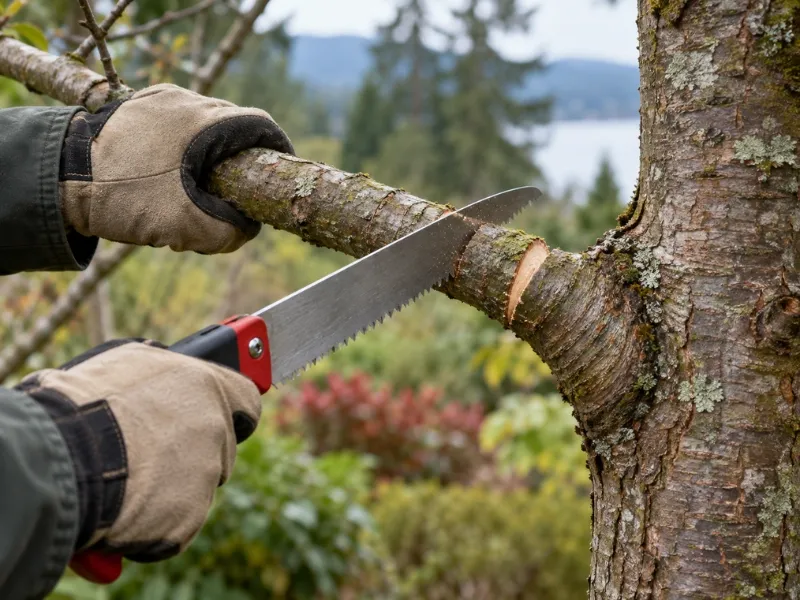
Proper pruning cuts have to be made just outside the branch collar, that is, the slightly swollen ring where a branch meets the trunk. The collar has a tissue (a) that the tree uses to seal the wound, so a clean cut will keep this part intact.
The USDA Forest Service's How to Prune Trees guide explains that a proper cut avoids injuring both the collar and the branch bark ridge. It also warns that flush cuts can lead to decay, while stubs slow wound closure. Here's how the common cuts compare:
Cut | What it looks like | What happens next |
Collar cut | A clean cut just outside the collar | The wound seals over in a few seasons |
Flush cut | Cut tight against the trunk, collar removed | Decay can move into the trunk |
Stub cut | A few inches of branch left behind | The stub dies and invites fungi |
Torn bark | A strip of bark peeled down the trunk | A long wound that's slow to close |
Reduction cut | A limb cut back to a healthy side branch | The side branch takes over the growth |
Heavy limbs also need a three-step cut. First, a shallow undercut stops the bark from tearing. Next, a second cut drops the weight. Finally, the last cut cleans up at the collar.
If you're wondering does pruning hurt a tree, the honest answer is that every cut is a wound. Still, a clean cut in the right spot is a wound the tree is built to close. A ragged cut in the wrong spot is one it may never close at all.
What does tree topping damage look like a few years later?
Tree topping damage shows up as clusters of fast, upright sprouts, dead stubs, and soft spots of decay where the top was cut. At first, a topped tree just looks short. The real trouble arrives over the next few seasons.
Here's what we usually find when we're called to a tree that was topped years ago:
Bunches of skinny shoots growing straight up from each cut
Dead stubs where the cut branch died back to the next limb
Hollow or punky wood at the top, where decay has moved in
Multiple new tops on firs and cedars, competing for the lead
Bigleaf maples are especially prone to that sprout explosion. In just a few years, they can grow back taller and bushier than before, only now with weak attachments. Firs and cedars have their own problem, since several new leaders fight for the top and split apart in a windstorm.
That's a big reason Sammamish doesn't allow it. The City of Sammamish's tree permitting guide states plainly that topping isn't allowed. So any company offering it here is offering work the city prohibits.
How does crown thinning differ from lion-tailing?
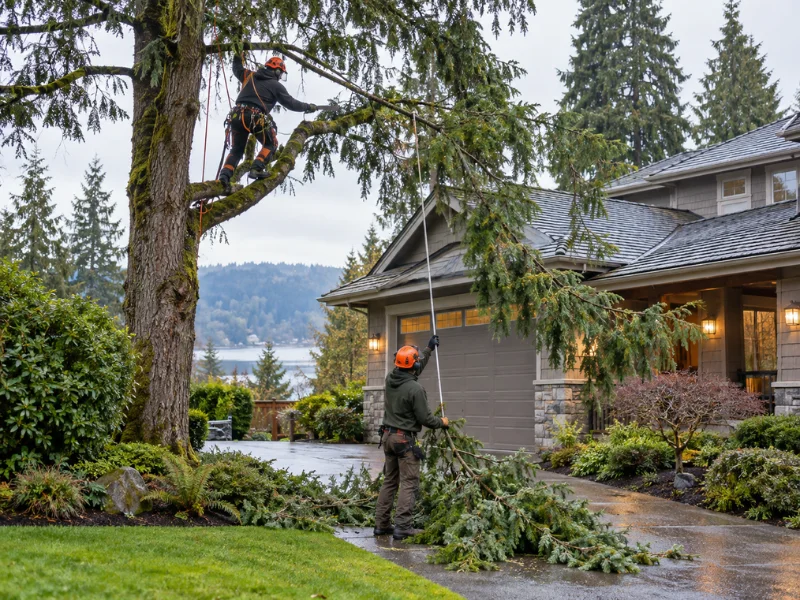
Crown thinning involves the removal of a few smaller branches from all over the canopy, whereas the lion-tailing technique removes the inner foliage leaving the leaves and branches at the tip. From a distance, both techniques appear to be almost similar. Up close, they're opposites.
Good crown thinning allows the light and wind to penetrate without affecting too much the form of the tree, whereas lion-tailing leaves long bare limbs with tufts on the ends, like a lion's tail. The USDA guide notes that lion's tails can cause sunscald, a flush of sprouts, and weak branches that break.
Conifers are a special case. According to the same USDA guide, conifers with branches in whorls rarely need crown thinning at all. In our experience on the Plateau, most big Douglas firs need deadwood removal and clearance from roofs, not heavy "wind thinning."
So if you're comparing quotes for crown thinning near Sammamish and Snoqualmie Washington, ask which trees are getting it and why. A good crew thins a maple or an alder. A careless one strips a fir and calls it the same thing.
What should a tree pruning service plan before the first cut?
A tree pruning service should consider what, in what order, and whether certain parts should be left over until the next year. This is more important than any single cut.
People asking how much of a tree can be pruned at once usually want a single number. A better first question is which branches matter most. Here's the order a careful crew usually works in:
Dead, broken, or hanging limbs, since they're a safety risk now
Branches rubbing or crossing, which wear wounds into each other
Clearance, such as limbs over the roof, driveway, or chimney
Structure, like a competing second leader on a young tree
Anything beyond that can often wait for a second visit. Spreading big changes over a few years keeps the tree from going into stress mode. It also gives you time to see how the tree responds. Our Sammamish pruning timing guide covers which months suit each type of tree.
Where do we offer tree pruning around Sammamish and Snoqualmie?
We offer tree pruning across Sammamish, out to Snoqualmie, and throughout the nearby Eastside. If you're comparing tree pruning services in Sammamish WA, we regularly work in:
Sammamish: Pine Lake, Beaver Lake, Klahanie, Sahalee, and the Lake Sammamish shoreline
Snoqualmie Valley: Snoqualmie and Fall City
Nearby: Issaquah, Redmond, and Duvall
Plenty of homeowners looking for proper tree pruning Sammamish WA have already had a bad experience with a crew that over-cut. That's why we explain each cut before we make it. Our tree pruning service page shows the full range of work, and our Sammamish tree service page covers everything else we do locally.
If you'd also like a professional opinion on a tree's health, our arborist guide explains what that visit involves. When you're ready, request a free estimate.
Frequently asked questions
1. What is the difference between pruning and topping?
Pruning involves the removal of specific branches at their point of origin, whereas topping entails the removal of the crown of the tree by making cuts horizontally across the top of the tree at varying levels regardless of the location of the branches. Pruning maintains the natural shape of the tree while allowing the tree to heal itself. On the other hand, topping creates large wounds on the tree that cannot heal efficiently. Therefore, pruning can be done multiple times majorly on the same tree, whereas topping requires frequent pruning to control the growth of the tree.
2. Why does topping damage a tree permanently?
Topping damages a tree permanently because the decay that starts at the big cuts can't be reversed. Trees don't heal the way people do. Instead, they wall off damaged wood, and a large topping cut is often too big to wall off well. Meanwhile, the new sprouts attach to that decaying wood, so they get heavier while their anchor gets weaker.
3. How much of a canopy can be taken at once?
No more than about a quarter of the living crown should be taken at once, according to USDA Forest Service guidance. If more needs to come off, it should be spread over several years. In Sammamish, pruning also stays permit-free only while less than 30% of the branches come off over the tree's whole life. Most healthy trees need far less than either limit.
4. What is crown thinning and when is it the right call?
Crown thinning is the selective removal of small branches from throughout the canopy to allow increased light and air penetration. It is the preferred method of tree pruning for dense broadleaf trees that are overly shading a yard or subject to strong prevailing winds. Crown thinning rarely is used on healthy conifers. Thinning generally should be done conservatively, maintaining the natural shape of the tree's crown.
5. How do you tell good pruning work from bad?
You can tell good pruning from bad by looking at the cuts and the overall shape. Good cuts are clean, sit just outside the branch collar, and leave no stubs or torn bark. The tree should still look natural, with foliage spread along its limbs. Bad work leaves stubs, flush cuts, bare limbs with tufts at the ends, or a flat-topped outline.
6. Should pruning cuts be painted or sealed?
No, pruning cuts usually shouldn't be painted or sealed. USDA guidance notes that wound dressings won't stop decay and can even slow the wound from closing. A clean cut in the right place does more good than any coating. The rare exception is certain disease-prone trees during high-risk seasons.
7. Can a topped tree be fixed?
Some topped trees can be saved. Usually, it takes years of restoration pruning to do the trick. The crew will select strong shoots to act as new leaders and the weak ones get thinned out. Alternatively, if the old pruning sites are rotted out, it might be best to remove them and start growing new trees in their place.
8. Will a pruned tree look bare afterward?
No, because a pruned tree should not look bare afterwards. Only the neighbors should not be able to see the work you did, except maybe for cleaned up dead branches or a higher canopy. If the tree looks skinny, crooked, or has a part that shows where you cut it from the street, you took too much! Good pruning works with the tree, not against it.
How can you book a tree pruning estimate in Sammamish?
Tree Ninjas 31524 NE Cherry Valley Rd, Duvall, WA Phone: (206) 736-3757 Email: [email protected] WA Contractor License: TREENNL752Q1 Office hours: Monday to Friday, 8:00 AM to 5:00 PM, with 24/7 emergency response Service area: Sammamish, Snoqualmie, Fall City, Issaquah, Redmond, Duvall, and the wider Eastside
